MURAKAMI FLOWER BECOMES ALEX MOSS FINE JEWELRY
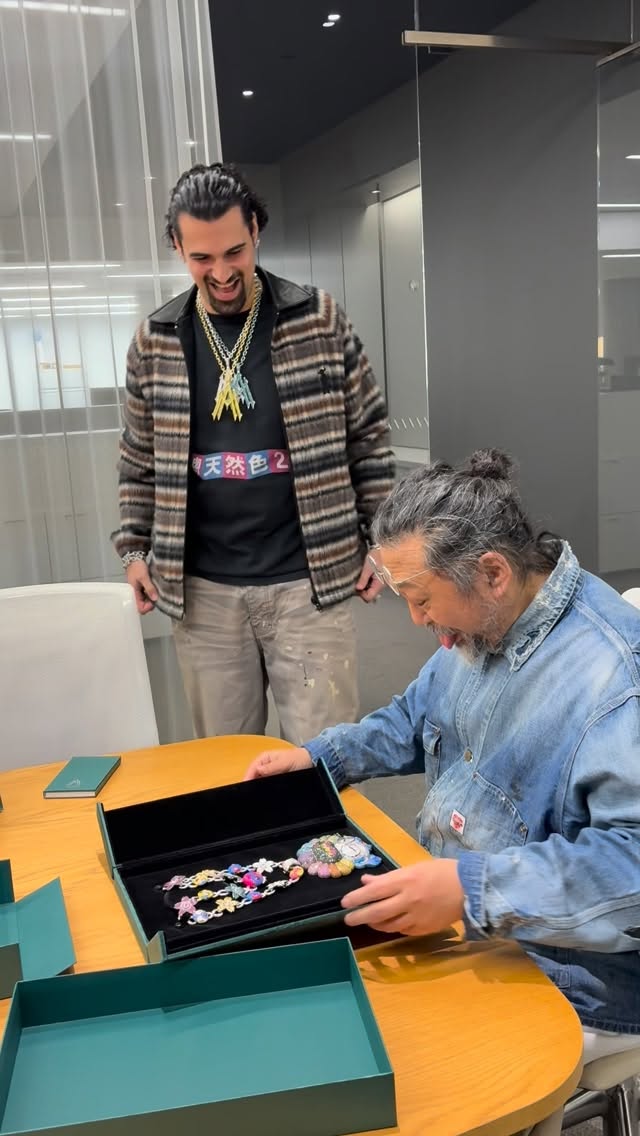
Takashi Murakami and New York fine jeweler Alex Moss collaborated on jewelry rendering Murakami's signature smiling flower in precious stones, captioned Pure Joy. The piece translates the most mass reproduced motif in contemporary art into a one of one fine jewelry context, inverting Murakami's usual high volume production logic. It positions the flower as a luxury object rather than a print or plush.
Key Points
- Takashi Murakami's smiling flower motif debuted in the mid 1990s and has appeared across paintings, plush, apparel, and the Kaikai Kiki brand.
- Alex Moss is a New York fine jeweler known for maximalist diamond and gemstone custom pieces.
- The collaboration renders the Murakami flower in precious stones, captioned Pure Joy.
- Murakami's 2007 Louis Vuitton multicolor collaboration with Marc Jacobs ran for a decade.
- Fine jewelry inverts Murakami's usual high volume reproduction logic into one of one scarcity.
Pure Joy. Two words and a smiling flower set in stones. Takashi Murakami put his most reproduced motif into the hands of Alex Moss, the New York jeweler who builds maximalist diamond pieces for people who do not flinch at the invoice. The flower that has lived on plush toys, skate decks, and a decade of Louis Vuitton handbags just became fine jewelry, and the move quietly inverts everything Murakami''s flower usually stands for.
The flower is the most mass produced image in contemporary art. Alex Moss just made it one of one.
Why the Flower in Fine Jewelry Is a Reversal
Murakami built the smiling flower in the mid 1990s and then reproduced it more times than almost any image in modern art history. Paintings, plush, keychains, rugs, the Kaikai Kiki commercial machine that treats the motif as infinitely scalable. The flower''s entire identity is abundance. It is everywhere, cheerful, and accessible at every price point from a five dollar sticker to a seven figure canvas.
Fine jewelry breaks that logic. A diamond set Alex Moss flower cannot be mass produced. It is bound by the stones, the labor, and the one of one custom process that defines Moss''s practice. Murakami is taking the most abundant image he owns and forcing it into the scarcest possible format. That tension is the whole reason the piece is interesting.
Alex Moss Is the Right Jeweler for This
Alex Moss runs one of the most recognizable custom fine jewelry practices in New York, building pieces for collectors, athletes, and musicians who want maximalism executed at a technical level most jewelers cannot reach. The Moss aesthetic is dense, colorful, and unapologetically excessive, which maps almost perfectly onto Murakami''s superflat color palette. The flower needs saturated color to read correctly. Moss works in saturated color.
The match is aesthetic, not just commercial. A more restrained jeweler would lose the flower in tasteful understatement. Moss renders it in full chroma, which is the only way the motif survives the translation into stones.
The Cross Industry Read on Artist Jewelry
Artist jewelry has become its own collectible category over the last decade. Daniel Arsham has done eroded watches. KAWS has done pendants. Murakami himself has touched jewelry through prior brand work. The category sits at the intersection of art collecting and luxury accessories, where the buyer wants a wearable piece of an artist''s practice rather than a wall hung canvas.
Cross reference. Daniel Arsham operates the same artist as commerce playbook at the print and object tier, where the artist''s frame is the value rather than the medium. Murakami in fine jewelry is the higher price band of the same move. The flower is the brand. The stones are the medium. The collector is buying the brand in a wearable format.
What Pure Joy Actually Sells
The caption Pure Joy is on theme for Murakami, whose entire flower project is built on a deliberately uncomplicated emotional register. The flower smiles. It does not brood. It does not deconstruct. It radiates a cartoon cheerfulness that has made it one of the most commercially successful art motifs ever produced.
That cheerfulness is also the marketing. A fine jewelry piece that signals pure joy rather than status or wealth is a different luxury proposition than a standard diamond piece. The buyer is purchasing happiness rendered in stones, which is a more Murakami sales pitch than any price tag.
Cross Vertical. The Reproduction Question.
Murakami''s career has always lived in the tension between art and commerce, between the unique object and the infinite reproduction. The Louis Vuitton multicolor monogram he designed with Marc Jacobs in 2003 ran for over a decade and put the flower on hundreds of thousands of handbags. That was abundance at industrial scale. The Alex Moss piece is the opposite pole of the same career.
The interesting question is whether the fine jewelry stays one of one or becomes a small production run. Murakami rarely leaves a successful format unscaled. A Pure Joy jewelry line in limited editions would be entirely in character, turning the one of one statement into a scarcity tiered collection.
What to Watch Next
Three things. Whether the Alex Moss flower stays a single piece or expands into a jewelry collection. Whether the collaboration gets a gallery or retail presentation rather than living only on social. And whether other contemporary artists follow Murakami into the maximalist fine jewelry lane that Alex Moss has built in New York.
The most reproduced flower in art, set in stones, one of one. Murakami took his most abundant image and made it scarce. Pure joy, priced accordingly.
Frequently Asked Questions
What is the Murakami flower?
Takashi Murakami's smiling flower is his most recognized motif, debuting in the mid 1990s and reproduced across paintings, plush toys, apparel, and his Kaikai Kiki brand output.
Who is Alex Moss?
Alex Moss is a New York fine jeweler known for maximalist custom diamond and gemstone pieces for collectors, athletes, and musicians.
What did they make?
A fine jewelry rendering of the Murakami flower in precious stones, captioned Pure Joy, translating the mass reproduced motif into a one of one luxury object.
Topics: new-york, luxury, takashi murakami, culture, daniel arsham, fine-jewelry, louis-vuitton, kaikai-kiki, art, takashi-murakami, murakami-flower, contemporary-art, louis vuitton, alex-moss, daniel-arsham