OPENAI'S NAVIER STOKES WIN CAME WITH A CREDIT FIGHT
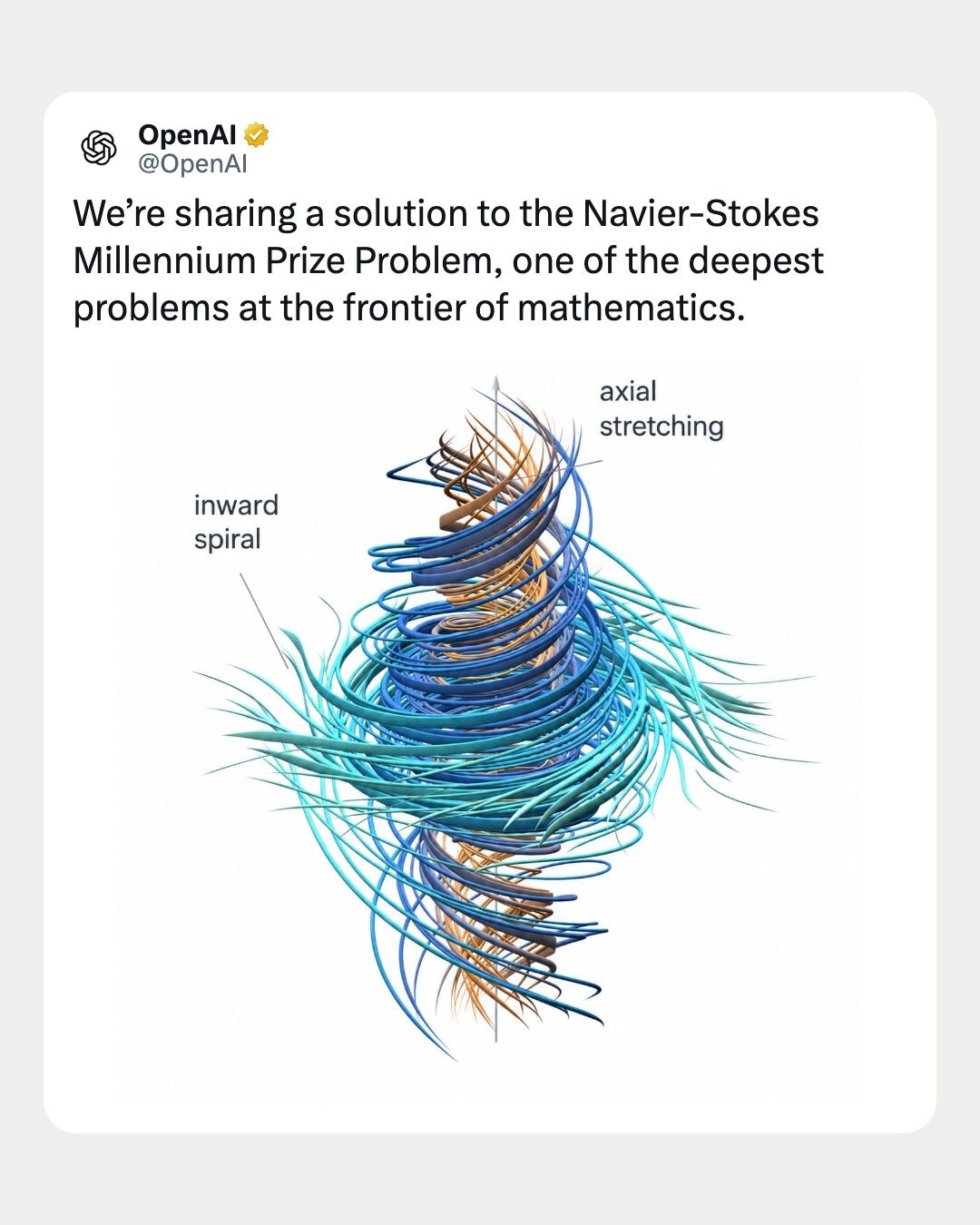
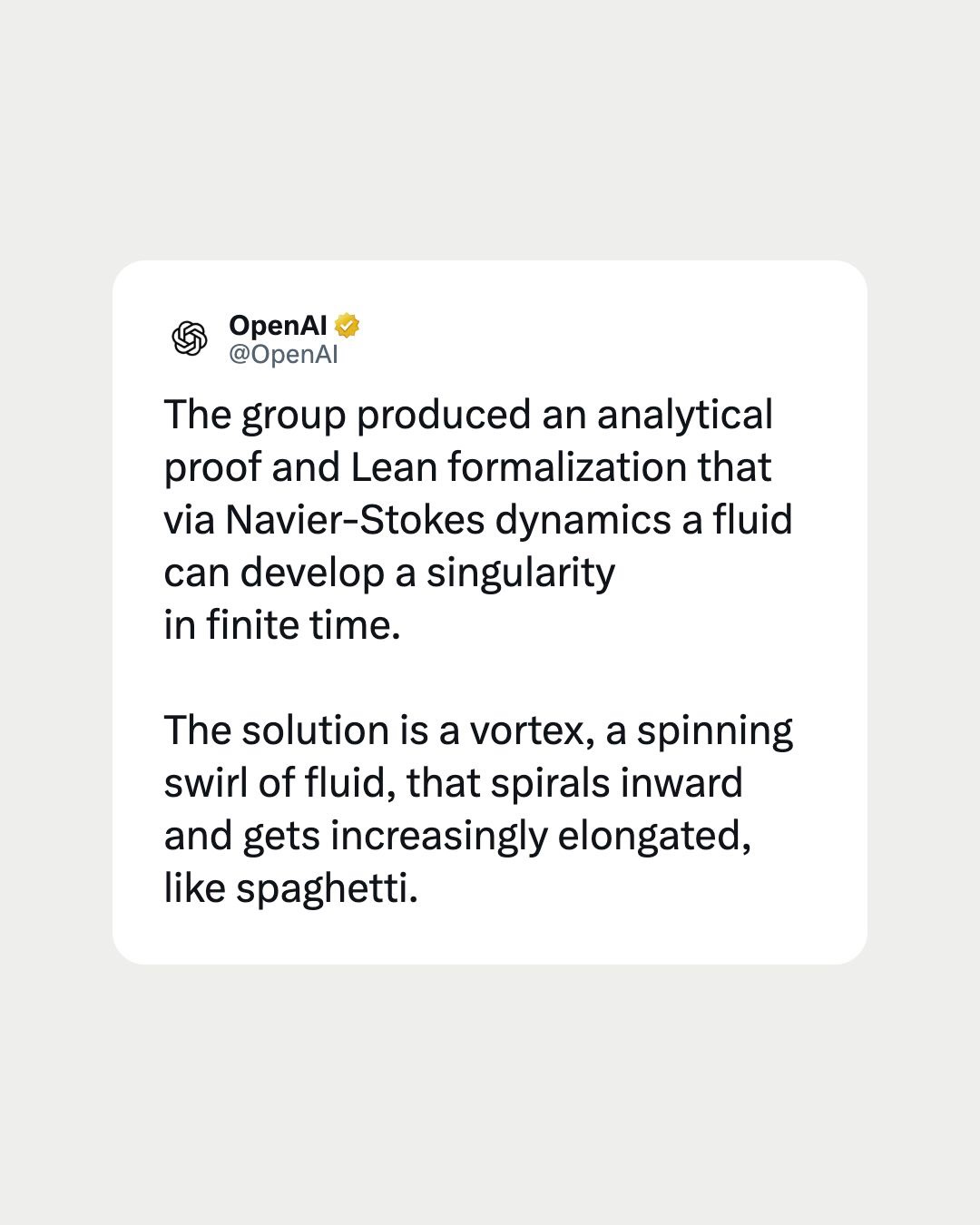
OpenAI announced on September 8, 2026, that an internal AI system, more capable than its own GPT 6 Astra model, produced a proof addressing the Navier Stokes existence and smoothness Millennium Prize Problem, a question open for about 90 years. The announcement also touched off a credit dispute with mathematicians Tristan Buckmaster and Levent Alpoge, who had independently published Lean verified proofs of related fluid equation blowups and who allege OpenAI pressured them over authorship and credit.
Key Points
- OpenAI says 10,000 agents took 88 hours and 130 billion tokens to produce the proof, per its own post.
- Buckmaster alleges Bubeck asked why he would ruin his career when he threatened to go public.
- OpenAI's own caption admits its proof differs from Buckmaster and Alpoge's in the Euler case.
OPENAI'S NAVIER STOKES WIN CAME WITH A CREDIT FIGHT
OpenAI announced this week that an internal model, one it says is significantly more capable than GPT 6 Astra, produced a proof of the Navier Stokes existence and smoothness problem, a Millennium Prize question that has sat open for roughly 90 years. In the same post it thanked two outside mathematicians by name for work it says it never saw before they released it publicly.
That gratitude did not land well with everyone in the room. One of the two mathematicians it thanked says the company pressured him to strip his own collaborator off separate work before it would let the matter rest, and the two accounts of what happened next do not agree.
88 Hours, 2.7 Million Messages, One Proof
OpenAI says roughly 10,000 autonomous agents reached the Navier Stokes result in about 88 hours, generating 2.7 million messages and about 130 billion output tokens. GPT 6 Astra, the model OpenAI released September 3, then spent 17 hours formalizing and checking the proof inside the theorem prover Lean, the verification layer that lets other mathematicians confirm the logic line by line without redoing the calculus themselves.
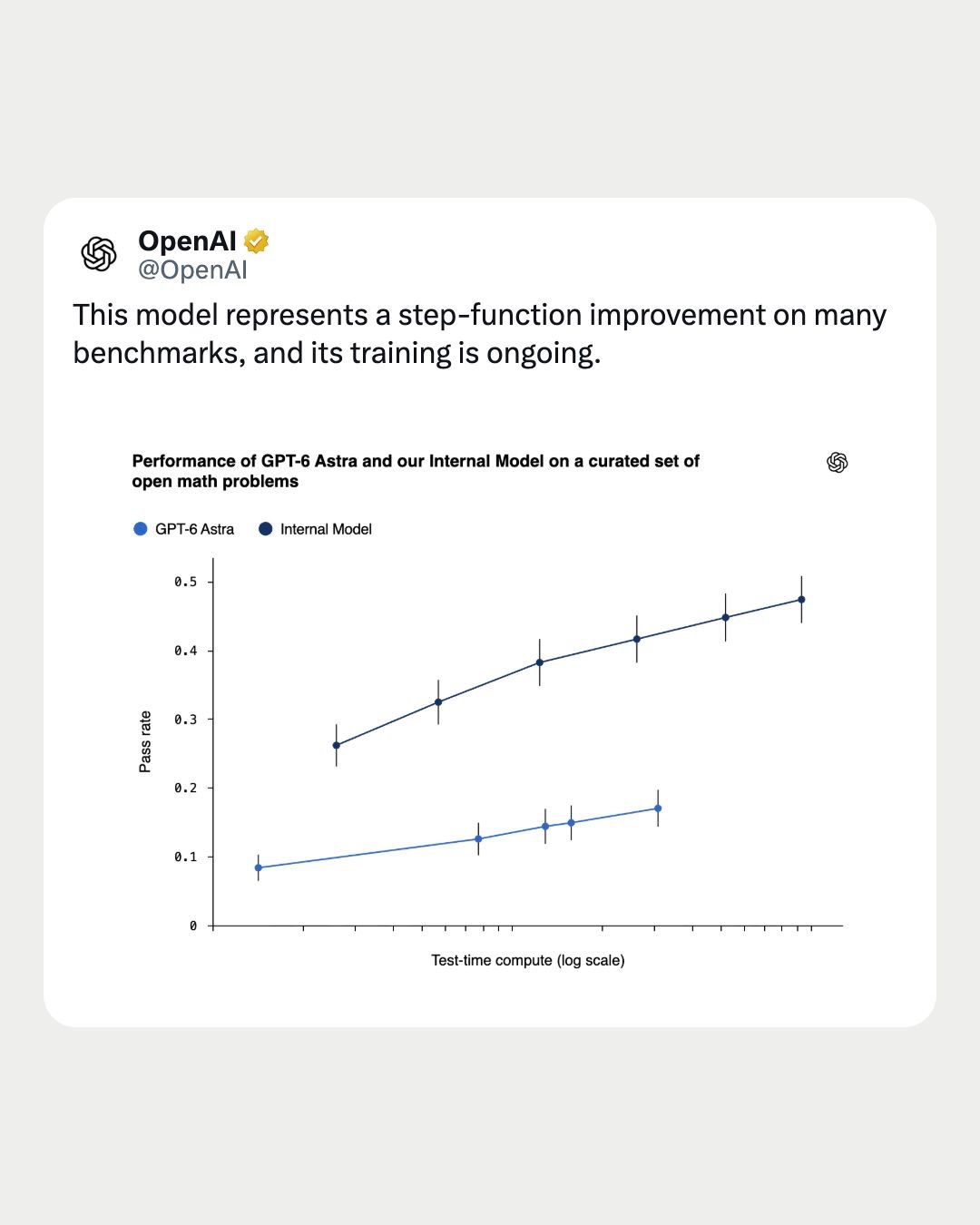
The caption calls the system behind that 88 hour run significantly more capable than GPT 6 Astra, which means the model that produced the proof is not one anyone outside OpenAI can currently rent or test. That gap is the leverage in this story. A rival lab can benchmark itself against a released model. It cannot benchmark itself against one that has no price on any card yet, and OpenAI chose a 90 year old open problem to introduce it.
Sebastien Bubeck Wanted a Joint Release
Sebastien Bubeck, an OpenAI scientist, has said he tried to coordinate the timing of OpenAI's announcement with a separate paper Tristan Buckmaster and Anthropic researcher Levent Alpoge were preparing on related fluid equations, and that the two turned him down. Buckmaster and Alpoge published their own Lean verified proofs of finite time blowup for three fluid systems, the 3D incompressible Euler equations, the Boussinesq system and incompressible porous media, in the stretch of days just before OpenAI's post went up, and Fields medalist Terence Tao praised the pair's proofs publicly once they landed.
Two teams reached adjacent results on one of the oldest open questions in fluid dynamics within days of each other. Neither side disputes the underlying mathematics. What they dispute is who announces first, in what order the names appear, and who controls the story the public reads about how it happened.
"Why Would You Ruin Your Career?"
Buckmaster has said OpenAI representatives, Bubeck among them, pushed him to remove Alpoge from authorship on the pair's own paper and floated separate arrangements for how OpenAI's Navier Stokes result would be announced alongside it. When Buckmaster told him he intended to describe the pressure publicly, he says Bubeck responded, "Why would you ruin your career?"
Bubeck has called the allegations false and inflammatory. In messages to Alpoge that he says he sent to be transparent, Bubeck wrote that OpenAI's internal model produced its Navier Stokes proof with minimal human involvement, that credit for the surrounding mathematics belongs to Alpoge and Buckmaster, and that he was willing to share everything OpenAI has so the pair could check the work themselves.
The Euler Case Is Where the Two Proofs Split
OpenAI's own post draws the line itself rather than waiting for outside reviewers to draw it. Its statement says the two teams proofs differ significantly, and that the precise results proved are different in the Euler case, one version forced by an outside push, the other left alone to blow up on its own.
Anthropic had already framed the week as a race before any of this surfaced. Five days earlier, it cut Claude Code's weekly limits while naming OpenAI's AGI model as the reason its own compute budget was under strain, and the price of renting a B200 GPU jumped 59 percent overnight that same week. A 10,000 agent, 88 hour math run does not happen on a spreadsheet. It happens on the compute both labs are already bidding against each other for, which is the part of this story neither caption mentions.
OpenAI got the proof and the goodwill line in one post. Whether it keeps both now depends on whose account of the private messages holds up, Buckmaster's or Bubeck's, and on whether anyone outside those four names ever gets to check the 130 billion tokens of work behind the headline. Ninety years unsolved turned out to be the easy part.
Related: OpenAI Dots: The Personal Agent Taking On Meta Muse.
Frequently Asked Questions
What did OpenAI claim to prove in its Navier Stokes announcement?
OpenAI said an internal model produced a proof that the Navier Stokes equations for fluid motion can develop a singularity in finite time, addressing the Navier Stokes existence and smoothness Millennium Prize Problem.
How long did OpenAI's proof take to produce?
OpenAI says about 10,000 autonomous agents worked for roughly 88 hours, producing 2.7 million messages and about 130 billion output tokens before GPT 6 Astra spent 17 hours checking the result in Lean.
Who are Tristan Buckmaster and Levent Alpoge?
Tristan Buckmaster is a mathematician at NYU who studies Navier Stokes singularities, and Levent Alpoge is a number theorist at Anthropic; the pair published their own Lean verified proofs of related fluid equation blowups around the same time as OpenAI's announcement.
What did Buckmaster allege about OpenAI's conduct?
Buckmaster said OpenAI representatives pushed him to remove Alpoge from authorship on their paper, and that Sebastien Bubeck asked why he would ruin his career when he said he would describe the pressure publicly.
How did Sebastien Bubeck respond to Buckmaster's allegations?
Bubeck called the allegations false and inflammatory and said in messages to Alpoge that OpenAI's model produced its proof with minimal human involvement, with credit belonging to Alpoge and Buckmaster.
Is OpenAI's Navier Stokes proof independently verified?
OpenAI published a writeup and a Lean formalization of its proof, but at announcement it had not gone through the outside peer review that Buckmaster and Alpoge's Lean verified work had.
What is the Navier Stokes Millennium Prize Problem?
It is one of the Clay Mathematics Institute's seven Millennium Prize Problems, asking whether smooth three dimensional fluid flow always stays smooth or can break down, open for roughly 90 years.
Does OpenAI's proof overlap with Buckmaster and Alpoge's work?
OpenAI's own statement says the two proofs differ significantly and that the precise results are different in the Euler case, one forced and one unforced.
Topics: levent-alpoge, navier-stokes, tristan-buckmaster, meta, sebastien-bubeck, millennium-prize-problems, openai, anthropic, ai-mathematics, credit-dispute, gpt-6-astra