HUGGING FACE'S NEW ROBOT IS A DUCK THAT ROLLER SKATES
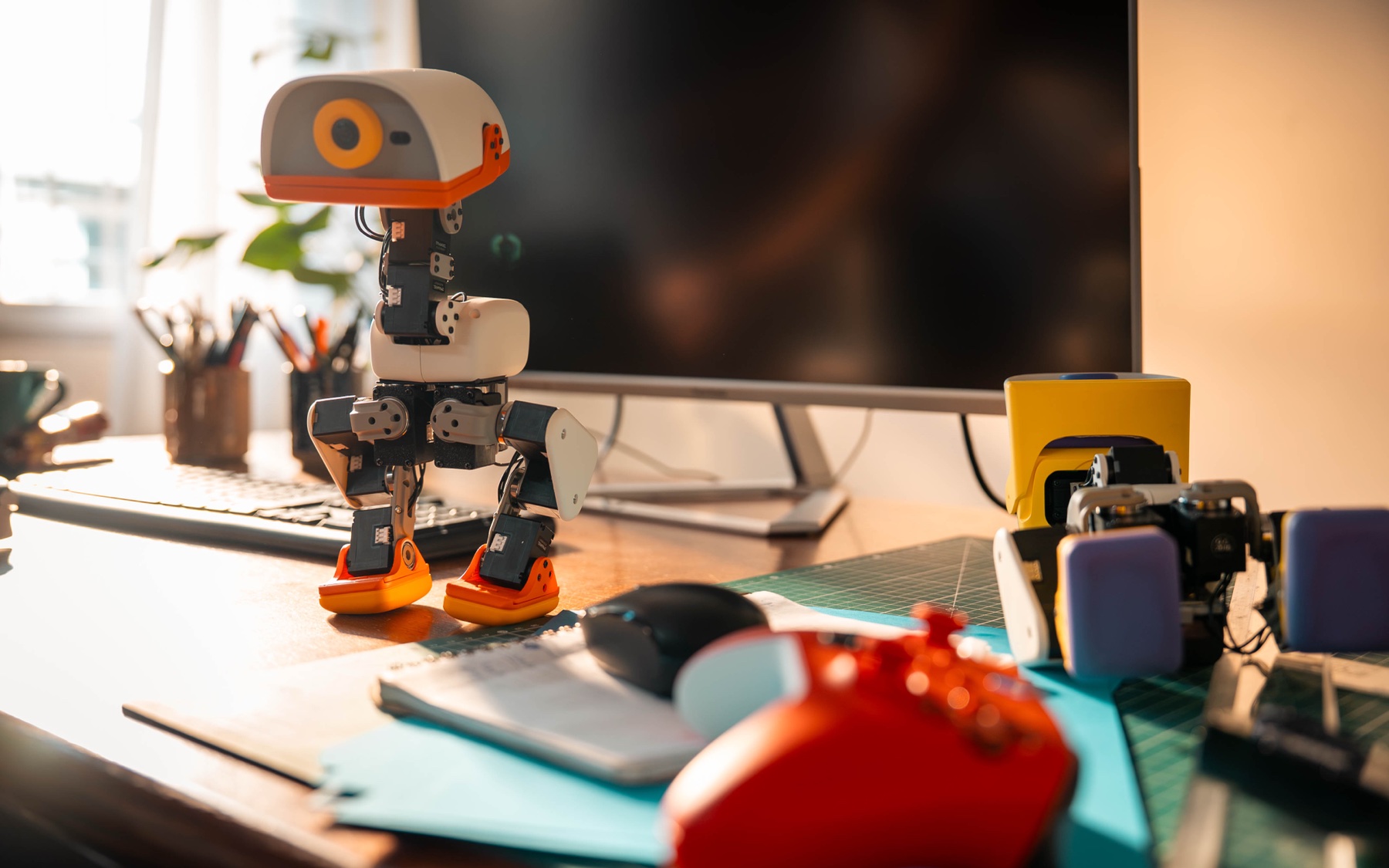
On August 27, 2026, Hugging Face debuted Microduck, a $399 open source bipedal robot shaped like a duck, developed with Pollen Robotics, the French robotics company Hugging Face acquired in April 2025. Microduck stands about 25 centimeters tall, weighs under two pounds, and contains 15 motors, a camera, a speaker and microphone, WiFi, Bluetooth, two inertial measurement units and a small lidar sensor. It can waddle, crouch, sing, pick up small objects with its articulated beak, recover after falling, and roller skate. The SDK, simulation environment and full reinforcement learning training stack are published on GitHub, allowing owners to train new behaviors in simulation and deploy them directly to the robot. CEO Clem Delangue described it as a robot you can teach new tricks with reinforcement learning and positioned it as part of democratizing physical AI and world models. Microduck ships before Christmas 2026 and comes in several colors. It joins Hugging Face's existing robot lineup: Reachy Mini at $499 and Reachy Mini Lite at $399. Reachy Mini, launched in July 2025, reportedly sold around 10,000 units by May 2026 and has an app store with more than 200 apps.
Key Points
- Microduck debuted August 27 at $399: a 25 centimeter open source bipedal duck with 15 motors, a camera, lidar, two IMUs, and a beak that doubles as a gripper.
- It waddles, crouches, sings, roller skates, and gets back up after falls, and it ships before Christmas 2026.
- The SDK, simulation environment and full reinforcement learning training stack are on GitHub; behaviors trained in simulation deploy straight to the robot.
- It comes from Pollen Robotics, which Hugging Face acquired in April 2025, and joins Reachy Mini, which reportedly sold about 10,000 units by May 2026 with a 200 plus app store.
- CEO Clem Delangue framed the launch as democratizing physical AI and world models through cheap open hardware.
The most useful robot demo of the year is a duck falling over and getting back up by itself. On August 27, Hugging Face debuted Microduck, a 25 centimeter open source robot that waddles, crouches, sings, picks things up with its beak, and roller skates, and the fall recovery is the part that matters. Every impressive humanoid video you have seen this year was shot in a lab you will never enter, for a machine you will never own. This one ships before Christmas.
Here is the thesis. Microduck is not competing with humanoids. It is competing with the Raspberry Pi, and that is a much bigger idea.
Fifteen Motors and a Beak That Grips
The spec sheet reads like a toy until you get to the software. Per the launch coverage, Microduck stands about 25 centimeters tall, weighs under two pounds, and packs 15 motors into a bipedal duck body, with a camera eye, a speaker and microphone, WiFi, Bluetooth, two IMUs, and a small lidar unit. The beak doubles as a gripper. It costs $399, comes in several colors, and Hugging Face says it ships before Christmas.
The software is the actual product. The SDK, the simulation environment, and the full reinforcement learning training stack are on GitHub. You train a new behavior in simulation and deploy it straight to the physical duck. CEO Clem Delangue described it as a robot "you can teach new tricks with reinforcement learning," and declared an era of open source robots meant "to democratize physical AI and world models."
Translate that from founder to human: the duck is a console, and reinforcement learning is the game.
The Cuteness Is Load Bearing
Nobody is scared of a duck. That sounds like a joke, but it is the strategy. The robotics industry has spent a decade shipping demo reels of headless dogs and faceless humanoids, and the public response has oscillated between awe and dread. Hugging Face, together with Pollen Robotics, the French firm it acquired in April 2025, keeps going the opposite way: small, cheap, expressive machines that read as pets instead of replacements.
It worked once already. Reachy Mini, the desktop robot Hugging Face launched in July 2025, reportedly moved around 10,000 units by May of this year and picked up its own app store with more than 200 apps along the way. The current lineup sells at $499, with a Lite version at $399, and Microduck slots in at the same price as the Lite. That is not humanoid money. That is birthday present money, and the difference in who ends up owning one is the entire point.
Clem Delangue Is Selling Consoles, Not Ducks
Map the incentives and the duck stops being a novelty. Hugging Face became the default home of open AI models by being the place everyone shares, forks, and fine tunes. Robotics is having its foundation model moment, world models trained on physical interaction data, and whoever owns the community layer owns the defaults for the next decade. Tesla and Figure are betting the form factor is a $20,000 humanoid. Hugging Face is betting it is a thousand dollars of open hardware in a hundred thousand bedrooms, all running the same open training stack, all feeding the same ecosystem.
Cheap hardware is the funnel. The training stack is the lock in, except the lock in is open source, which historically is the kind that wins. Android did not beat the iPhone on elegance. It beat it on being everywhere.
Christmas Is a Long Way From a Demo Reel
The fair counter: launch videos are marketing, and shipping consumer robotics by a holiday deadline is a promise that has humbled far better funded companies. A duck that skates in a produced video and a duck that survives a nine year old's bedroom for six months are different products. Reinforcement learning on real hardware is also still fiddly in ways the GitHub README will not warn you about, and the first wave of buyers will find every one of those ways by January.
But the price of being wrong here is $399, not a mortgage payment. That is the number that changes the behavior. Learning robotics stops being a graduate program and becomes a weekend.
Verdict: watch if you are normal, try if you have ever installed Python for fun. The prediction is bigger than the duck. Within two years the default way anyone under 20 touches real robotics will be an open source Hugging Face machine, the same way a generation learned computing on a $35 board nobody took seriously either. The humanoids will still be in the lab. The ducks will be in the house.
Related: NICKBUILDSTUFF BUILDS A 5 FOOT GAME BOY COLOR FOR ZELDA.
Related: MIROFISH TOPPED GITHUB TRENDING AND GOT SHANDA MONEY TO SIMULATE THE FUTURE.
Frequently Asked Questions
What is the Hugging Face Microduck?
Microduck is a $399 open source bipedal robot shaped like a duck, debuted by Hugging Face on August 27, 2026. It stands about 25 centimeters tall, weighs under two pounds, and can waddle, crouch, sing, roller skate, pick up small objects with its beak, and get back up when it falls.
How much does the Microduck cost and when does it ship?
It costs $399 and Hugging Face says it ships before Christmas 2026. It comes in several colors.
Can you program the Microduck yourself?
Yes. The SDK, simulation environment and full reinforcement learning training stack are published on GitHub. You can train new behaviors in simulation and deploy them directly to the physical robot.
What sensors does the Microduck have?
A camera in its eye, a speaker and microphone, WiFi, Bluetooth, two inertial measurement units, and a small lidar sensor, with 15 motors driving its bipedal body.
Who makes the Microduck?
It was developed by Hugging Face with Pollen Robotics, the French robotics company Hugging Face acquired in April 2025, the same team behind the Reachy Mini desktop robot.
How is Microduck different from the Reachy Mini?
Reachy Mini is a stationary desktop robot, sold at $499 with a Lite version at $399, and reportedly sold about 10,000 units by May 2026. Microduck is a walking bipedal robot at $399 focused on legged movement and reinforcement learning tricks.
Topics: reachy-mini, pollen-robotics, consumer-robots, microduck, tesla, hugging-face, clem-delangue, github, hugging face, robotics, reinforcement-learning, open-source, physical-ai