Derrick Adams Tells Gagosian How Television Built the Work
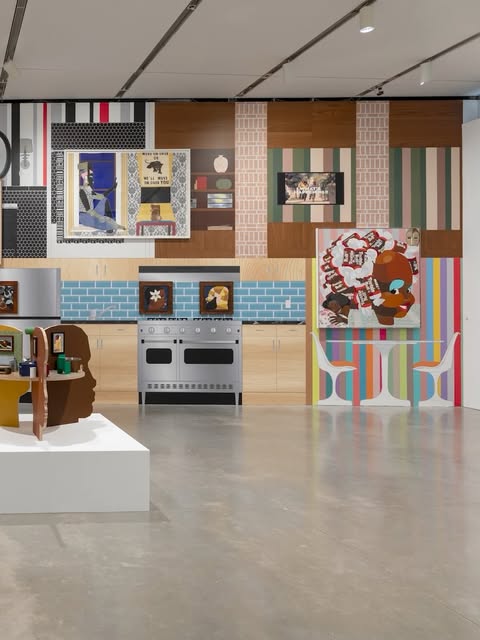
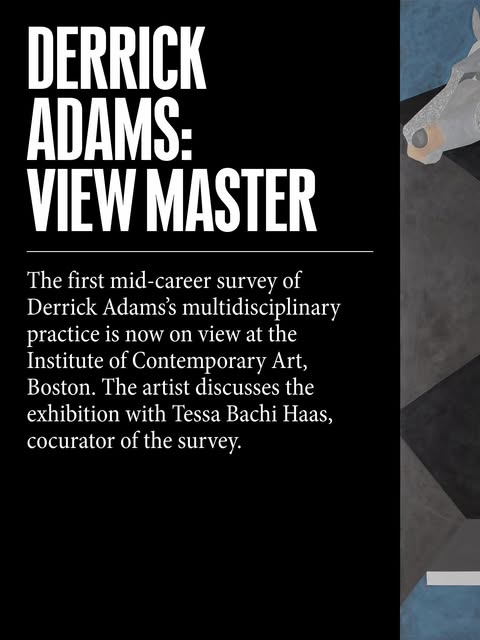
Derrick Adams told Gagosian Quarterly that television taught him composition before art school did. The Haas interview during View Master at ICA Boston confirms Adams at the top institutional tier.
Key Points
- Derrick Adams named television as his compositional model before formal art training
- Tessa Bachi Haas cocurated View Master at ICA Boston with Gagosian backing
- Gagosian Quarterly interview signals Adams at the top institutional market tier
- Secondary market has moved consistently upward since 2019 Whitney Biennial inclusion
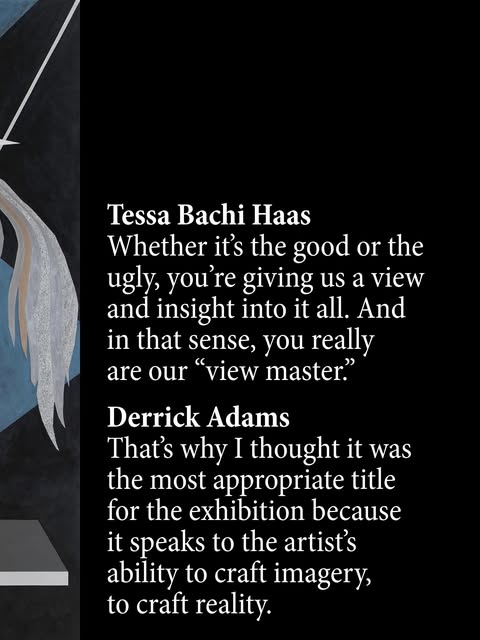
The Gagosian Quarterly interview ran long. Tessa Bachi Haas, who cocurated View Master at ICA Boston, asked Derrick Adams about television, and he answered without deflecting. Saturday morning cartoons. Game shows. The specific light of a cathode ray tube in a dark room. That interview, published during the run of the show, is the clearest origin story Adams has ever told on record.
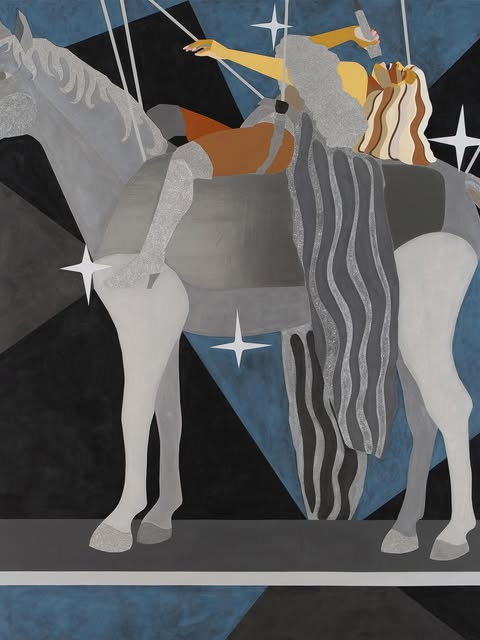
The paintings have been making a different argument for years, one that most critics reach for the word joyful to describe without looking carefully at what the joy is made of. The figures in Adams's work are large, deliberate, and held in a kind of broadcast stillness. They are not moving because they are on. That is a different condition from rest.
The Gagosian Quarterly feature arrived during a period when Adams's market position had already shifted, but the critical narrative had not yet caught up. The interview closes that gap.
Television Gave Adams His Grid Before Art School Did
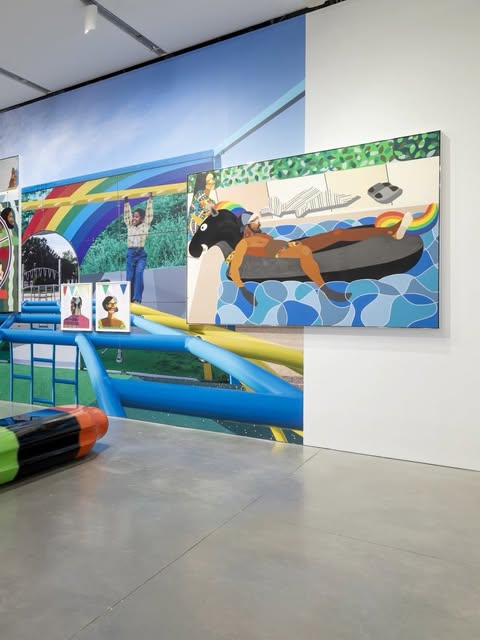
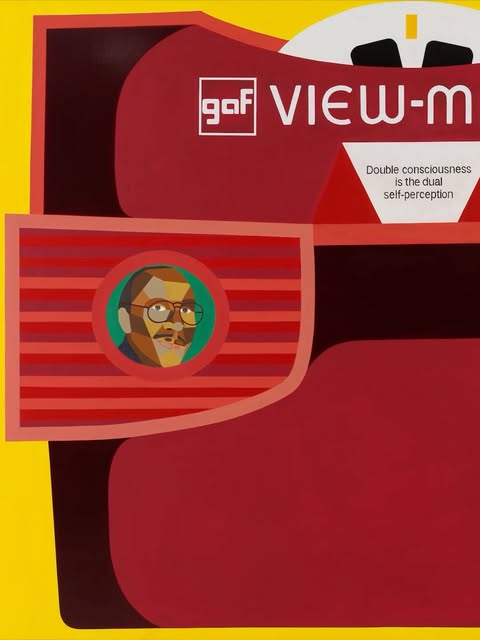
The paintings in View Master read like storyboards for a broadcast that never aired. Acrylic on canvas, large format, figures built from blocks of saturated color against geometric grounds. The palette is controlled and warm: cobalt against burnt orange, teal against yellow. Nothing in the color choices is accidental. Adams described in the Haas interview how television taught him to read color as information before he learned to use it as expression. A variety show set. A game show stage. The way color coded status and role and energy in a medium that could not afford ambiguity.
The figures do not move. They stand, sit, and pose in arrangements that suggest they are aware of being watched, because in the visual logic that Adams absorbed before he entered a studio, everyone on a screen is always being watched. That consciousness is not anxiety in his work. It is composure. The awareness of the camera as a condition of existence.
In the Gagosian Quarterly conversation, Adams described the View Master toy itself: the handheld stereo viewer that gave the show its title. The device created a private image world, one that required you to hold it to your eyes and block everything else out. A personal screen before screens were personal. That image logic runs through the paintings. The figures exist in their own complete visual field. They do not need you. But they are willing to be seen. View Master at ICA Boston
ICA Boston and Gagosian Together Signal a Career at the Top Tier
View Master at ICA Boston was not a first major show for Adams, but it was the most legible institutional argument for his permanent place in the conversation. ICA Boston does not program retrospectives as career favors. The show, with Bachi Haas as cocurator and Gagosian's name in the press machinery, was the institution and the market making the same bet at the same time. That alignment is rare and deliberate.
Gagosian Quarterly does not publish extended artist interviews to fill editorial space. The Haas conversation ran thousands of words and covered childhood, television, arts education, and the specific visual logic Adams developed watching broadcast media before anyone called it research. The length of the piece is the argument. Gagosian is investing its editorial weight in Adams's origin story because the origin story now serves the institutional case. Gagosian, institutional placement, and the Athens exhibition
Adams's secondary market has moved with consistent upward pressure since his 2019 Whitney Biennial inclusion. Post View Master, with Gagosian explicitly framing the narrative through the Quarterly feature, the acquisition window for institutional buyers is narrowing. Collections that have not moved are watching the window close.
The Placement Read
Adams told Haas that television made him understand how images could be simultaneously made for millions and received by one person alone in one room. That is also a precise description of what the paintings do. The work does not need a wall label. It explains itself through the broadcast logic most viewers already carry without being able to name it.
The Gagosian Quarterly feature is the institutional confirmation that Adams's critical argument has been accepted at the market's top tier. ICA Boston provided the retrospective. Haas provided the intellectual frame. The paintings have been making the case for a decade. The placement is not a bet anymore. It is a statement.
Frequently Asked Questions
What is the View Master exhibition at ICA Boston?
View Master is a retrospective of Derrick Adams's work, cocurated by Tessa Bachi Haas, that examined television, childhood, and broadcast aesthetics as formative influences on Adams's painting practice.
What did Derrick Adams say about television in the Gagosian Quarterly interview?
Adams described television as a compositional model that taught him to read color as information and understand framing before he received formal art training, citing Saturday morning cartoons and game show set design.
What does a Gagosian Quarterly feature signal about an artist's market position?
A major editorial feature in Gagosian Quarterly represents institutional investment in an artist's critical narrative, typically signaling confidence in long-term market trajectory and flagging the artist to institutional buyers.
Topics: Derrick Adams, contemporary art, ICA Boston, art market, View Master, Gagosian, gagosian, Tessa Bachi Haas