TETSUYA ISHIDA DIED AT 31, NOW HE OPENS IN PARIS
Tetsuya Ishida (1973-2005), the Japanese painter who died at 31 after a 2005 train accident, gets his first solo exhibition in France at Gagosian Paris, opening June 10 and running through July 31, 2026. The show features paintings including Supermarket (1996) and Recalled (1998), two works that diagnosed salaryman dehumanization and Japan's lost decade through hyper detailed surrealist scenes.
Key Points
- Tetsuya Ishida, 1973-2005, made about 200 paintings on Japan's lost decade isolation in roughly ten years before he died at 31.
- His first exhibition in France opens June 10 at Gagosian, 4 rue de Ponthieu, Paris, and runs through July 31, 2026.
- The show features Recalled, 1998, and Supermarket, 1996, two paintings that read salaryman dehumanization as diagnosis.
The first thing you do in front of a Tetsuya Ishida painting is decide whether to keep looking. The work is hyper detailed, the scenes are small enough to read on a phone screen, and the figures are doing something quietly wrong with their bodies. Some of them are crying. Some have machine parts where their arms should be. None of them look like they want to be there.
Tetsuya Ishida, 1973 to 2005, died at thirty one. He was struck by a passing train at a railroad crossing in 2005. He left behind about two hundred paintings made in roughly a decade, every one of them a piece of the same long argument about Japan's lost decade, the recession of the 1990s, and the bodies it broke in the process. Tonight at 6pm his first exhibition in France opens at Gagosian, 4 rue de Ponthieu, Paris. It runs through July 31.
Supermarket, 1996. A Suited Man Has Two Conveyor Belt Arms.
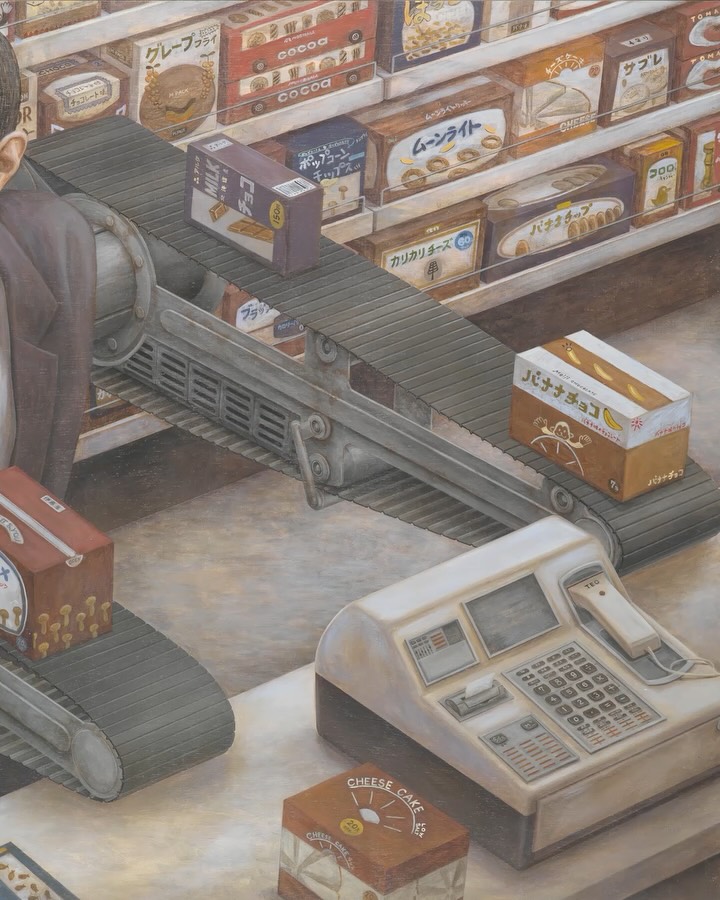
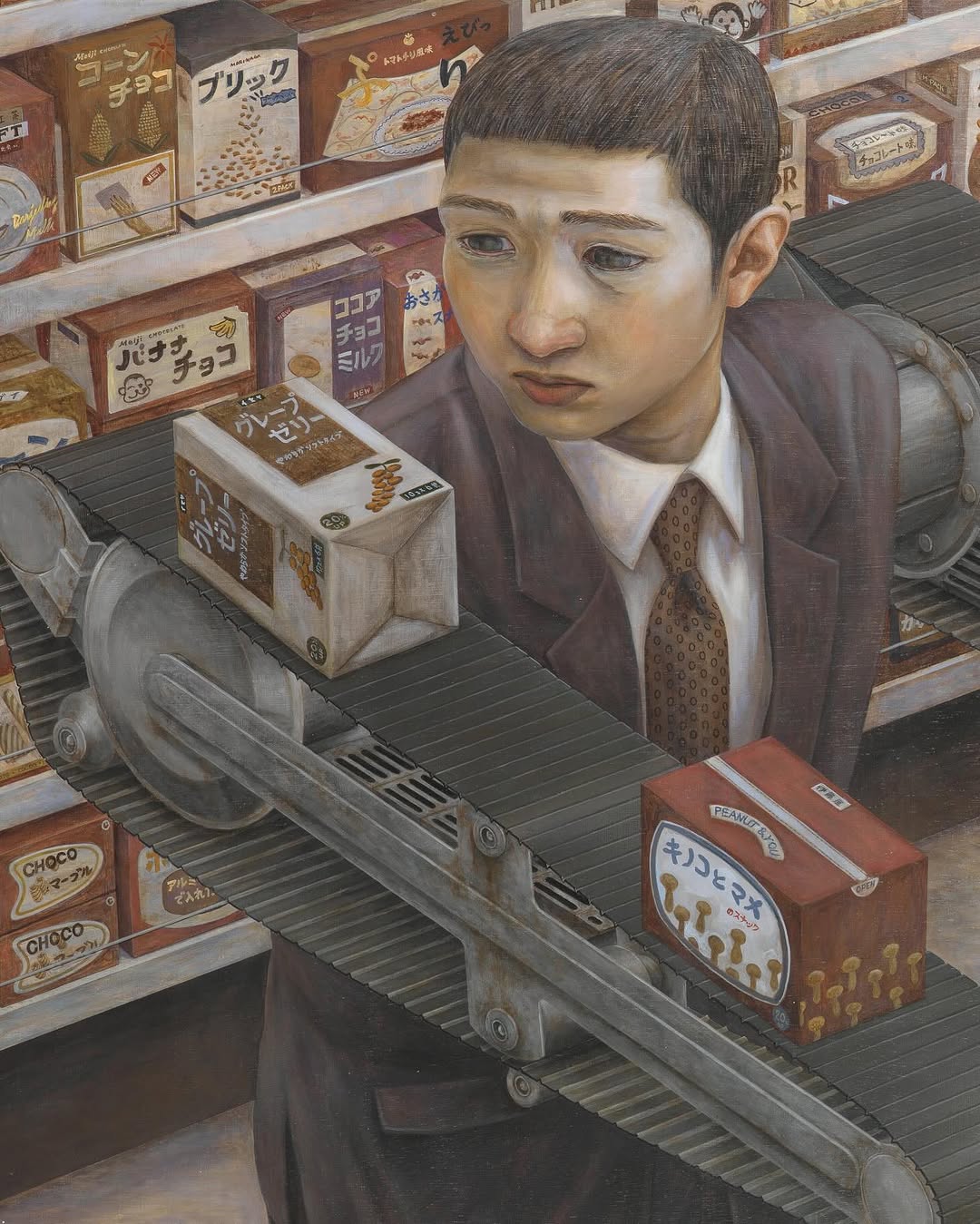
Supermarket is the painting Gagosian put in the deck. It shows a man in a dark business suit, head down, standing between a cash register and shelves stocked with brightly branded packages of food. Where his arms should be, two conveyor belts run from his shoulders into the merchandise. He is not a worker stocking the shelves. He is the shelves.
Stand in front of it for a minute and the joke flips. The painting reads as comic for the first ten seconds, the suited man as inventory, the gag of the merger between human and machine. Then the suit becomes legible as the uniform of the salaryman, the conveyor belts become the dailiness of the work, and the joke ages into a diagnosis. Late capitalism does not turn you into a robot. It makes you the medium through which products move. Ishida painted that thirty years ago. It is still the joke, and it is still not funny.
Recalled Puts a Family in Mourning Around a Body.
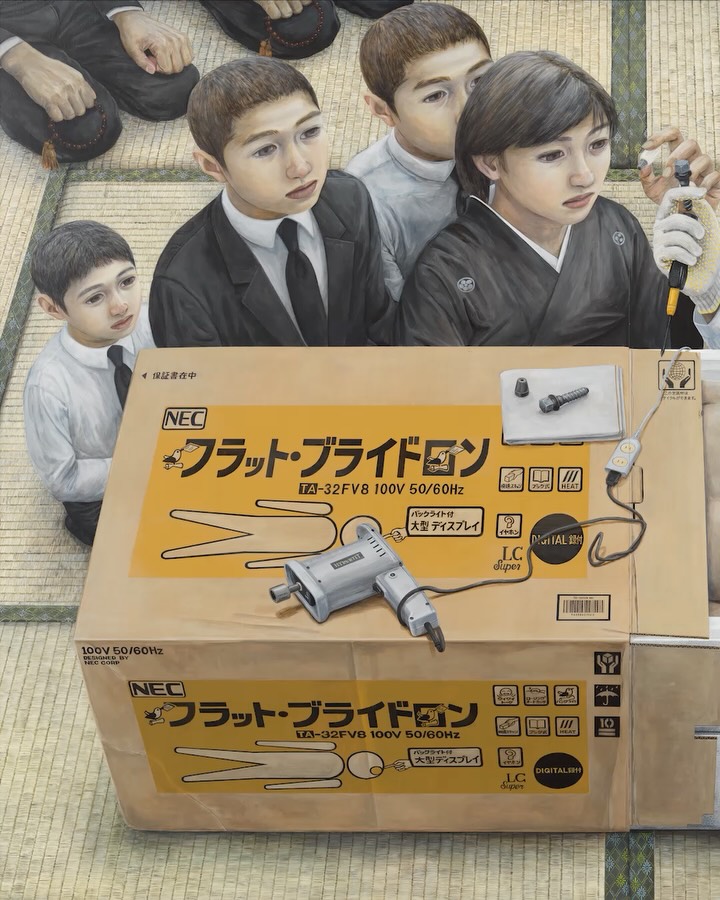
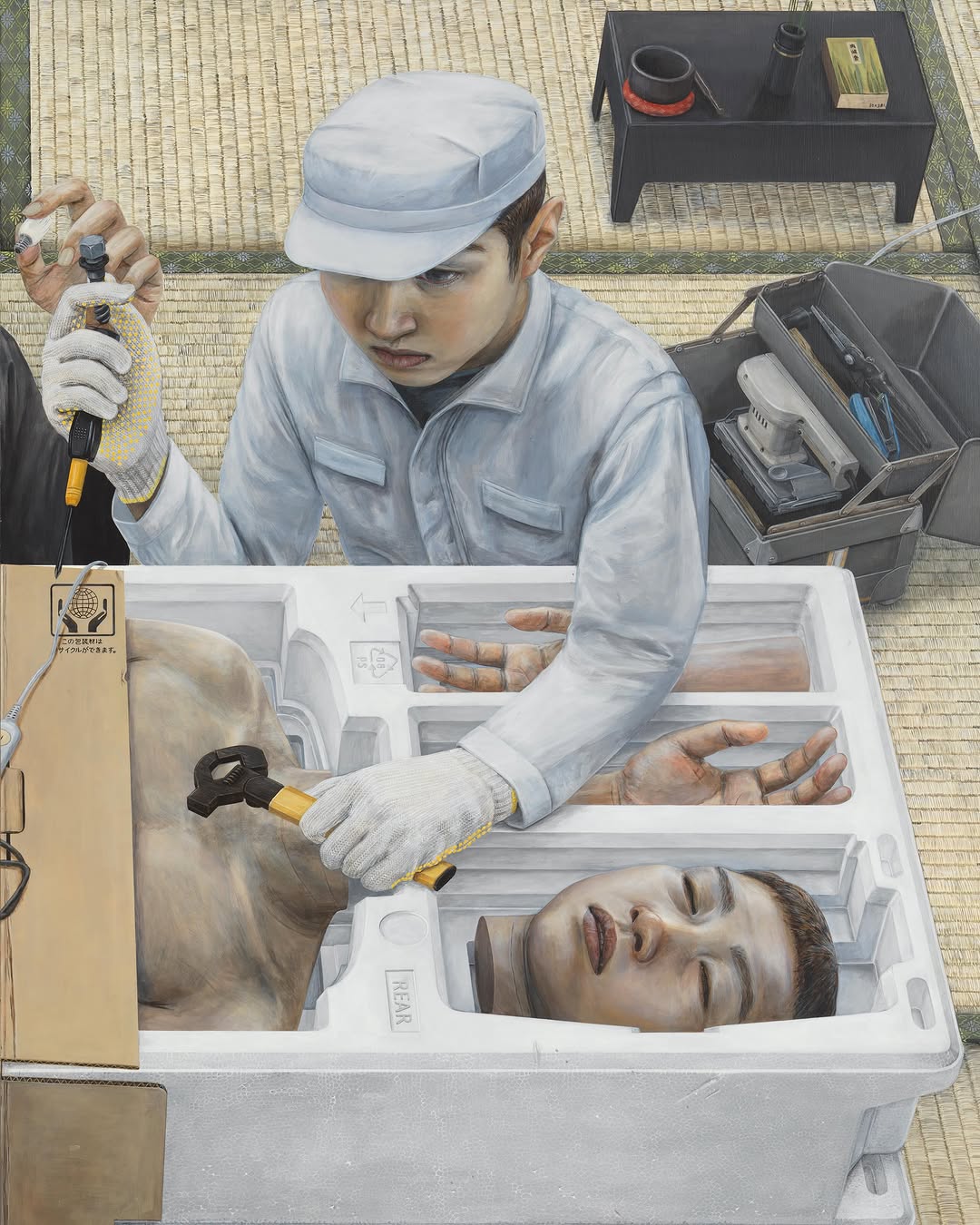
Recalled is the painting in the lead image. A family in dark mourning attire kneels on tatami mats. A technician in light clothes leans over a man's body on the floor, working on him with what reads as both a medical and a manufacturing tool. The family is not crying. They are watching.
The title does the trick. Recalled, the way a product is recalled. The man on the floor is not being mourned. He is being inspected. Ishida painted the family in stillness and the technician in motion. That is the whole thesis: in the lost decade, the man who could not produce was being returned to the factory, with the room arranged the way you arrange a funeral.
This is the work doing what the artist statement cannot. The image goes in, and the metaphor unpacks itself slowly enough that you cannot quite blink it off.
Ishida Made 200 Paintings in Ten Years.
That is roughly twenty a year, every year, for the entire arc of his career. He was educated at Musashino Art University in Tokyo. He used himself as the figure in many of the paintings. The recurring face is his own, multiplied and put through small horrors. The art world he was working inside did not match the income of the labor he was painting. He kept working anyway.
The placement reader read: a body of two hundred works from a thirty one year old is denser than the average ten year career of a hundred more famous artists. He was prolific. He was clear. He died before he got the institutional moment he had told friends he wanted.
The American art world caught up to him through the Wrightwood 659 Chicago show, Self-Portrait of Other, and through Gagosian's New York programming. Paris is the next move. The institutional placement matters. A solo show in a Gagosian space in Paris is the kind of slot that other Japanese postwar painters earned through decades of biennials. Ishida is getting it on the merit of the paintings alone, the same gallery that gave Sterling Ruby a Paris room earlier this spring.
Paris Gets Him First, Twenty One Years Late.
Ishida had wanted a New York solo show in his lifetime. He did not get one. The two decade lag is the part of his trajectory art history will keep writing about. Whether you take the train accident as accident or as something else, the dream stayed a dream while he was alive, and the institutions arrived after.
That is the harder ekphrasis to write. The painting is in front of you. The painter is not. You stand at 4 rue de Ponthieu tonight and the work does its job in a country that did not show him while he was here. The cross-vertical pull will hit anyone who has followed Japan's design imports lately, from Brain Dead pulling Japanese milk glass into A.P.C. to the contemporary painters working in the lineage Ishida helped open.
The honest reaction, six minutes in: the dehumanization Ishida was painting in 1996 reads now like documentary. It has not aged into nostalgia, the way some 90s art has. It has aged into recognition. Tonight in Paris is the room finally agreeing with the painter. Through July 31, you can stand three feet away and see what was true the whole time.
Frequently Asked Questions
Who was Tetsuya Ishida?
Tetsuya Ishida (1973-2005) was a Japanese painter educated at Musashino Art University in Tokyo who made about 200 hyper detailed paintings on isolation, salaryman dehumanization, and Japan's lost decade before dying at 31.
How did Tetsuya Ishida die?
Ishida was struck by a passing train at a railroad crossing in 2005, at age 31. Some accounts have described the death as a possible suicide.
Where is the Tetsuya Ishida Gagosian Paris show?
At Gagosian, 4 rue de Ponthieu, Paris. The exhibition opens June 10 with a 6 to 8pm reception and runs through July 31, 2026.
What is the Tetsuya Ishida painting Supermarket about?
Supermarket, 1996, depicts a man in a business suit with conveyor belts replacing his arms, standing between a cash register and shelves of branded food. It reads the salaryman as the medium through which late capitalist products move.
What is Tetsuya Ishida's Recalled painting?
Recalled, 1998, depicts a family in mourning attire kneeling on tatami mats while a technician inspects a man's body on the floor. The title reframes the scene the way a defective product is recalled to the factory.
Topics: gagosian, contemporary-painting, recalled, paris, art, brain-dead, lost-decade, brain dead, japanese-art, supermarket, surrealism, tetsuya-ishida