PUMA SALEHE BEMBURY TRVL WEAR WORLD CUP 2026
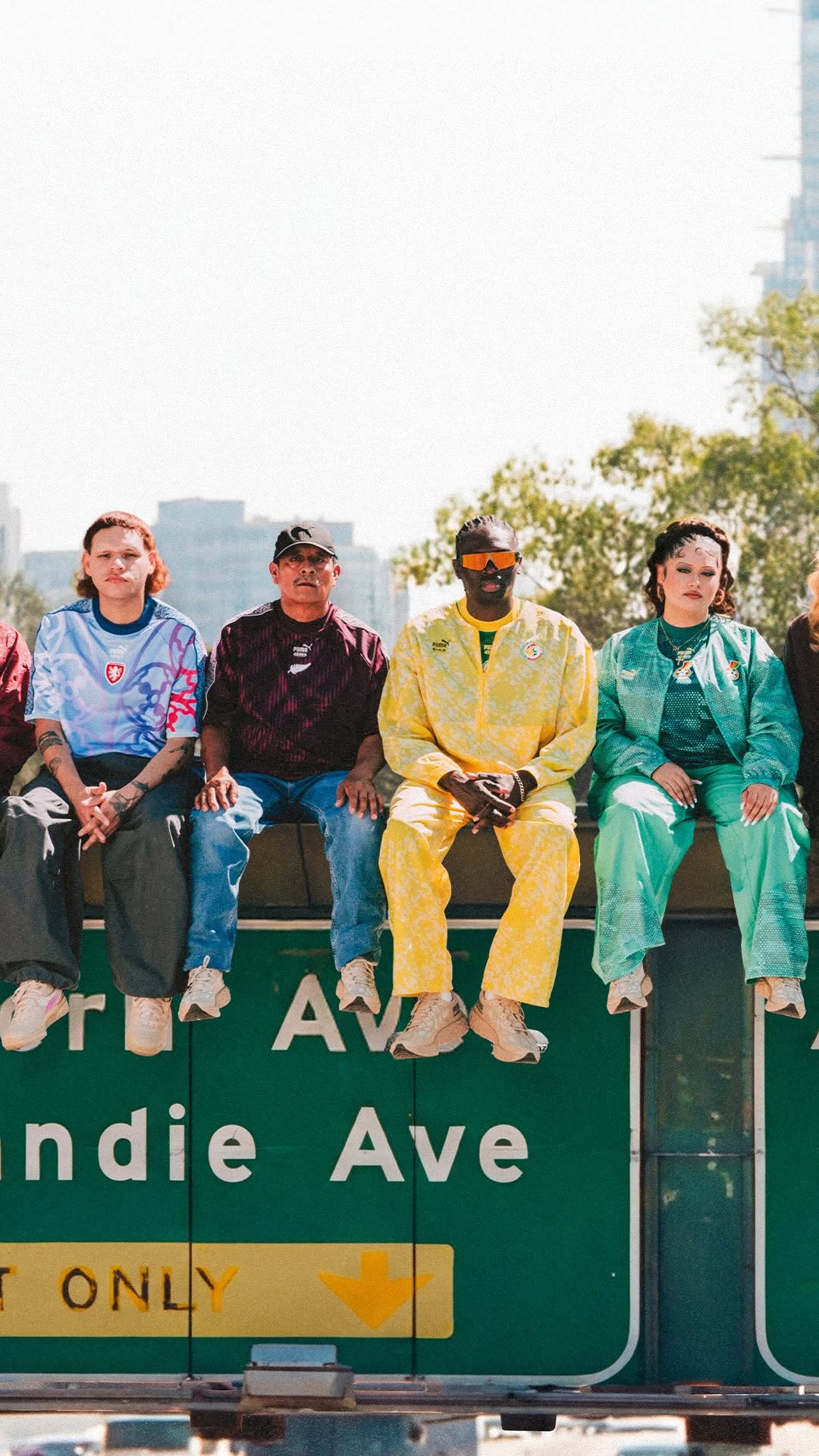
Salehe Bembury's TRVL WEAR for Puma: goalkeeper kits for 11 World Cup nations, Velum NITRO sneaker, and a June 4 drop. Sneaker culture meets football.
Puma Salehe Bembury just brought the organic-texture playbook from sneaker culture directly into football. The TRVL WEAR collection, dropping June 4, 2026, is not a kit. It is a full travel wardrobe — track suits, KING jerseys, and a Velum NITRO™ sneaker — built for the eleven national teams Puma sponsors at the World Cup and styled for the moment before the match, not during it.
Salehe Bembury Did Not Come From Football
He came from Versace, where he was VP of Sneakers. Before that, he made a Crocs silhouette that sold out globally and carried a topographical fingerprint texture across its footbed. He collaborated with New Balance on the 574 and the 1906R using visual systems pulled from geological surveys and marine biology. His vocabulary is nature rendered in rubber and foam: ridgelines, spore maps, cellular diagrams. None of that is football. All of it is useful when you need eleven goalkeeper kits for eleven different nations and each one has to say something specific about its place in the world.
That is the actual brief Puma handed him. Design goalkeeper jerseys for Ivory Coast, Morocco, Switzerland, Senegal, Serbia, and the other six Puma-sponsored nations. Each jersey is supposed to carry that country's geographical landscape, biological narrative, and cultural legacy inside bold organic patterns and localized color stories. Bembury is not the first designer to cross from sneakers to football kits. He is the first to bring a methodology this specific.
Eleven Teams. Eleven Different Ecologies.
The goalkeeper jersey is the most overlooked canvas in football. It has to stand apart from the outfield kit by law — different colorway to avoid confusion — which means it is also the jersey with the most freedom. Bembury understood this. Each of the eleven jerseys in TRVL WEAR is a distinct object, not a colorway variation of a master template. Ivory Coast gets something that reads coastal and equatorial. Morocco gets geometry filtered through Atlas mountain terrain. Switzerland gets restraint with elevation embedded in the pattern.
This approach tracks directly with Bembury's New Balance work, where each silhouette was treated as a separate design problem rather than a product line entry. The 574 collab leaned into trail-map contour lines. The 1906R used microscopy imagery. The goalkeeper jerseys follow the same logic: start with a place, extract its visual DNA, build the pattern from that evidence. The output looks like Bembury's other work because the process is identical. The fact that it is now worn on a World Cup pitch in front of a global audience is the escalation, not the departure.
The World Cup 2026 cultural moment is producing collaborations with real design ambition across every brand in the space — the Kids of Immigrants x Nike T90 Mule, dropping May 28, is another example of how designers are using the tournament as leverage for serious creative work.The Velum NITRO Arrives in Sand
The travel wear component of TRVL WEAR is built around a Velum NITRO™ sneaker in a sandy, earth-tone ensemble. Velum is Puma's current performance-adjacent NITRO foam platform — responsive, lightweight, designed to move between training context and airport lounge without looking like either. The sandy colorway is not incidental. It is the neutral that makes everything else in the collection travel together: the track suits, the KING t-shirts and jerseys, the goalkeeper kit when it is folded in a bag instead of worn on a pitch.
The KING lineage matters here. The KING football boot is Puma's heritage silhouette — Pelé wore it at the 1970 World Cup in Mexico, which is the single most important product placement in the brand's history. Putting KING branding on t-shirts and jerseys inside a travel collection is a deliberate act of memory retrieval. Bembury is known for embedding historical and geographical depth into his work. Pairing his texture vocabulary with KING's symbolic weight is either a coincidence or the most intentional move in the collection. It is not a coincidence.
Adidas is running the competing World Cup 2026 brand narrative with an eleven-photo roster post and the Built Together campaign — a different strategy, same cultural urgency.June 4 Is a Sales Event Disguised as a Statement
The release date is June 4, 2026. The World Cup starts June 11. That seven-day window is not accidental. Puma and Bembury want the collection to be in hands, on bodies, and in the conversation before the first group-stage match kicks off. TRVL WEAR ships through PUMA.com and Puma stores globally, which means the distribution is intentionally wide — this is not a limited sneaker drop designed to manufacture scarcity. The scarcity is already built into the design: eleven nations, eleven specific ecologies, one designer with a recognizable methodology applied to all of them.
The temperature on Bembury collabs has stayed consistently high since the Crocs moment. His audience follows him across categories — from foam clogs to trail runners to now goalkeeper kits and travel track suits. That cross-category loyalty is exactly what Puma is buying. Not just a guest designer credit. A built-in audience that does not need to be converted to football to care about this collection.
The prediction: TRVL WEAR sells through in the first week, the goalkeeper jersey for Morocco or Ivory Coast becomes the collector item of the 2026 World Cup cycle, and Bembury's move into kit design gets treated as the inflection point that made football a serious destination for sneaker designers. The groundwork is already laid. June 4 is just the proof.
Topics: world cup 2026, sneakers, salehe-bembury, adidas, culture, crocs, collaboration, new-balance, world-cup, kids of immigrants, new balance, salehe bembury, world cup, puma, kids-of-immigrants, trvl wear, nike, football