LIGHTSPRAY CLOUDMONSTER 3 HYPER: 205G AND A NEW FACTORY
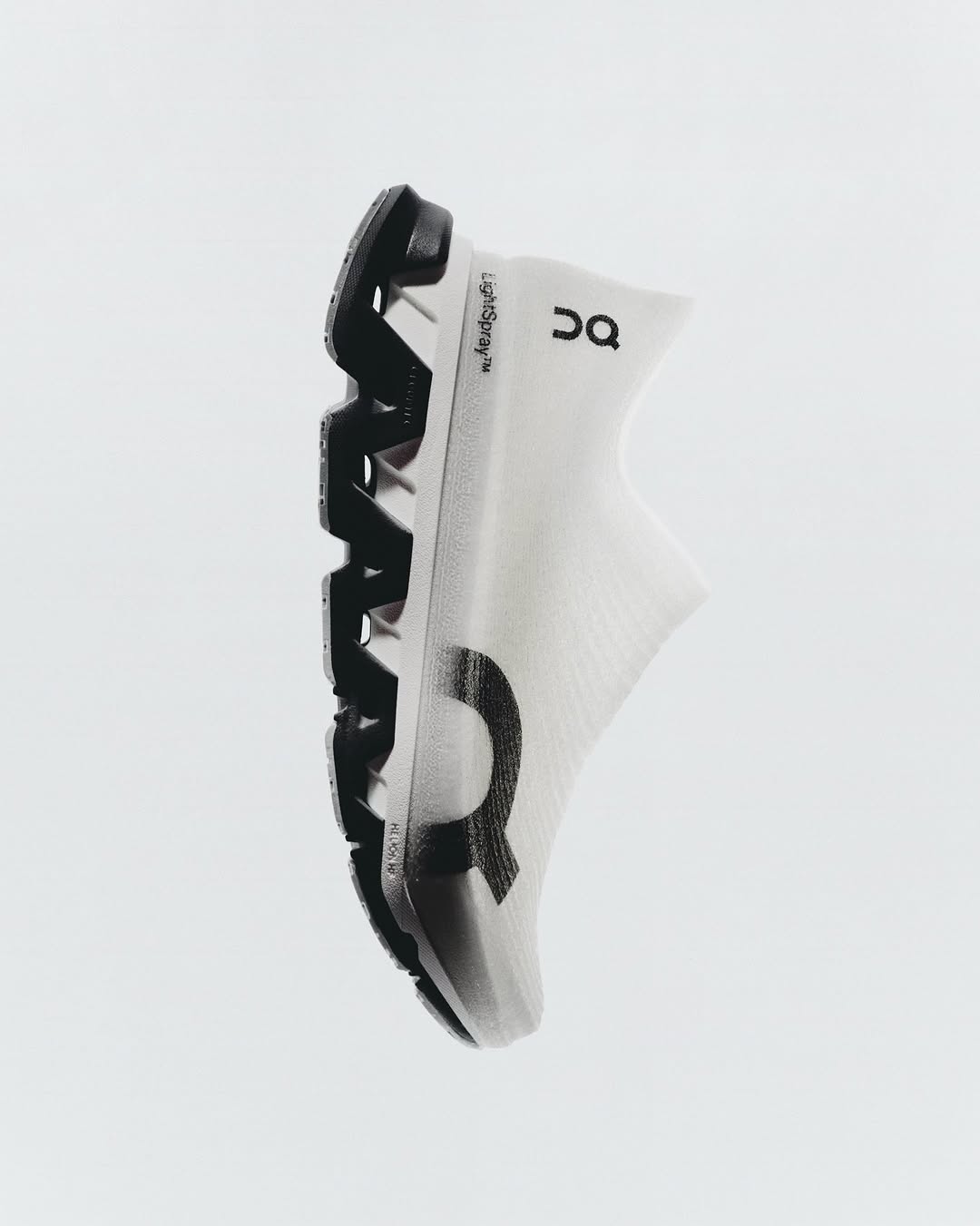
On's LightSpray Cloudmonster 3 Hyper, released March 5, 2026 at $280, is built from just eight components and weighs 205g in a men's US 8.5, making it 90 grams lighter than the standard Cloudmonster 3. The shoe is the first product manufactured at scale in On's new Busan, South Korea facility, which houses 32 robots and increases global LightSpray production capacity 30-fold compared to the original four-robot Zurich pilot. On's R&D team claims only 3% of LightSpray's long-term potential has been revealed, with plans to expand the technology beyond footwear.
Key Points
- The Busan LightSpray factory houses 32 robots and can produce approximately 1,000 pairs per day, a 30-fold increase over On's original four-robot Zurich facility opened in July 2025.
- On posted a record CHF 794.4 million in net sales in Q3 2025 with a 65.7% gross profit margin, funding the $280 price point and robotic factory expansion.
- At the 2024 Paris Olympics, Kenyan runner Hellen Obiri became the first Olympic marathon medalist to race in a LightSpray upper, establishing the technology's elite credentials before its super trainer debut.
200 Steps Collapsed Into Three Minutes
A conventional running shoe upper passes through roughly 200 individual manufacturing steps before it reaches your foot. Panels cut, edges trimmed, layers glued, seams stitched, across multiple factories and dozens of hands. Building a running shoe is, by any reasonable measure, an absurdly complicated process. A conventional pair involves somewhere in the neighborhood of 200 individual manufacturing steps, typically spread across multiple factories and dozens of human hands.
On's answer to that process is a robotic arm, 1.5 kilometers of thermoplastic filament, and three minutes. LightSpray condenses traditional upper production, which typically requires approximately 200 steps across multiple factories, into a single, fully automated process. A robotic arm sprays 1.5 kilometers of specialized filament onto a last, creating an ultra-light, one-piece upper in around three minutes.
The LightSpray Cloudmonster 3 Hyper, which dropped in North America on March 5, 2026, is the first shoe built at scale from that process. Not a racing prototype. Not a limited Olympic collab. A trainer. One you can buy for $280 and run 60-mile weeks in.
The Busan Factory That Changed the Math
At first glance, On's new LightSpray facility outside Busan doesn't look like a shoe factory at all; there are no stacks of fabric, no sewing machines, hardly any people in sight. Instead, 32 industrial robots move in near-perfect synchrony, spraying filament onto shoe lasts with choreographed precision, creating the LightSpray running shoes in just three minutes.
The backstory matters here. Following the opening of the first facility with four robots in Zurich in July 2025, the new South Korea factory adds another 32 fully automated robots set to increase the brand's global LightSpray production capacity 30-fold in 2026. Four robots in Zurich to 32 in Busan, and the Cloudmonster 3 Hyper is the first product that comes out the other end at real volume. The Busan factory is capable of producing approximately 1,000 pairs of shoes per day. While this represents a fraction of the brand's total volume, the scalability of the technology suggests a future where localized micro-factories could serve specific regional markets.
Co-founder Caspar Coppetti is blunt about why South Korea specifically. On Holding currently sources 90 percent of its shoes from third-party manufacturers in Vietnam and 10 percent from Indonesia. Co-founder Caspar Coppetti said automation allows the brand to produce faster and closer to key consumer markets, noting that rising labour costs, geopolitical uncertainty and US tariff pressure are all pushing the industry towards a different manufacturing model.
This is not a sustainability press release. This is supply chain strategy dressed in performance packaging.
Eight Parts, 90 Grams Lighter, One Big Question
By extending this ultralight upper construction to a new footwear collection, On delivers the lightest Cloudmonster ever made without compromising on feeling. Made from just eight pieces, one upper, two midsole components, and five small rubber elements, the LightSpray Cloudmonster 3 Hyper weighs only 205g. This minimal construction reduces carbon footprint while delivering elite-level training performance.
For context: a men's size 8.5 comes in at 205 grams, which is 90 grams lighter than the baseline Cloudmonster 3 that released simultaneously. That is not a marginal trim. That is a different category of shoe wearing the same name.
Under that sprayed upper sits a two-tier midsole built for long efforts. Underneath the gossamer upper sits a two-piece midsole setup: Helion HF hyper foam for maximum energy return on top, with a base layer of standard Helion for durability. Notably, On chose to skip a plate here, a deliberate call to keep the ride less strenuous and preserve leg freshness over longer periods. Pair that with the enhanced rocker geometry for smooth push-offs and you have a shoe clearly built for sustained output.
The question the running community is genuinely split on: is the LightSpray upper a functional advantage or just an aesthetic one? Some are skeptical of its ability to scale to widespread adoption in its current state. Is it cool and interesting and a conversational piece when worn in public? Yes, no doubt. But the review consensus points to fit retention over long distances as the real pressure test. LightSpray's lace-free, form-fitting design is a technical achievement, but laceless shoes ask a lot from the sock system and upper structure to keep things locked down during dynamic movement, especially on descents. The included sock is a smart step, but runners with wider feet or high arches might want to try them on before committing.
For what it's worth, co-founder Olivier Bernhard has logged over 1,000 kilometers in prototypes before signing off. That is not a marketing number. That is a bet.
LightSpray Debuted at the Olympics. Now It Lives in Your Training Log.
LightSpray first earned its credibility at the highest level of competition. At the Paris Olympics, Kenyan distance runner Hellen Obiri raced in On's Cloudboom Strike LS, becoming the first Olympic marathon medalist to compete in a LightSpray upper.
Moving it from an Olympic racing upper to a $280 super trainer is the harder bet. The Cloudmonster franchise started in 2022 as a deliberate move toward the maximalist market that Hoka had owned. On launched the Cloudmonster on March 31, 2022. It deviates from the company's previous designs by having a larger sole. Jacob Gallagher of The Wall Street Journal described it as "a maximalist sneaker" and claimed that this design is primarily associated with Hoka, and called Hoka "one of On's main competitors in the specialized running market."
Four years later, On isn't just competing in the maximalist space. It's trying to rewrite how the maximalist shoe gets made. On can claim up to 75% lower CO₂ emissions for the upper versus its other racing shoes, plus significant reductions in manufacturing waste. The construction also lends itself to circularity at end of life in a way that multi-material, glue-heavy builds simply can't.
And On has the financial position to absorb the risk of this bet. Following a Q3 2025 where net sales hit a record CHF 794.4 million and the gross profit margin reached a staggering 65.7%, the company raised its full-year 2025 net sales guidance to approximately CHF 2.98 billion. A company posting those margins can afford to build a robot factory in South Korea and price the output at $280 to test whether the market follows.
The LOEWE collaboration gave On fashion credibility. When you position yourself with a luxury fashion brand like LOEWE, the core On offering starts to feel more premium. There are no longer questions about On's design credibility, or their positioning as a premium brand. The entire range benefits from elevated perception. The product hasn't changed, but the context in which it is positioned has. LightSpray is the performance equivalent of that move: it doesn't just improve a shoe, it repositions what an On shoe means.
3% of the Potential, Already Charging $280
A manufacturing process that compresses 200 steps into one, requires less physical space, generates less material waste, and can be remotely updated like software is a genuinely different model for how physical goods get made. On has stated that its team of roughly 400 R&D specialists, material scientists, roboticists, and AI engineers, has so far revealed only three percent of LightSpray's long-term potential. The company plans to extend the technology beyond running into other product categories, with additional collaborations and drops planned throughout 2026.
Three percent. That's the internal claim, and it's either the most confident thing a sportswear brand has said in years, or the most expensive piece of hype in the category. The honest answer is probably both.
On positions itself as a premium brand with a distinct, clean aesthetic, the Apple of running shoes. Apple's move wasn't making a better phone. It was controlling the entire stack: design, manufacturing, software, retail. On, with LightSpray factories in Zurich and Busan and plans for the Americas and Europe next, is attempting the same vertical integration play in footwear. The Cloudmonster 3 Hyper in a new June colorway isn't a product update. It's a proof of concept for a manufacturing platform that hasn't been fully built yet.
By 2028, the real question won't be whether the upper is better than Nike's Atomknit. It'll be whether On can produce LightSpray at a price point that normalizes a robot-built shoe as the default. At $280, they're not there yet. But 1,000 pairs a day in Busan, and a plan to open Americas production next, suggests the timeline is shorter than the industry thinks.
Frequently Asked Questions
How much does the On LightSpray Cloudmonster 3 Hyper cost?
The On LightSpray Cloudmonster 3 Hyper retails at $280. It is the top tier of the Cloudmonster 3 family, which also includes the Cloudmonster 3 Hyper at $220 and the standard Cloudmonster 3 at $190.
What is LightSpray technology and how does it work?
LightSpray is On's proprietary manufacturing process where a robotic arm sprays 1.5 kilometers of thermoplastic filament onto a shoe last in approximately three minutes, creating a seamless, laceless, one-piece upper. It reduces traditional upper production from roughly 200 steps to a single automated sequence.
How much does the LightSpray Cloudmonster 3 Hyper weigh?
The LightSpray Cloudmonster 3 Hyper weighs 205 grams in a men's US size 8.5, which is 90 grams lighter than the standard Cloudmonster 3 released simultaneously in March 2026.
Topics: on-running, helion-hf, performance-footwear, lightspray, focus-53-81, running-shoes, on-holding, busan-factory, super-trainer, cloudmonster-3-hyper, apple, nike, robot-manufacturing