DALLAS IBC ROUTES ALL 104 WORLD CUP MATCHES TO EARTH
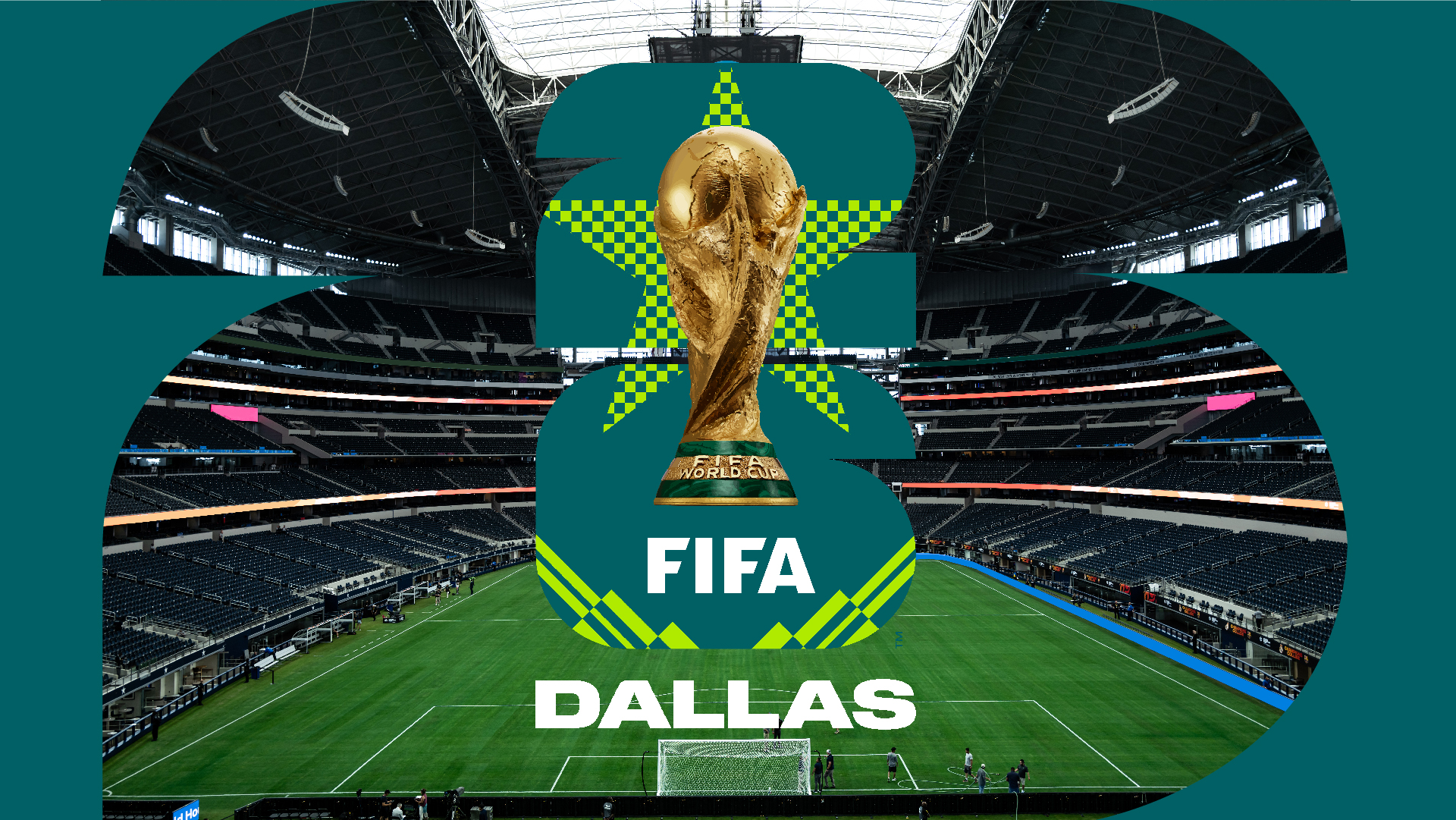
FIFA's International Broadcast Center for the 2026 World Cup is housed at the Kay Bailey Hutchison Convention Center in Dallas, spanning 485,000 square feet and serving approximately 2,000 broadcast media professionals. Verizon's Broadcast Contribution Network carries roughly 7 terabits per second of data from all 16 venues back to Dallas, where Host Broadcast Services deploys 45 cameras per match across all 104 fixtures. Dallas was chosen for its central geographic position across the three-nation tournament footprint spanning Canada, Mexico, and the United States.
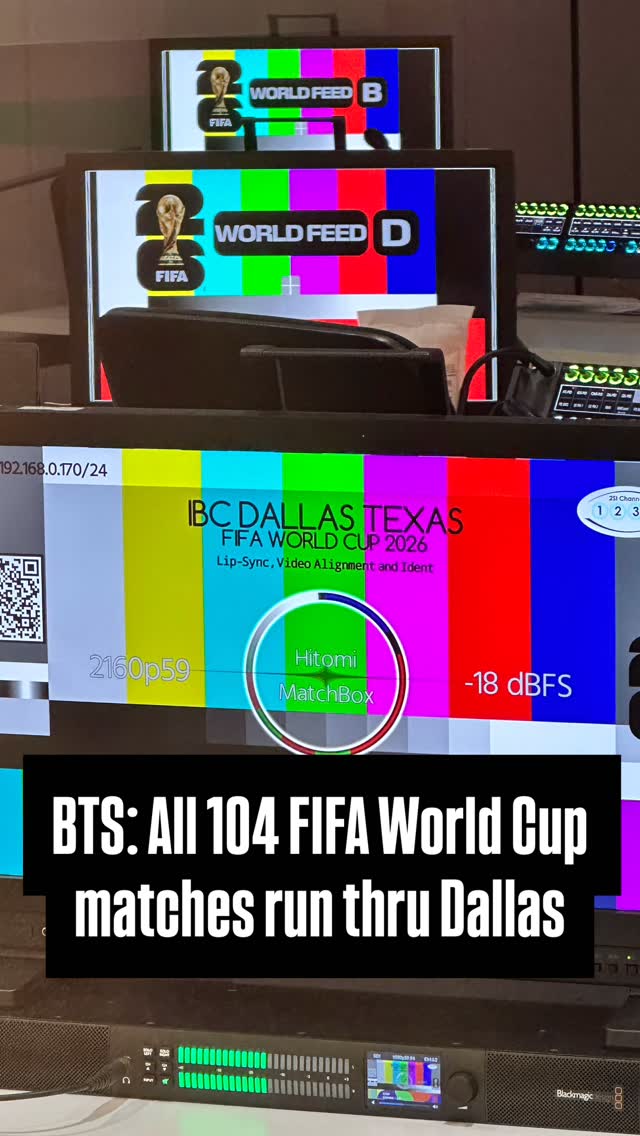
Key Points
- Verizon's Broadcast Contribution Network carries approximately 7 terabits per second of data from 16 venues to the Dallas IBC, with five-second latency from stadium to control room.
- HBS deploys 45 cameras per match across all 104 World Cup fixtures, including RefCams, 360-degree cameras, cablecams, and what senior producer Paul King calls 'digital-first devices' that may include iPhones.
- Dallas is hosting the IBC for the second time, having also served as the broadcast hub during the 1994 FIFA World Cup USA, and is playing more World Cup matches than any other single host site at nine games.
Every goal at the 2026 World Cup, all 104 matches across 16 stadiums in three countries, passes through one room in downtown Dallas before it reaches a single television on Earth. The room is inside the Kay Bailey Hutchison Convention Center, it spans 485,000 square feet, and for the length of the tournament it is the most consequential piece of real estate in sports. The matches happen in Kansas City and Mexico City and Toronto. The World Cup, the one billions of people actually watch, happens in Dallas.
This is the part of the tournament nobody buys a ticket to and everybody depends on.
Why Every Match Routes Through One Texas Room
FIFA''s International Broadcast Center is the central nervous system of the World Cup. Every camera at every venue feeds back to this single facility, where the host feed is assembled and then distributed outward to the world. The 2026 IBC occupies 45,000 square meters at the Kay Bailey Hutchison Convention Center and runs from January through the end of July, a six month occupation of a building that normally hosts trade shows.
The centralization is the whole design. Rather than 16 stadiums each producing and distributing their own coverage, every venue sends its raw feeds to Dallas, where Host Broadcast Services builds the unified broadcast and the centralized Video Assistant Referee room makes the calls that decide matches. One room generates the pictures. One room makes the decisions. Both are in Dallas.
Verizon Is Moving 7 Terabits Per Second
The number that makes this possible is 7 terabits per second. That is the volume of data Verizon''s Broadcast Contribution Network carries from all 16 host venues back to the Dallas IBC, running on 64 separate 100 gigabit wave circuits. The infrastructure uses SMPTE ST 2110 transport with JPEG XS compression to hold latency to roughly five seconds from the stadium to the control room.
Five seconds is the figure that matters for the viewer. A referee in Kansas City makes a call, the feed travels to Dallas, the VAR room reviews it, and the decision returns, all inside a window short enough that the broadcast never feels remote. The fiber is invisible to the audience and it is the only reason the tournament looks live. Cross reference. Porsche has been selling the idea that the best infrastructure disappears into the experience. The Dallas IBC is that principle at national scale. Nobody watching a match thinks about the 7 terabits. That is the point.
45 Cameras Per Match, Including iPhones
Host Broadcast Services is deploying 45 cameras per match across all 104 fixtures. The rig includes polecams, cablecams, RefCams mounted on officials, cine style cameras, 360 degree cameras, and what HBS senior producer Paul King calls digital first devices, which may include iPhones. The camera count per game is among the largest ever assembled for a sporting event, and every one of those angles routes back to Dallas.
The mix is the interesting part. A RefCam puts the viewer inside the decision. A 360 degree camera lets every broadcaster build its own angle. The digital first devices acknowledge that the way people watch in 2026 is not the way they watched in 2014, and the host feed has to serve a phone screen as seriously as a living room television. The infrastructure is built for an audience that watches everywhere at once.
Dallas Has Done This Before
This is not Dallas''s first World Cup broadcast center. The city served as the broadcast hub for the 1994 FIFA World Cup as well, which makes the 2026 IBC a return rather than a debut. Dallas is also playing more World Cup matches than any other single host site, with nine games scheduled, anchored by the AT&T Stadium infrastructure nearby. The city that routes the tournament to the world is also hosting more of it than anyone else.
That dual role is why Texas has been a focal point of the whole 2026 cycle. Cross reference. Adidas brought its own heat to Texas as a key host market activation. The brand activations chase the audience. The broadcast center is where the audience actually gets the tournament. Both roads run through Texas.
The 180 Broadcasters on the Other End
The Dallas feed distributes to 180 broadcasters covering more than 200 countries. Fox Sports works from Los Angeles, Telemundo from Miami, the BBC and ITV from London, and every one of them pulls from the HBS core feed generated in Dallas. The local broadcast you watch, in your language with your commentators, is a customized wrapper around a picture that was built in a Texas convention center.
That is the quiet power of the IBC. The feeds that carry the Messi farewell the entire sport is watching to every country on Earth originate in one room. The aura travels on Verizon fiber. The goodbye is rendered in JPEG XS. The most emotional tournament in recent memory reaches the world through the most technical room in sports.
What It Means for How We Watch
Three things to track. Whether the five second latency holds across the knockout rounds when the stakes and the audience peak. Whether the digital first camera devices change what the host feed looks like for phone viewers. And whether the centralized model, one room for 104 matches, becomes the permanent template for how mega events are broadcast.
The matches are spread across a continent. The World Cup is assembled in Dallas. For 39 days, a convention center is not hosting a convention. It is hosting the tournament, for everyone who is not in the stadium.
Frequently Asked Questions
Where is the FIFA World Cup 2026 International Broadcast Center located?
The FIFA World Cup 2026 International Broadcast Center is located at the Kay Bailey Hutchison Convention Center in downtown Dallas, Texas. The facility spans 45,000 square meters (485,000 square feet) and operates from January through the end of July 2026.
How does Verizon connect World Cup venues to the Dallas IBC?
Verizon powers the FIFA Broadcast Contribution Network (BCN) using high-capacity fiber and wave services, carrying approximately 7 terabits per second of data from all 16 host venues to the Dallas IBC. The infrastructure uses JPEG-XS compression to achieve five-second latency from stadium to control room.
How many cameras are used per World Cup 2026 match?
Host Broadcast Services deploys 45 cameras per match across all 104 fixtures, including polecams, cablecams, RefCams, cine-style cameras, 360-degree cameras, and what HBS senior producer Paul King calls 'digital-first devices.'
Who controls the VAR room for the 2026 World Cup?
The centralized Video Assistant Referee (VAR) room is housed inside the Dallas IBC at the Kay Bailey Hutchison Convention Center, operated as part of FIFA's Football Technology and Innovation Department infrastructure.
How many broadcasters receive World Cup 2026 feeds from Dallas?
The Dallas IBC distributes match feeds to 180 broadcasters worldwide, covering over 200 countries. Fox Sports operates from Los Angeles, Telemundo from Miami, and the BBC and ITV from London, all pulling from the HBS core feed generated in Dallas.
Topics: world-cup, broadcast-infrastructure, porsche, verizon, dallas, world cup, international-broadcast-center, adidas, hbs, sports-tech, fifa-world-cup-2026, world-cup-broadcast