Why Cars and Skiing Have Always Needed Each Other
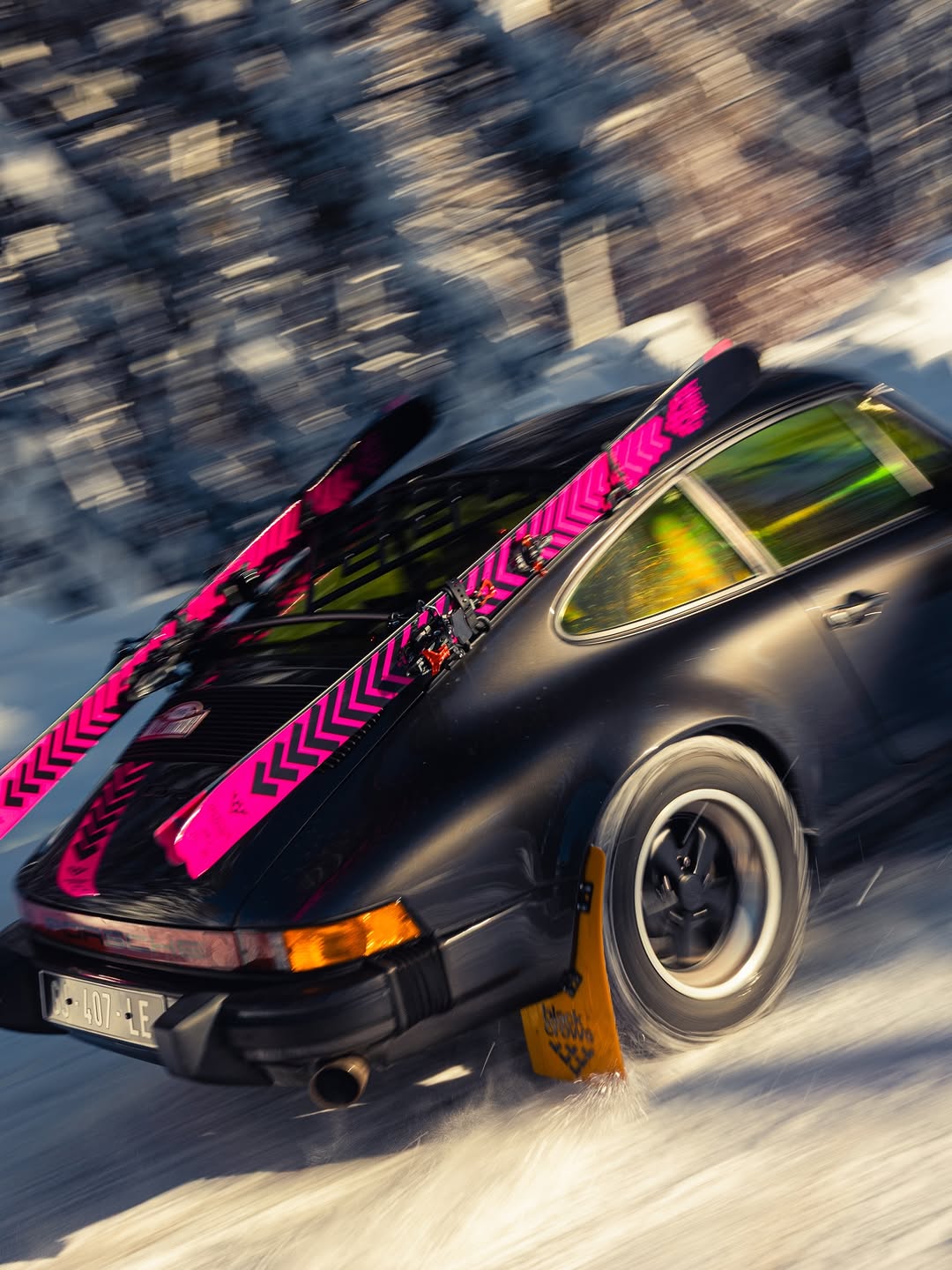
Type7 magazine documents the postwar decade when skiing and automobiles became culturally inseparable in Europe. Hans Truöl's 1960 photograph Der Sprung, showing a Porsche 356 in Alpine snow with Olympic skier Egon Zimmermann airborne above it, exemplifies the visual code that formed when both sports cars and alpine skiing were accessible only to a small privileged demographic. Lancia introduced the first production V6 with the Aurelia in 1950, the same year Ferrari began road car production.

Key Points
- Hans Truöl's Der Sprung (1960) shows a Porsche 356 in Alpine snow with Olympian Egon Zimmermann airborne above it.
- Lancia introduced the first production V6 engine with the Aurelia in 1950 — the same year Ferrari began road car production.
- Type7 is a Porsche-powered publication covering automotive, art, and collector culture through their alpine and motorsport archive.
The 1960 photograph known as Der Sprung shows a 1960 Porsche 356 in a canyon of snow with Olympic skier Egon Zimmermann airborne directly above it. The image was taken by Hans Truöl in the Austrian Alps. It ran in European motor and sporting press and has been reprinted in automotive culture contexts for sixty years since.
This is the image that Type7 is referencing when it argues that cars and skiing have been linked since winter sports became a mass aspiration in the 1950s. The argument is correct. And the reason it is correct is not about shared aesthetics.
1950: Skiing Was a Privilege, and So Was a Car That Could Get You There
The Alps in 1950 were not accessible by commercial ski infrastructure in the way they would become by 1975. There were no standardized lift systems across most resorts. There were no purpose-built ski motorways. Getting to Kitzbühel or Gstaad or Verbier required a car that could perform in winter conditions, which in 1950 meant a car from a class of owner who had already made financial decisions that most of the postwar European population had not yet been asked to make.
Lancia's Aurelia, introduced in 1950, was at the time the most technically sophisticated production car in Europe. Its V6 engine was the first production V6 in automotive history. The Aurelia's buyers were the same demographic that skied at altitude before skiing became reachable by train. Ferrari entered the road car market the same year. The Lancia D50 Formula One car was transferred to Ferrari in 1955, and a version of it won the 1956 World Championship with Juan Manuel Fangio.
None of these cars were built for skiing. But their owners were the people who skied first, and the machinery moved together because the owners moved together.
Der Sprung and the Architecture of the Image
Hans Truöl's Der Sprung works as an image because it makes the impossible read as comfortable. A Porsche 356 in snow at that altitude in 1960 is not a natural occurrence. Zimmermann airborne above it adds human scale to machine scale. The composition reads as spontaneous and was almost certainly not.
Type7, the Porsche-powered magazine that covers automotive culture alongside art, architecture, and collector culture, has documented this intersection across its editorial archive. Its photographers, including Lorenzo Kikisch who has shot Le Mans racers in the Alps and Porsche Cayenne Transsyberia vehicles in the Austrian mountains, continue working in this visual language.
The language persists because the underlying status equation persists. A car that can reach an alpine resort in winter remains a specific object. The 2026 Alpine GT3 that laps Spa before its owner drives it to Zermatt the following weekend is a direct descendant of the social role played by the Aurelia in 1952.
What Type7 Is Actually Documenting
Type7 began as a Porsche-adjacent publication and has expanded its scope without losing its original precision. The magazine documents collector culture at the junction of automotive excellence and the broader lifestyle that high-performance machinery has historically implied. Skiing enters that editorial frame not as a sport but as a location marker.
The resort is where the car arrives. The car is how you arrive at the resort. The photograph of Der Sprung is famous not because Zimmermann is a great skier, which he was, having competed at the 1960 Winter Olympics, but because the composition makes the car and the skier equivalent. Both are performance objects in an alpine environment. Both require significant investment to operate at this level. Both signal the same thing about the person in or around them.
The 1950s Established a Visual Code That Type7 Still Runs
By the time skiing became a mass leisure activity in the 1970s and 1980s, the visual code of cars and snow had already been set. Lancia, Ferrari, Porsche, and BMW had all appeared in the alpine context. The aspirational image of a rear-engined coupe outside a chalet had been established in European print media across the 1950s and 1960s before it became template content for automotive advertising in the 1970s.
Type7's editorial on this moment is not nostalgia. It is institutional memory. The publication documents the specific period when automobiles and winter sports were equally privileged, equally inaccessible, and equally photogenic. That period ran from approximately 1948 to 1972, and its visual output is still producing reference material seventy years later.
Related Reading
- SCHUPPAN 962CR FAILED SUPERCAR PROJECT RESURFACES IN DESIGN STUDY
- TYPE7 MADE CAR PHOTOGRAPHY A DESIGN MOVEMENT
- TYPE7 SPOTLIGHTS INNOVATIVE MEXICAN ARCHITECTURE PROJECT
Related: LACOSTE HIDES 290 CROCODILES INSIDE ONE ALPINE RALLY CAR.
Frequently Asked Questions
What is Der Sprung?
Der Sprung is a 1960 photograph by Hans Truöl showing a Porsche 356 in Alpine snow with Olympic skier Egon Zimmermann airborne above it. It has been reprinted in automotive culture contexts for over sixty years.
What is Type7 magazine?
Type7 is a Porsche-powered publication covering automotive culture alongside art, architecture, and collector culture, known for documenting alpine automotive photography.
When did cars and skiing become culturally linked?
The connection solidified in the postwar 1950s, when both automobiles and alpine skiing were accessible only to a privileged demographic in Europe, creating a shared visual and social identity.
Topics: der-sprung, skiing, type7, collector, design, ferrari, focus-57-80, automotive-culture, porsche, alpine