META NEURAL BAND READS WRIST SIGNALS, NOT YOUR MIND
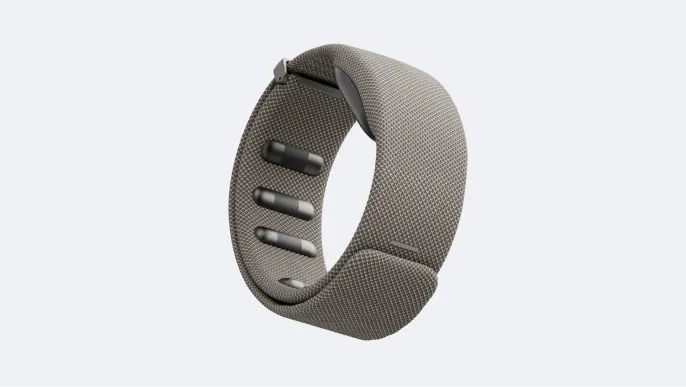
The Meta Neural Band is a surface electromyography wristband that controls the Meta Ray Ban Display glasses by reading forearm muscle signals. Meta's Nature paper measured handwriting at 20.9 words per minute, while Zuckerberg claimed about 30 words a minute on stage on September 17, 2025. The band descends from CTRL labs, announced as a Facebook purchase on September 23, 2019, and launched September 30, 2025 in the $799 glasses bundle, with a $199 replacement through customer service only.
Key Points
- Meta's Nature paper, published July 23, 2025, measured the band's handwriting at 20.9 words per minute, against roughly 36 on a phone keyboard.
- Zuckerberg said on September 17, 2025 that he was up to about 30 words a minute on the band, a stage remark rather than a measured result.
- The band launched September 30, 2025 in the $799 Ray Ban Display bundle, six years after the CTRL labs purchase was announced, and a replacement costs $199 through customer service only.
The Meta Neural Band wristband reads muscles, not minds, and Meta's own Nature paper measured its handwriting at 20.9 words per minute in closed loop testing. On September 17, 2025, Mark Zuckerberg told the Connect audience the band picks up "signals from your brain" and then said he had reached about 30 words a minute on it. The band went on sale 13 days later, September 30, 2025, inside the Meta Ray Ban Display glasses, six years after Facebook announced it would buy the startup CTRL labs.
The retail version is a muscle sensor rated IPX7 for water resistance with up to 18 hours of battery, and Meta says all processing of raw EMG data happens on the device.
Zuckerberg Said Brain, Meta's Paper Measured the Wrist
Meta's Nature paper, published July 23, 2025, describes a wristband that records surface electromyography, the electrical signals muscles produce, and decodes them with models trained on data from thousands of consenting participants. The authors report that the models work across people without personal calibration, and that personalizing them lifts handwriting performance by 16 percent.
The Register set the paper's 20.9 words per minute against roughly 36 on a phone keyboard and more than 40 for a proficient typist. At Connect in Menlo Park, California, Zuckerberg said, "We are replacing the keyboard, mouse, touch, screen, buttons, dials, with the ability to send signals from your brain with little muscle movements that the neural band will pick up, so you can silently control your glasses with barely perceptible movements," as NBC News reported. He also said, "I'm up to about 30 words a minute on this." The paper's 20.9 is a measured closed loop result for handwriting; the 30 was a stage remark about typing out a text message, so the two numbers come from different tasks.
GOAT, 2048 and Handwriting Arrived After the Box Shipped
Meta opened neural handwriting to Early Access owners of the Display glasses on January 6, 2026, limited to the United States and English. The wearer writes with a finger on any surface and the band turns the movement into messages for WhatsApp and Messenger.
The glasses' first major software update followed on March 13, 2026, according to UploadVR. Reels, four widgets, GOAT and 2048 all came in the March 2026 update to the display, with a thumb swipe along the index finger to scroll Reels, a double tap to like, and a pinch to make the goat jump. At CES in January 2026 Meta also showed a proof of concept with Garmin that reads thumb, index and middle finger gestures to run an in car interface, and announced research with the University of Utah on steering the TetraSki mobility device with band gestures.
Meta's developer recap of Connect 2026, held September 23 and 24, says web apps on the display can now read wrist motion from the band, and that the Wearables Device Access Toolkit reached version 1.0 after a year in preview.
Six Years From the CTRL labs Deal to a Retail Box
Facebook announced on September 23, 2019 that it would acquire CTRL labs, and Bloomberg reported a price between $500 million and $1 billion that Facebook did not disclose. Thomas Reardon, the former Microsoft Internet Explorer architect who cofounded the company in 2015 with Columbia neuroscientists, is now a lead author with Patrick Kaifosh on the Nature paper.
Andrew Bosworth, then head of Facebook's augmented and virtual reality unit, wrote in announcing the deal, "We know there are more natural, intuitive ways to interact with devices and technology." UploadVR noted that the hardware in the Nature paper strongly resembles a prototype first shown in 2021, which leaves four years between that first look and the retail box, and six between the purchase and the shelf.
Standalone Sales Were Ruled Out and Replacements Run 25 Percent of the Glasses
NBC News reported that Zuckerberg said at Connect on September 17, 2025 that the wristband would not be sold on its own, only with the glasses. The Meta Ray Ban Display with Meta Neural Band went on sale September 30, 2025 for $799 at Best Buy, LensCrafters, Sunglass Hut, Ray Ban Stores and Meta Lab.
A replacement band costs $199, exactly 25 percent of the glasses' price, and is available through customer service only, The Tech Buzz reported on October 30, 2025, after support had first told buyers replacements were unavailable. Meta spokesperson Tyler Yee said replacements apply to cases outside the limited warranty.
Meta paused planned early 2026 expansion of the glasses to the UK, France, Italy and Canada in January, citing demand and limited inventory. On September 23, 2026 Engadget reported the glasses available in the UK at 749 pounds and in Canada at 1,149 Canadian dollars, with Germany, France and Italy at 899 euros and availability on October 13.
Meta's VR Glasses Launched Without a Wristband
Meta's VR Glasses, unveiled September 23, 2026 for a spring 2027 release at $1,300, take hand tracking, eye tracking and voice as inputs and ship without controllers. Road to VR adds that Touch Plus controllers are sold separately, and Engadget's rundown of the headset names no wristband.
At about 100 grams on the head, Meta's 100 gram VR Glasses move the compute into a separate puck of about 300 grams, according to Road to VR. For now the band's only retail home is a pair of $799 glasses, and its best measured text speed is 20.9 words per minute against the 30 its CEO claimed on stage.
Frequently Asked Questions
What is the Meta Neural Band?
The Meta Neural Band is a wristband from Meta that reads electrical signals from forearm muscles using surface electromyography and turns them into gestures that control the Meta Ray Ban Display glasses.
Does the Meta Neural Band read your brain?
No. It records muscle activity at the wrist and forearm with sEMG and needs no implant, although Zuckerberg described it on September 17, 2025 as sending signals from your brain with little muscle movements.
How fast can you write with the Meta Neural Band?
Meta's Nature paper measured handwriting at 20.9 words per minute in closed loop testing. Zuckerberg said on stage he was up to about 30 words a minute, a remark that was not a measured result.
How much does a replacement Meta Neural Band cost?
A replacement costs $199, exactly 25 percent of the $799 glasses bundle, and is available through customer service only, The Tech Buzz reported on October 30, 2025.
Can you buy the Meta Neural Band on its own?
No. NBC News reported that Zuckerberg said at Connect on September 17, 2025 that the band would be sold only together with the glasses, which went on sale September 30, 2025.
Where did the Meta Neural Band technology come from?
It came from CTRL labs, a startup Facebook announced it would acquire on September 23, 2019, in a deal Bloomberg priced between $500 million and $1 billion.
Topics: garmin, ray-ban, engadget, ctrl-labs, electromyography, ray-ban-display, microsoft, ray-ban-meta, ray-ban meta, smart-glasses, meta, wearable-tech, meta-neural-band, ai-hardware, mark zuckerberg, mark-zuckerberg