TORONTO FLOATED A CORNER STORE ON LAKE ONTARIO
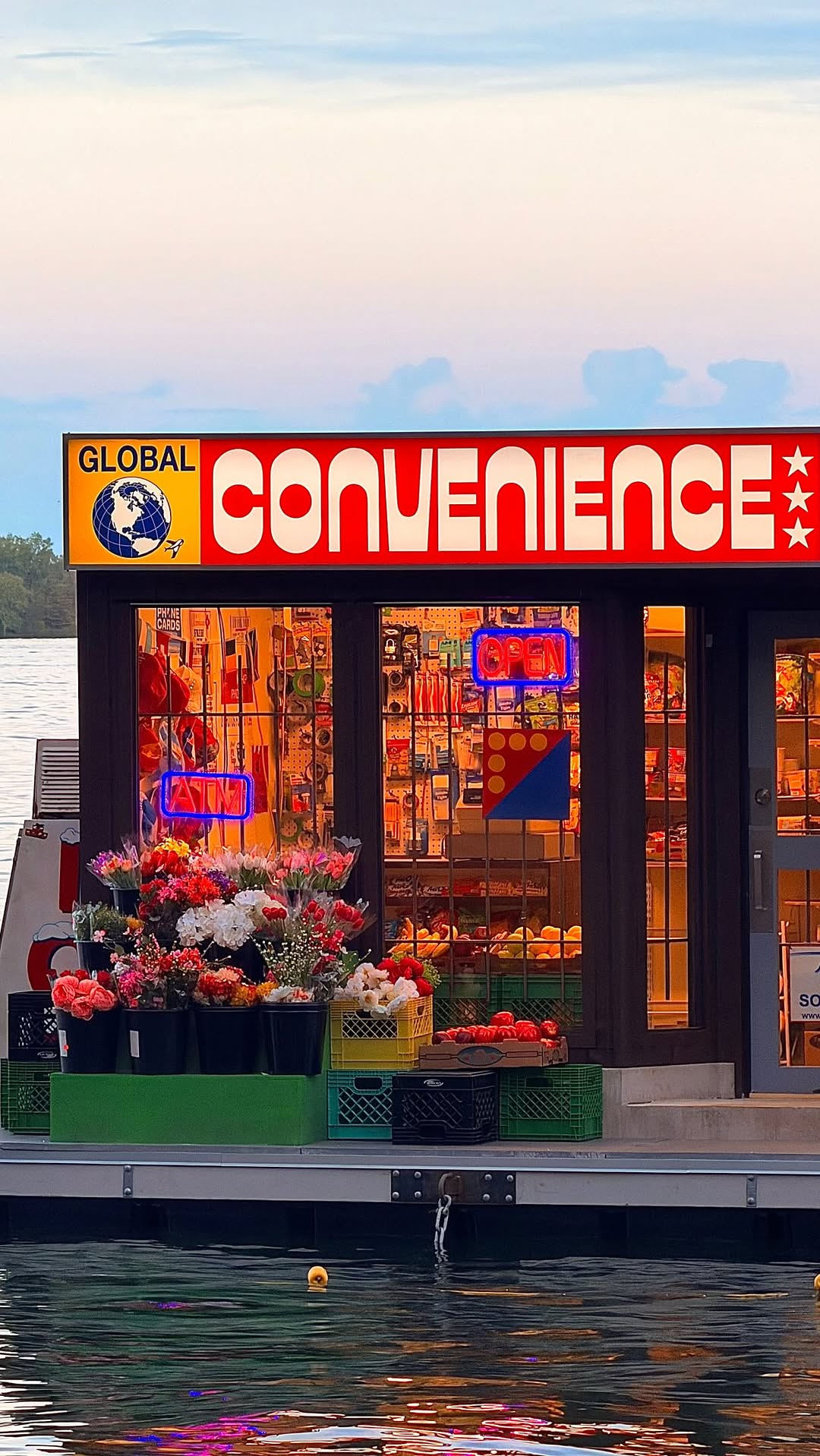
Global Convenience is a public art installation by TF Dean Studio and Puncture Design Studio, selected through Waterfront Toronto's 2026 Floating Public Art program and moored at Harbour Square Park Basin. The installation replicates a fully stocked neighborhood convenience store and is the sixth floating artwork at the site since 2019. It is inaccessible from shore, using physical distance to reframe an ordinary object as a monument to migration and daily urban ritual.
Key Points
- Global Convenience is the 6th floating artwork at Harbour Square Park Basin since Waterfront Toronto launched in 2019.
- TF Dean Studio and Puncture Design Studio built the structure to explore themes of arrival, daily ritual, and migration.
- The store is fully stocked and visible from shore but sits 30 feet offshore and is not accessible to visitors.
Harbour Square Park Basin, Toronto. A fully stocked corner store floats 30 feet offshore on Lake Ontario. Fluorescent signage, product shelves, chip racks visible from the waterfront path. Nothing is moving toward you. You cannot reach it.
The piece is called Global Convenience. Trevor Wheatley and Cosmo Dean of TF Dean Studio built it alongside Rashad Maharaj and Spencer Cathcart of Puncture Design Studio. Waterfront Toronto selected it through an open call competition as the sixth floating artwork at Harbour Square Park Basin since the Floating Public Art program launched in 2019.
You cannot shop there. That is the whole argument.
Every City Has This Store
The corner store is the most universally recognized piece of architecture on earth. The dépanneur in Montreal. The bodega in New York. The konbini in Tokyo. The tienda in Bogotá. Four Toronto artists looked at that fact and floated one offshore where it would be seen but never entered.
TF Dean Studio and Puncture Design drew inspiration from community markets across Toronto and global cities to examine themes of arrival, daily ritual, and migration. Those are abstract nouns for a very concrete fact: the convenience store is the spatial signature of newcomers. Migrants open them. Working families sustain them. The irregular hours, the handwritten price tags, six discontinued sodas and one brand of cigarettes: cultural artifacts from the same archive as church programs and faded team pennants.
Making it unreachable turns an ordinary object into a monument. The chips are there. You cannot buy them. That gap is the piece.
Six Commissions, Seven Years, One Open Call
Waterfront Toronto launched its Floating Public Art program seven years ago, and Global Convenience is its sixth commission. The structure sits at Harbour Square Park Basin, where the Toronto shoreline meets Lake Ontario proper.
Six commissions across seven years is a patient pace. The global default for public art procurement is a branded sculpture in a plaza, selected by committee to offend nobody. Running an open call competition for floated structures is, in the context of institutional art programming, an outlier. That a team used the opportunity to commission something explicitly tied to immigration and everyday working life says something about what the city wants to declare about itself in 2026.
FO covered Rei Kawakubo's window installation for Comme des Garçons in São Paulo this month, where she compressed an entire cultural argument into a single retail frame. Global Convenience operates from the opposite direction: not abstracting commerce but literalizing it until the recognizable becomes strange.
30 Feet of Water Is the Entire Review
Inaccessibility is the content. A floating convenience store you could actually reach would be a boat bar with overpriced drinks. Placing it offshore, visible but untouchable, removes the product from any transaction and forces the object to mean something outside of use.
This is not new territory for art. Marcel Duchamp removed a urinal from its function in 1917 and it became one of the most discussed objects in the twentieth century. The difference with Global Convenience is scale, community specificity, and the choice of object. A convenience store is not neutral. It carries the history of whoever opened it, whatever block it stood on, and whoever came through the door at 2 AM for milk and a lottery ticket. Those histories are invisible in the original context. Made inaccessible and floated on a lake, they become the only thing you can see.
Joshua Vides opens his permanent installation at the Petersen Automotive Museum on June 21, and the parallel is exact: an object coded to a specific community placed somewhere that demands a longer look than the original context allowed.The Corner Store Knows Where Culture Is Going
The convenience store has been romanticized in hip hop since the early 2000s, appeared on streetwear mood boards as neighborhood authenticity shorthand, and occupied gentrification discourse in New York for over a decade. It has been mourned, fetishized, and turned into marketing.
Global Convenience does none of that. It floats there. It is stocked like the real thing. You cannot enter. The Waterfront Toronto program will keep it at Harbour Square Park Basin through the duration of the installation period.
Wheatley, Dean, Maharaj, and Cathcart did not make a metaphor about migration. They built a store, put it on water, and let the water explain it. Go look. The unreachable chips are already doing the work.
Frequently Asked Questions
What is Global Convenience in Toronto?
Global Convenience is a public art installation built to look like a fully stocked corner store, floating at Harbour Square Park Basin on Lake Ontario. Created by TF Dean Studio and Puncture Design Studio, it is part of Waterfront Toronto's 2026 Floating Public Art program.
Who made the Global Convenience art installation?
Trevor Wheatley and Cosmo Dean of TF Dean Studio created it alongside Rashad Maharaj and Spencer Cathcart of Puncture Design Studio, selected via an open call competition in 2026.
Can you actually shop at the floating convenience store in Toronto?
No. The store is fully stocked but sits 30 feet offshore and is not accessible from land. It is designed to be viewed from the waterfront path, not entered.
Where is the floating convenience store in Toronto?
It is moored at Harbour Square Park Basin on the Toronto waterfront, where the shoreline meets Lake Ontario.
How many floating artworks has Waterfront Toronto commissioned?
Global Convenience is the sixth floating artwork at Harbour Square Park Basin since the program launched in 2019, seven years ago.
Topics: toronto, art-installation, global-convenience, waterfront-toronto, public-art, culture, comme-des-garons, puncture-design-studio, comme des garçons, lake-ontario, canada, tf-dean-studio