A.P.C. FRGMT INTERACTION #30 IS A DENIM ARCHIVE IN TWO NAMES
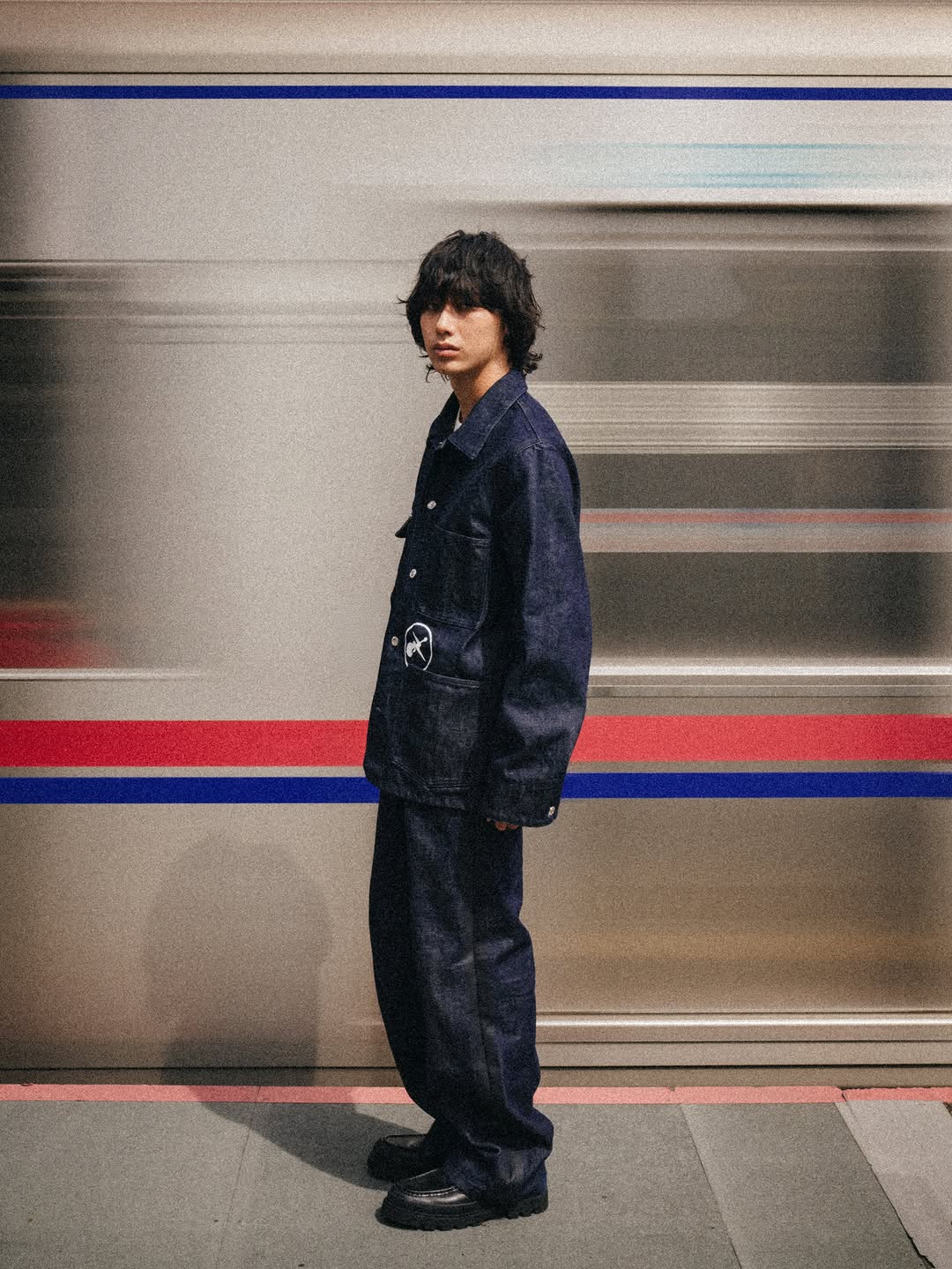
A.P.C. and Fragment Design's 30th Interaction drops a Canadian tuxedo referencing Chaplin, Paul Newman, and two initials embroidered on poplin.


The denim in this jacket references twelve workers from a 1936 film. That is the opening fact of A.P.C. FRGMT Interaction #30, the thirtieth entry in A.P.C.'s ongoing collaboration series and the first time Jean Touitou and Hiroshi Fujiwara have made clothes together.
They have known each other a long time. Touitou founded A.P.C. in Paris in 1987. Fujiwara built Fragment Design in Tokyo and earned a designation no one disputes: the godfather of Harajuku. Between them, they have decades of parallel credibility in fashion and music. What they had never done, until a conversation in a kitchen on Rue Madame, was make a garment.
Chaplin's Models. Twelve Silhouettes From Modern Times.
The work jacket in this collection was not designed from scratch. It was designed from documentation. Touitou and Fujiwara pulled twelve workers from Charlie Chaplin's 1936 film Modern Times and studied the jackets those men wore. Each one is a data point in a specific silhouette vocabulary: the way a lapel sits on a working body, how a pocket is positioned for function rather than ornament, where the seam falls at the shoulder when a jacket is made for movement.
That is not nostalgia. That is pattern research conducted through cinema because the original garments no longer exist in accessible form. The film is the archive.
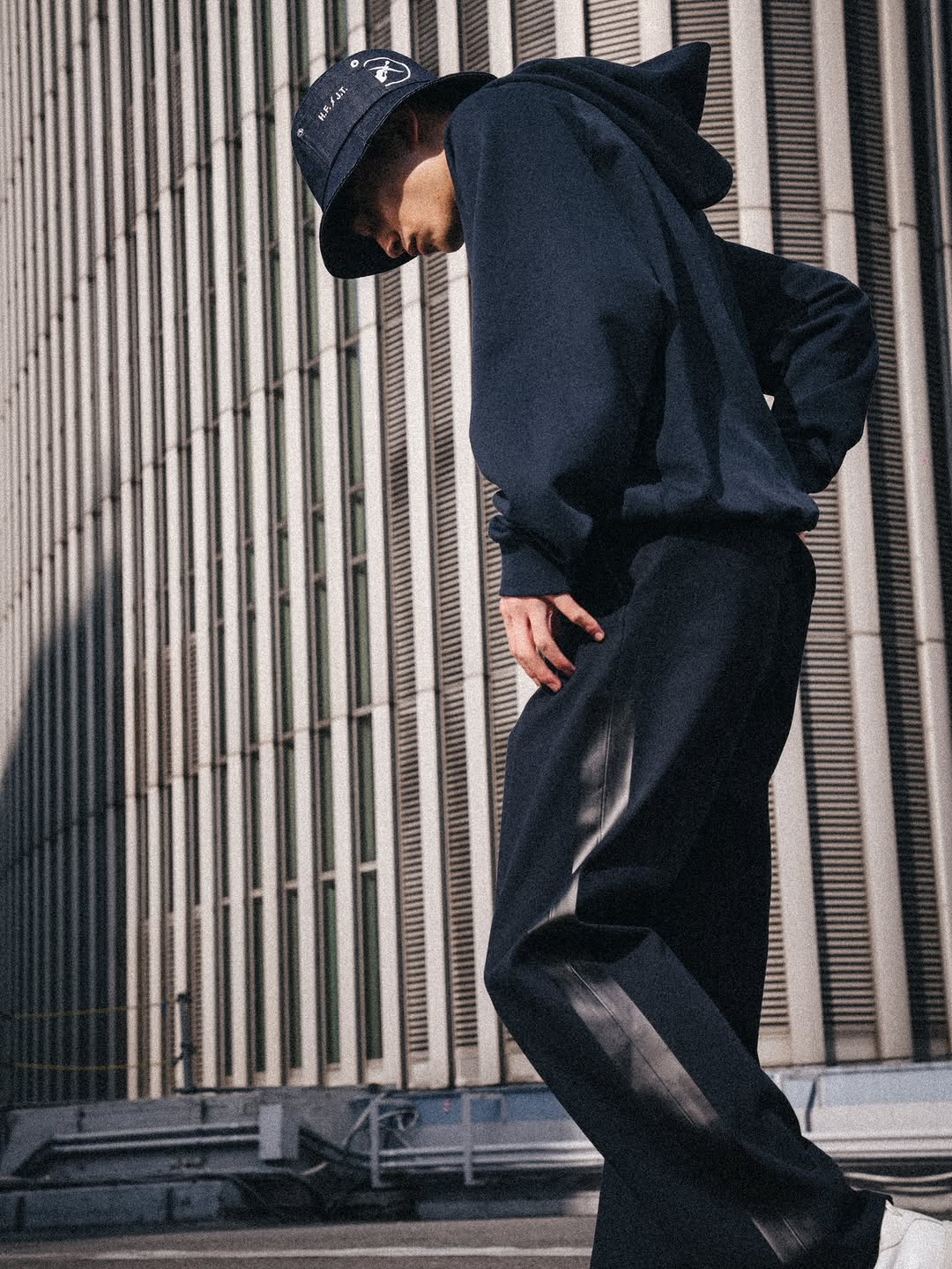
The jeans carry a second film reference. The rubber stripe running along the outer seam and the inner cuff detail both trace back to Paul Newman in Cool Hand Luke, released in 1967. Newman's denim in that film is not styled. It is worn. The garment exists in functional relationship to the body wearing it, which is exactly the condition A.P.C.'s denim philosophy has always aimed at. The collection does not quote these films decoratively. It reads them as technical sources.
Jean Touitou and Hiroshi Fujiwara Have Known Each Other for Decades
The collection was conceived in the kitchen at Rue Madame, A.P.C.'s Paris headquarters address. That specific location matters because the kitchen is not the studio. It is where the constraints of formal design presentation do not apply, where two people who trust each other's judgment can work through a problem without a brand brief in the room.
Fujiwara's history runs parallel to Touitou's in ways that made the conversation possible. He is a DJ and producer who built Fragment Design around the same instinct that built A.P.C.: that taste is structural, not decorative. Fragment's collaborations with Nike, Levi's, and The Beatles all follow a logic of constraint and precision rather than volume and visibility. Fujiwara understands what Touitou understands: that a good object is better than a loud one.
This is the first time that shared understanding produced actual clothing. Prior collaboration between the two was in music. Interaction #30 is where the conversation finally became wearable.
The Slash Between A.P.C. and FRGMT Is the Design Brief
The combined logo for this collection is a slash. A.P.C. on the left, FRGMT on the right, connected by a forward stroke that does not subordinate either name to the other. Touitou and Fujiwara cite the Supports/Surfaces art movement as a reference point, the late 1960s French movement that deconstructed form and material and then reconstructed them as the subject of the work itself.
The slash is doing the same thing. It is not a co-branding solution. It is a statement about the relationship between the two entities: adjacent, connected, distinct. The guitar and dagger emblem that belongs to A.P.C.'s visual history has been redrawn for this collection with Fragment's lightning bolt replacing one element. The result is a symbol that could only exist as this specific combination. Neither brand owns it independently.
The Canadian tuxedo anchors the silhouette. Denim jacket plus denim jeans is a complete look, democratic in origin and cinematic in the way Touitou and Fujiwara have built it here: references stacked from Modern Times to Cool Hand Luke, the work jacket to the outer seam stripe. The outfit reads as casual. The construction reads as deliberate.
Poplin, Rubber, and Initials That Are Not for Sale
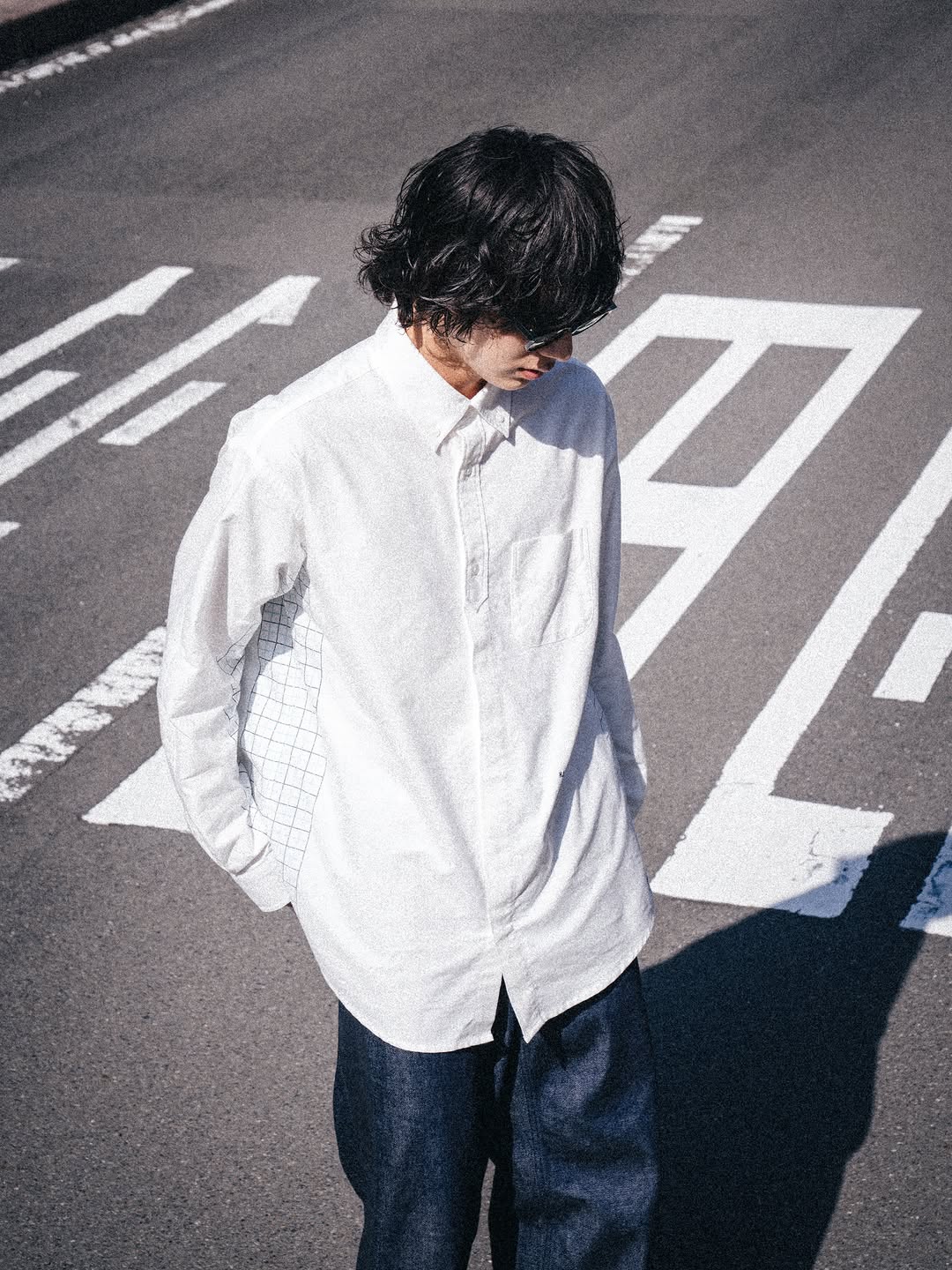
The capsule's third piece is a white poplin shirt with checked side panels. Embroidered on the shirt are two sets of initials: H.F. for Hiroshi Fujiwara, J.T. for Jean Touitou. Not for the customer. For the two people who made the collection, signing the work the way a painter signs a canvas, in a location that will sit against the body of whoever wears it.
That detail is not marketing. It is the most personal object in the collection and also the quietest one. The checked panels interrupt the poplin's field without announcing themselves from across the room. The initials are embroidered, not printed. This shirt exists at the furthest remove from the visibility logic of most collaboration merchandise.
The full capsule is available now in-store and online worldwide. Photography and video by @rkrkrk, whose visual identity for the collection matches its discipline: close to the fabric, direct on the construction, no atmosphere that the garments don't earn.
For the broader A.P.C. collaboration series, Interaction #29 with Brain Dead brought Japanese milk glass to a coffee mug and Japanese craft accessories to the lineup. Interaction #30 moves in a different direction: apparel first, archive-sourced, made by two people who have been circling this project for decades. Fragment Design's reach into other categories is documented elsewhere at FO, including the Bang & Olufsen Beosystem 9000C, a $55,000 CD system that shares the same precision-object logic as this denim capsule.
Buy, Skip, or Wait on A.P.C. x FRGMT Interaction #30
Buy the work jacket if you have been waiting for a denim piece with actual construction research behind it. The Chaplin documentation is not a story for the lookbook. It shaped the silhouette. That is worth the premium over a standard A.P.C. trucker.
Buy the shirt if you want the quietest piece in the collection. The poplin is a daily-wear object with a level of specificity that will not announce itself until someone looks closely.
Skip if you need the logo visible at distance. The slash is subtle. Fragment's lightning bolt on the guitar-and-dagger emblem rewards attention, but it does not perform from across the room.
Wait if you are watching the jeans. The rubber outer-seam stripe and the Newman inner-cuff reference are the most distinctive construction details in the collection, and A.P.C. denim at this tier has a track record of either selling through or restocking. The Dover Street Market LA activation is adjacent context: the same design-serious retail environment where this capsule will perform. If it is there, that is the right place to see it in person before committing.
Topics: Fragment Design, bang & olufsen, Paul Newman, Chaplin, collaboration, Hiroshi Fujiwara, Jean Touitou, Interaction 30, denim, Canadian tuxedo, brain-dead, bang-olufsen, brain dead, A.P.C., nike