Why Supreme x Juelz Santana Is Bigger Than You Think
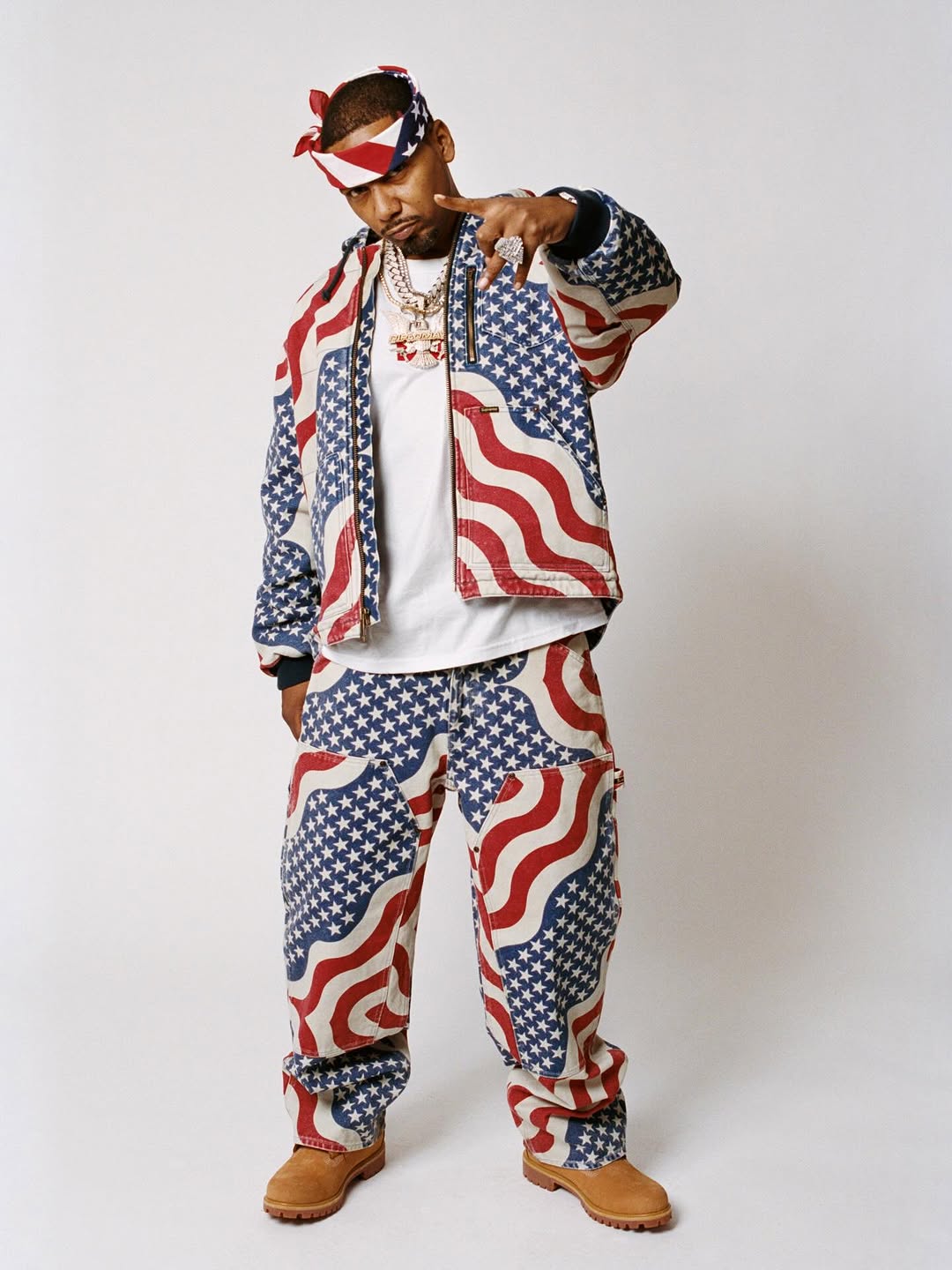
Supreme enlisted Juelz Santana for its SS26 Week 5 campaign, photographed by Ari Marcopoulos. The shoot features the brands Flag Quilted Hooded Work Jacket and Painter Pants in an American flag print that mirrors the cover of Santanas 2003 debut album Final Destination. Marcopoulos has documented Supreme since 1994, making this campaign a convergence of hip-hop archive, streetwear history, and New York visual culture.
Key Points
- Supreme SS26 Week 5 features Juelz Santana in Flag quilted workwear, shot by longtime Supreme photographer Ari Marcopoulos
- The American flag print directly references the cover of Juelzs 2003 debut LP Final Destination, a full-circle 23 years in the making
- Marcopoulos has documented Supreme since the brand opened on Lafayette Street in 1994, giving him unmatched authority as the visual archivist of downtown New York
In 2003, Juelz Santana wrapped himself in an American flag print on the cover of Final Destination, Dipset swagger turned into textile. Twenty-three years later he is wearing the same graphic again, on a Supreme Flag Quilted Hooded Work Jacket, the same energy, the same flag. Full circle barely covers it.
2003. The Flag. The Kid Who Wore It First.
Final Destination came out when Juelz was 21. The Diplomats were at their peak, Cam was everywhere, and Juelz was the youngest one in the room who somehow also had the most heat. The album cover put him in American flag print at a moment when that imagery carried weight. This was two years after September 11. Wearing the flag was not neutral. It was a statement about belonging, about claiming space in a country that was not always sure it claimed you back.
The print sat in the archive for over two decades. Juelz kept making music. The culture kept moving. Supreme kept building.
Ari Marcopoulos Has Been Here Since 1994
Here is what makes this more than a nostalgia play. Supreme did not hire a trend-chasing editorial photographer for this shoot. They called Ari Marcopoulos, the man who has been documenting their world since the brand opened its doors on Lafayette Street in 1994.
Marcopoulos is Dutch-American, self-taught, and has work in both the Whitney Museum of American Art and the San Francisco Museum of Modern Art. He spent the early 1990s at The Banks under the Brooklyn Bridge, shooting Harold Hunter and the kids who became the soul of New York skate culture. He was there before Supreme was Supreme. His photographs are in the institutional record of what downtown New York actually looked like before it became a brand.
When Supreme puts Marcopoulos behind the camera, they are not hiring a photographer. They are activating a living archive. His presence authenticates the moment in a way no one else can.
The Flag Quilted Hooded Work Jacket Is the Real Story
Step back from the cultural biography for a second and look at the product. The Flag Quilted Hooded Work Jacket is workwear construction. Quilted shell, hooded cut, the kind of silhouette that reads more upstate logging than Lafayette Street. Supreme took American flag graphics and put them on a garment built for physical labor. That tension, between a graphic that reads as Dipset nostalgia and a construction that codes as functional, is the whole conversation in one piece.
The matching Flag Double Knee Painter Pants land the same way. Double-knee reinforcement is a working-class construction detail. Painters wear those pants because the knees take punishment. Supreme is not making painter pants for painters. They are making painter pants for people who know the reference and want to wear the history.
The S Logo 6-Panel caps round out the offering in the same print. Three pieces, one graphic, the full fit Juelz wore in 2003 available thirty days from now for whoever is fastest online.
What Supreme and Hip-Hop Have Always Known
Supreme has been seeding its campaigns with hip-hop royalty since before most of its current customer base was born. Raekwon. Kool G Rap. Method Man. Each one brought a specific downtown New York energy that the brand needed to stay true to its origin while also expanding its reach.
Juelz Santana is a different kind of pickup. He is not at a career peak. He is not on a promotional cycle. He is 40 years old and the culture is circling back to exactly the era when he was operating at full power. The Dipset renaissance is real. There are 22-year-olds who have memorized Diplomatic Immunity the way people memorized Illmatic in 1997.
Supreme identified that wave before most publications did. That is the pattern. The brand does not follow culture. It times its endorsements to the moment before the wave crests.
Spring 2026 Is Betting on Archival Hip-Hop
This campaign sits alongside a Ghostface Killah inclusion in the same Week 5 drop. Two Diplomats and Wu-Tang era artists in one week. That is not a coincidence. Supreme is reading the cultural temperature and finding that the early 2000s New York street rap moment is exactly where young consumers want to plant their flag right now.
The question is whether the product matches the ambition. Quilted workwear in American flag print is not a subtle ask. It requires commitment. You are not wearing this for a coffee run. You are wearing this because you know what Final Destination sounded like in 2003 and you want to put that knowledge on your body.
That is exactly the customer Supreme is building for. And Juelz Santana, photographed by Ari Marcopoulos, is exactly the right person to make that argument.
Related Reading
- Supreme Honda Generator Costs $1,598 and Runs for 8 Hours
- Supreme's Spring Summer 2026
- AIMÉ LEON DORE SS26 DELIVERY 5 IS COMING
Frequently Asked Questions
What is the Supreme x Juelz Santana campaign?
Supreme photographed Juelz Santana for its SS26 Week 5 lookbook, shot by Ari Marcopoulos. Juelz wears the Flag Quilted Hooded Work Jacket and matching Painter Pants, both featuring American flag graphics similar to those on his 2003 Final Destination album cover.
Who is Ari Marcopoulos?
Ari Marcopoulos is a Dutch-American documentary photographer who began shooting Supreme when the brand opened in 1994. His work is in the Whitney Museum and SFMOMA. He is one of the foundational visual voices of New York skate culture.
When does the Supreme Flag collection drop?
The Flag Quilted Hooded Work Jacket, Flag Double Knee Painter Pants, and S Logo 6-Panel caps are part of Supreme SS26 Week 5. Check the Supreme website for exact release date and regional availability.
Topics: new-york, juelz-santana, ari-marcopoulos, supreme-suprsupreme, streetwear, hip-hop, focus-69-8, dipset, ss26, whitney-museum, whitney museum, supreme