POLYMARKET OPENS A PREDICTION BAR IN WASHINGTON DC
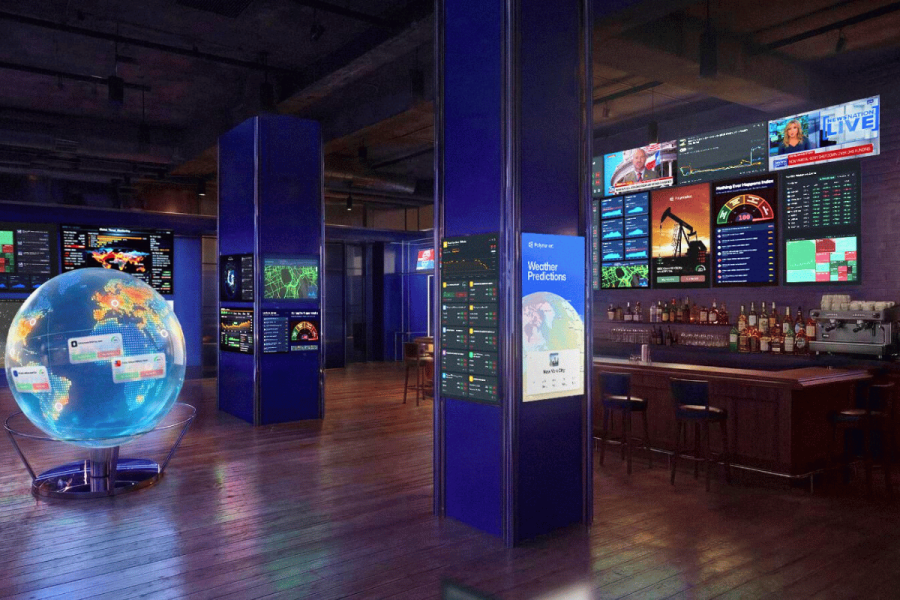
Polymarket is opening The Situation Room, a themed bar in Washington D.C. on March 21, 2026, featuring live prediction market odds, Bloomberg terminals, and flight tracking displays. The venue targets D.C.'s political class ahead of the 2026 midterm cycle.
Key Points
- Polymarket opens The Situation Room bar in Washington D.C. on March 21 2026
- The bar displays live Polymarket odds, Bloomberg terminals, and flight trackers instead of sports
- Polymarket processed over $3.5 billion in trading volume during the 2024 election cycle
A Sports Bar for People Who Watch Countries Instead of Teams
Polymarket is opening "The Situation Room" in Washington D.C. this Friday, March 21. The concept is disarmingly simple and completely unprecedented: a bar where every screen shows real time global events instead of basketball games. Social media feeds, Bloomberg terminals, flight tracking maps, and live Polymarket prediction market odds all running simultaneously while patrons drink and debate whether a ceasefire holds or a Senate confirmation vote passes.
The name is not subtle, and that is the point. The White House Situation Room sits a few miles away on Pennsylvania Avenue. Polymarket chose the capital of the country whose regulatory apparatus has spent the last three years trying to decide whether prediction markets are legal, innovative, or dangerous. Putting a bar named "The Situation Room" within walking distance of the actual one is either confidence or provocation. Probably both.
The Business Behind the Bit
Polymarket processed over $3.5 billion in trading volume during the 2024 U.S. presidential election cycle, becoming the single most cited prediction market in mainstream media coverage of the race. CNN, CNBC, Fox News, and the New York Times all referenced Polymarket odds as a proxy for voter sentiment, often appearing on screen before traditional polling averages. When a prediction market moves before a poll, the prediction market becomes the poll.
Opening a physical bar converts that media attention and digital brand equity into physical permanence. A Polymarket venue in D.C. becomes a default meeting spot for political operatives, journalists, policy analysts, and lobbyists, exactly the people who already check the platform hourly from their phones between meetings. The drink tab is secondary. The real product is embedding the Polymarket brand into the daily social routine of Washington's information class, the people who shape narratives for a living.
The strategy mirrors what Bloomberg did with its Manhattan headquarters cafeteria, where terminal screens line the walls and the lunch crowd trades market intelligence between bites of salad. Polymarket is building the public, accessible version of that experience, except anyone can walk in off the street, and the stakes displayed on screen include whether Congress passes a specific bill or whether a geopolitical flashpoint in Eastern Europe escalates before the weekend.
Why D.C. and Why Now
Prediction markets occupy a regulatory gray zone in the United States that has only recently begun to clarify. The CFTC approved Kalshi's political event contracts in late 2024 after a protracted legal battle that went to federal court. Polymarket, which operates offshore for U.S. users through a non custodial architecture, is making a calculated public statement with this venue: the product belongs here, in the city where the decisions that prediction markets price are actually made.
The timing is surgically precise. The 2026 midterm cycle begins in earnest this spring. Congressional primaries in multiple swing states, contested Senate races that will determine chamber control, and policy bets on everything from interest rate cuts to infrastructure spending will drive trading volume through November. A physical venue in D.C. that displays live odds on these specific outcomes creates an ambient advertising channel that no digital campaign, no matter how well targeted, can replicate. You cannot scroll past a wall of screens while ordering a drink.
The Cultural Equation
Polymarket is doing to political information what ESPN did to sports scores in the early 1990s. Before SportsCenter, you read scores in the morning newspaper. After SportsCenter, scores became entertainment, a spectacle you watched live with commentary and analysis laid on top. Polymarket is applying the same transformation to prediction odds: turning probability into atmosphere, turning information into a social experience.
The closest physical comparison in hospitality is the sports bar itself, a concept that barely existed before satellite television made it possible to show multiple live games in one venue. The Situation Room is the prediction market equivalent: multiple live global events displayed simultaneously, with the implicit invitation to form an opinion and, if you are on your phone, put money behind it.
Where This Goes Next
If the D.C. location generates the foot traffic and media coverage that Polymarket clearly expects, anticipate expansion to New York, London, and Dubai within 18 months. The global prediction market industry is projected to reach $65 billion in annual trading volume by 2028, up from roughly $5 billion in 2023. Converting digital platform engagement into physical infrastructure is the playbook that Peloton attempted with showrooms and that Warby Parker perfected with retail stores.
The critical difference: Polymarket's venue does not need to sell anything beyond a drink menu. Every person who watches a screen, checks a probability number, or debates a bet with the person on the next barstool is already using the product. The bar is the conversion funnel. The conversation is the activation. The Instagram story from a journalist showing the odds screen to 50,000 followers is the marketing budget.
Prediction: "The Situation Room" becomes the most photographed bar in D.C. by May 2026. Not because of the cocktail menu. Because every political journalist covering the midterms will post the odds screen to their story at least once a week, and that organic content loop is worth more than any ad buy Polymarket could purchase.
Related Reading
- AIME LEON DORE GOLF SS26: THE LOGO WITH A FLAGSTICK IS A SYSTEM
- ANTHROPIC MYTHOS HAD UNAUTHORIZED ACCESS THROUGH A VENDOR BREACH
- Anthropic Prepares Claude Opus 4.7 and a Design Tool That Spooked Adobe
Related: HAIDER ACKERMANN BRINGS PVC TRENCHES TO TFAW26.
Related: SPOTIFY ERASES 500,000 of Malcolm Todd's STREAMS OVER A $3 MILLION BET.
Related: SATAOSHI NAKAMOTO TEASES FW26 WITH CRYPTIC MESSAGE.
Frequently Asked Questions
What is The Situation Room by Polymarket?
The Situation Room is a bar in Washington D.C. that displays real-time global events, Bloomberg terminals, flight trackers, and live Polymarket prediction market odds instead of traditional sports broadcasts. It opens March 21, 2026.
Where is the Polymarket bar located?
The Situation Room by Polymarket is located in Washington D.C. It is described as the world's first bar dedicated to monitoring the situation through prediction markets and live global data feeds.
What are prediction markets?
Prediction markets are platforms where users trade on the outcomes of real-world events. Polymarket, the largest prediction market, processed over $3.5 billion in volume during the 2024 U.S. presidential election and is widely cited by major news outlets.
Topics: fintech, geopolitics, sportscenter, politics, anthropic, polymarket, washington-dc, situation-room, focus-49-7, crypto, espn, adobe, prediction-markets