PHIL KNIGHT POURED RUBBER INTO A WAFFLE IRON TO BUILD NIKE
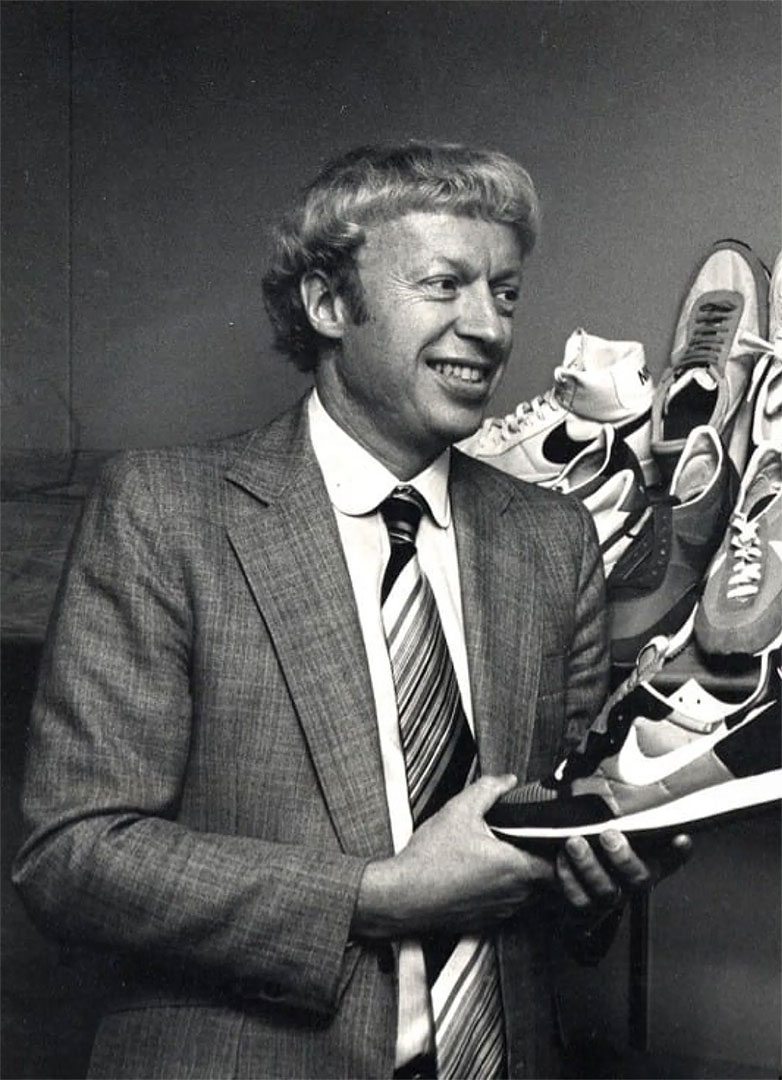
Nike began in 1964 as Blue Ribbon Sports, founded by Phil Knight and Bill Bowerman with $500 each to import Japanese running shoes. The Nike brand launched in 1971 with a $35 Swoosh logo and the waffle-sole design Bowerman built in his kitchen. Elliott Hill has led the company as CEO since October 2024, after fiscal 2025 revenue fell to $46.3 billion.
Key Points
- Phil Knight and Bill Bowerman each put in $500 to start Blue Ribbon Sports in 1964.
- Carolyn Davidson designed the $35 Swoosh in 1971; her stock gift is now worth about $1 million.
- Elliott Hill became CEO in October 2024 after fiscal 2025 revenue fell 10% to $46.3 billion.
The Trunk and the Track
On January 25, 1964, Phil Knight and Bill Bowerman each invested $500 to form Blue Ribbon Sports in Eugene, Oregon. Knight was 26, a mediocre middle-distance runner and Stanford MBA graduate. Bowerman was the University of Oregon track coach, obsessed with shaving ounces off his runners' shoes. Their initial business model was modest: import Onitsuka Tiger running shoes from Japan and sell them at track meets from the trunk of Knight's green Plymouth Valiant.
Knight sold $8,000 worth of shoes in 1964, working full-time as an accountant at Price Waterhouse. By 1969, Blue Ribbon Sports was doing $300,000 in annual revenue. The relationship with Onitsuka was stable until Knight discovered the Japanese company was secretly negotiating with other American distributors. In 1971, he severed the partnership and launched his own brand. He needed a name and a logo.
The $35 Swoosh
Portland State University graphic design student Carolyn Davidson charged $35 to design the Swoosh in June 1971, after roughly 17.5 billed hours. Knight initially told her, "I don't love it, but maybe it'll grow on me." It did; FO's own 50-year logo archive dig traces every tweak since. The Nike name came from Jeff Johnson, Blue Ribbon's first employee, who dreamed about the Greek goddess of victory the night before the filing deadline. The first Nike shoe, the Moon Shoe, used a waffle-patterned sole that Bowerman created by pouring liquid urethane into his wife's waffle iron, the same geometry that resurfaced on the Astrograbber in 2024. He destroyed the iron. His wife, Barbara, was displeased.
Two Near-Death Experiences
Nike nearly collapsed twice. In 1984, the aerobics boom caught them flat-footed; Reebok surged past Nike with the Freestyle, and Nike's market share dropped below 20%. Knight bet the company on a young basketball player named Michael Jordan, offering him $500,000 per year, a sneaker line, and 5% royalties, an unprecedented deal that Adidas and Converse had both declined. The Air Jordan 1 launched in 1985 and sold $126 million in its first year, spawning a collaboration economy that now runs from Stussy's decade of Nike team-ups to Supreme's 2001 Air Max Ecstasy revival at DSM LA. Nike regained market leadership by 1990.
The second crisis came in the late 1990s when labor rights investigations exposed factory conditions in Indonesia and Vietnam. Nike's stock dropped 57% from its 1997 peak. Knight hired former UN Ambassador Andrew Young to audit factories, implemented the first industry-wide minimum age standards, and published a full supplier list in 2005, a radical transparency move that competitors took another decade to match.
The Numbers That Dwarf Industries
As of fiscal year 2024, Nike's annual revenue was $51.4 billion. Its market capitalization hovers around $200 billion, exceeding Ford ($43B), General Motors ($47B), and Stellantis ($40B) combined. The company sells products in 190 countries and sponsors more professional athletes than any organization in history. The Jordan Brand alone generates $5.1 billion annually; if it were a standalone company, it would be the third-largest footwear brand on Earth behind Nike and Adidas. The Air Force 1, the archive piece FO has traced back to Baltimore's 1980s obsession with the shoe, and revival runs like the Shox BB4's return to Third of June colorways still outsell entire rival brands on their own.
Phil Knight's personal net worth was estimated at $45 billion in early 2026. Carolyn Davidson received additional Nike stock in 1983 as a gift from Knight. Those shares, based on Nike's 2024 price, are worth approximately $1 million. The $35 Swoosh has generated more brand value than any single design element in commercial history.
The Family Still Owns It
Sixty-plus years later, Nike is still a Knight family company in every way that matters. Phil Knight stepped down as chairman in 2016, but the family controls roughly 97% of Nike's Class A voting shares through Swoosh LLC, the holding vehicle Knight set up after Nike's 1980 IPO to keep voting control away from Wall Street. Knight and his wife Penny remain among the largest donors in American higher education, funding Stanford's Knight Management Center and the University of Oregon's Knight Campus for Accelerating Scientific Impact.
Elliott Hill became president and CEO on October 14, 2024, a rare instance of Nike pulling a 32-year company veteran back from retirement to run it. Hill replaced John Donahoe, whose direct-to-consumer strategy had pulled Nike back from wholesale partners like Foot Locker and Dick's Sporting Goods, opening shelf space that On Running and Hoka moved into; Donahoe himself later acknowledged Nike had gone too far. The reset has not shown up in the numbers yet: fiscal 2025 revenue fell to $46.3 billion, down 10% from fiscal 2024's $51.4 billion.
The company Bowerman and Knight ran out of a Plymouth Valiant trunk now operates from the Philip H. Knight Campus in Beaverton, Oregon, a roughly 400-acre site renamed for Knight in 2016. It is still incorporated in Oregon and listed on the New York Stock Exchange as NKE, even as roughly 96% of its footwear is made across Vietnam, Indonesia and China. The NBA jersey deal alone runs through 2037, long after anyone who remembers the waffle iron will be running the place.
The Definitive Take
Nike is not a shoe company. It is a marketing infrastructure that happens to sell shoes. Every innovation, from Air cushioning to Flyknit to self-lacing, exists to feed a storytelling engine that turns athletes into mythology and products into cultural currency. The company that started in the trunk of a Plymouth Valiant now sponsors more Olympic athletes than most countries field.
Frequently Asked Questions
Who founded Nike?
Phil Knight and Bill Bowerman founded Nike on January 25, 1964, when they each put in $500 to start Blue Ribbon Sports in Eugene, Oregon, years before the Nike brand itself launched in 1971.
How did Nike start?
Nike started as Blue Ribbon Sports, a side business Phil Knight ran out of the trunk of his green Plymouth Valiant, selling imported Onitsuka Tiger running shoes at track meets while working full time as an accountant.
How much was the Nike Swoosh logo?
Portland State design student Carolyn Davidson was paid $35 for the Swoosh in 1971. Nike later gave her a stock gift now worth roughly $1 million.
Why is it called Nike?
Blue Ribbon Sports employee Jeff Johnson proposed the name Nike, after the Greek goddess of victory, the night before the company's 1971 trademark filing deadline.
Who owns Nike?
The Knight family controls Nike through Swoosh LLC, which holds roughly 97% of the company's Class A voting shares even though Phil Knight stepped down as chairman in 2016.
Who is the CEO of Nike?
Elliott Hill has been Nike's president and CEO since October 14, 2024, after the board replaced John Donahoe.
Where is Nike headquartered?
Nike is headquartered at the Philip H. Knight Campus in Beaverton, Oregon, a roughly 400-acre site renamed for the co-founder in 2016.
Is Nike an American company?
Yes. Nike is incorporated in Oregon and trades on the New York Stock Exchange as NKE, though roughly 96% of its footwear is manufactured in Vietnam, Indonesia and China.
Topics: sneakers, bill-bowerman, swoosh, streetwear, phil-knight, fashion, focus-69-25, jordan brand, adidas, air-jordan, converse, reebok, jordan-brand, stssy, nba, supreme, legacy-brand, nike, stüssy