Nike ACG's Ankle Cuff Ignores Debris Like It Was Designed to Do Nothing Else

Nike ACG's Zegama Hike, releasing July 2026, is a mid-cut hiking boot built on the Zegama trail running platform. It features a ZoomX/Cushlon 3.0 stacked midsole, Vibram Megagrip outsole, and an integrated ankle gaiter cuff for debris exclusion. The shoe competes against Salomon and HOKA at the $160-185 price point while carrying ACG's streetwear credibility.

Key Points
- The ankle gaiter cuff is an integrated debris-exclusion system — more trail-critical than the ZoomX or Vibram specs it gets branded with.
- Vibram Megagrip gives 30% higher wet granite friction than standard carbon rubber — the outsole Salomon and HOKA trust for premium trail.
- ACG's language strategy ("critters outdoors") actively separates the Zegama Hike from Nike's athletic narrative into outdoor culture.
Nike ACG's own caption for this shoe: "An ankle cuff that ignores debris like terms and conditions." That is a brand voice that knows exactly who it is writing to.
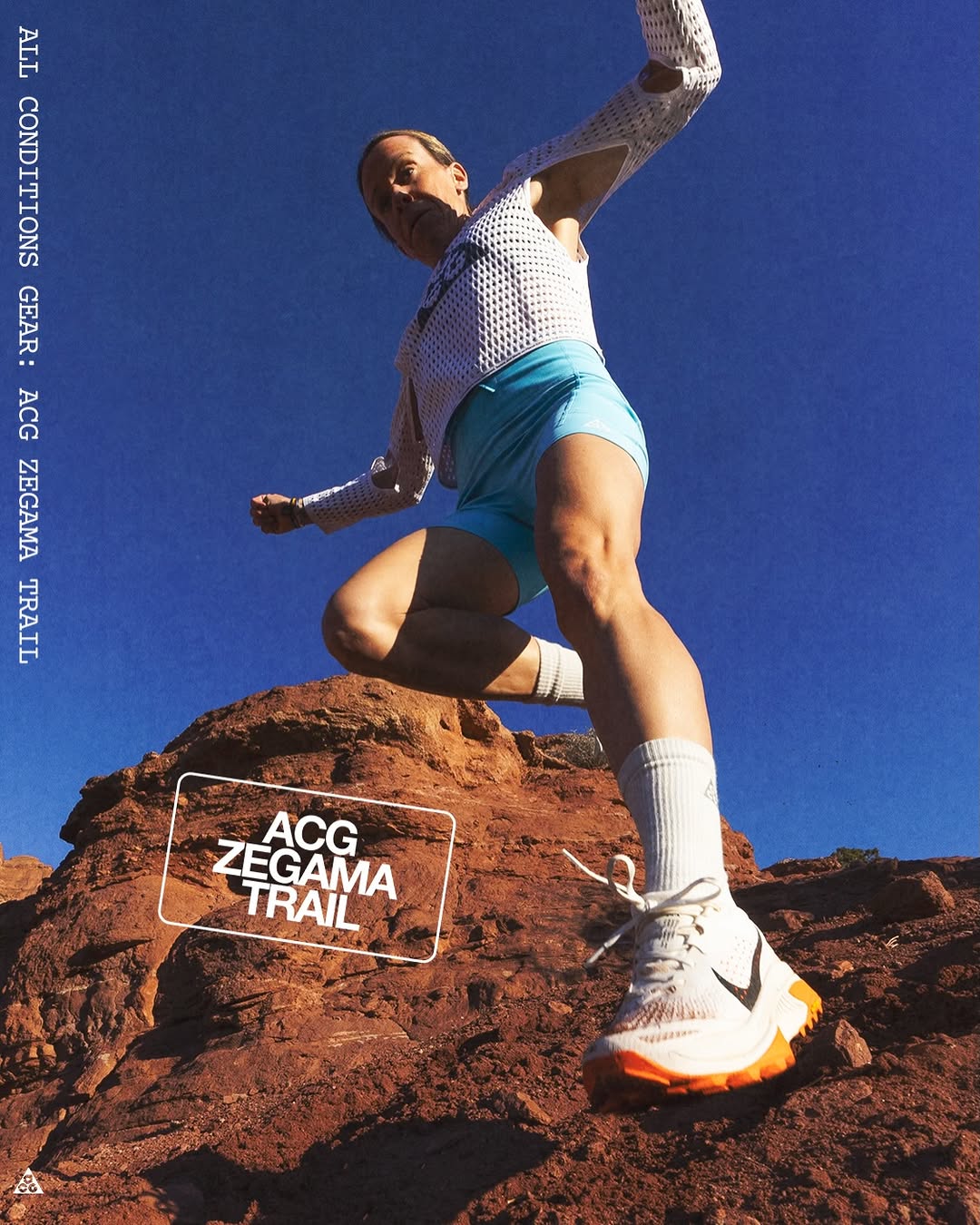
The shoe in question is the Nike ACG ankle cuff construction, specifically the Zegama Hike releasing July 2026, the first mid-cut hiking boot ACG has built on the Zegama trail running platform. The Zegama Trail running shoe already exists as a low-cut performance runner. The Hike takes that same midsole architecture and adds a mid-cut upper with a gaiter-style ankle cuff designed to shed debris on technical terrain.
ZoomX on Top, Cushlon 3.0 Below
The midsole stack combines two foams with different roles. ZoomX, Nike's most responsive foam compound, sits in the top layer providing energy return at toe-off. Cushlon 3.0, a more rigid and durable compound, sits in the lower layer providing protection from ground irregularities. This is the same principle used in the Pegasus trail line but at a higher level of material specification.
The outsole uses Vibram Megagrip, which is the compound used on hiking boots in the Salomon Speedcross category and throughout the premium trail market. Vibram Megagrip's specific advantage is its traction on wet rock, the surface that defeats most rubber compounds. The coefficient of friction on wet granite is approximately 30% higher with Megagrip than with standard carbon rubber outsoles.
The upper is built on a trail-oriented last with a spacious forefoot and toe box. Trail-specific lasts are wider at the front and more protective through the mid-foot than road-running lasts. ACG has had a trail-specific design language since the 1990s sub-brand launched as a way to separate Nike's outdoor product from its athletic footwear. The modern ACG line is both a continuation of that aesthetic and a technical product that competes against Salomon, HOKA, and Merrell at the performance tier.
The Gaiter That Does the Work
The ankle cuff the campaign references is a precision-fit gaiter integrated into the upper. The function: when debris, gravel, small rocks, and trail particulate gets between the sock and the collar of a low-cut shoe, it causes blisters and interrupts stride rhythm. A mid-cut shoe with a snug ankle cuff prevents the entry of that debris entirely.
This is less glamorous than the ZoomX and Vibram specs. It is also more likely to determine whether you finish a 20-mile trail day without stopping to empty your shoes three times. The practical detail, not the technical specification, is often where the performance gap between a good trail shoe and the right trail shoe lives.
ACG's creative direction for the Zegama Hike has been deliberately anti-athletic in its language. "Scientific creatures sitting indoors, exclusively to be worn by critters outdoors." That phrasing is doing something specific: it is separating the ACG Zegama from the Nike performance-focused narrative and recentering it in the outdoors-culture community where ACG's credibility actually lives.
The Market ACG Is Playing In
Salomon's XT-6 retails at $175 and has a five-year waitlist in certain colorways driven entirely by streetwear adoption rather than hiking performance. HOKA's Speedgoat 6 retails at $165 and dominates trail racing podiums. Merrell's Moab Speed Mid is the entry-level benchmark at $140.
The Nike ACG Zegama Hike will almost certainly retail between $160 and $185 based on the Zegama Trail's existing price ($155 for the low-cut version). That positions it against Salomon and HOKA rather than Merrell, which means it needs to compete on the Vibram outsole and ZoomX midsole combination against alternatives that have established performance reputations.
ACG's advantage is the Nike distribution network and the streetwear credibility that the ACG sub-brand has built through collaborations with Undercover, Matthew M. Williams, and NOCTA. Trail shoes with streetwear adjacency trade at a premium that pure-performance trail shoes do not reach. The Zegama Hike is targeting both communities simultaneously.
July 2026. Make the Call Before Then.
The low-cut Zegama Trail runs $155 and is the right choice for technical trail running where ankle support is less critical. The Hike at its expected $160 to $185 price point makes sense if you are putting in hiking miles where ankle stability matters more than ground clearance speed.
The Vibram Megagrip outsole and ZoomX midsole combination at that price is competitive with what Salomon charges without the streetwear credibility that ACG carries into the lifestyle market. The ankle cuff is the specific detail that makes this shoe right for the terrain it was built for.
Related Reading
- NIKE ACG DROPS WILD GEAR BATCH 2 OF 4
- NIKE ACG teaser visuals w/ CPFM
- NIKE ACG TEASES MYSTERIOUS 'START YOUR ENGINES' CAMPAIGN
Frequently Asked Questions
What is the Nike ACG Zegama Hike?
The Nike ACG Zegama Hike is a mid-cut hybrid hiking boot based on the Zegama trail running platform, releasing July 2026. It features a ZoomX/Cushlon 3.0 midsole stack, Vibram Megagrip outsole, and a precision-fit ankle gaiter cuff for debris exclusion.
How does the Nike ACG Zegama Hike compare to the Zegama Trail?
The Zegama Trail is a low-cut trail runner at $155 designed for performance trail running. The Zegama Hike is a mid-cut hiking boot with the same midsole and Vibram outsole, adding an ankle cuff for stability and debris exclusion on technical hiking terrain.
What is Vibram Megagrip?
Vibram Megagrip is a rubber outsole compound used on premium trail and hiking footwear from Salomon, HOKA, and now Nike ACG. It provides approximately 30% higher friction on wet rock compared to standard carbon rubber outsoles.
Topics: sneakers, hiking, hoka, zegama-hike, july-2026, acg, trail-shoe, fashion, zoomx, nike-acg, salomon, nike acg, hoka-hoka, outdoor, vibram-megagrip, nike