MESSI SCORES IN 7 STRAIGHT WORLD CUP GAMES AT 39
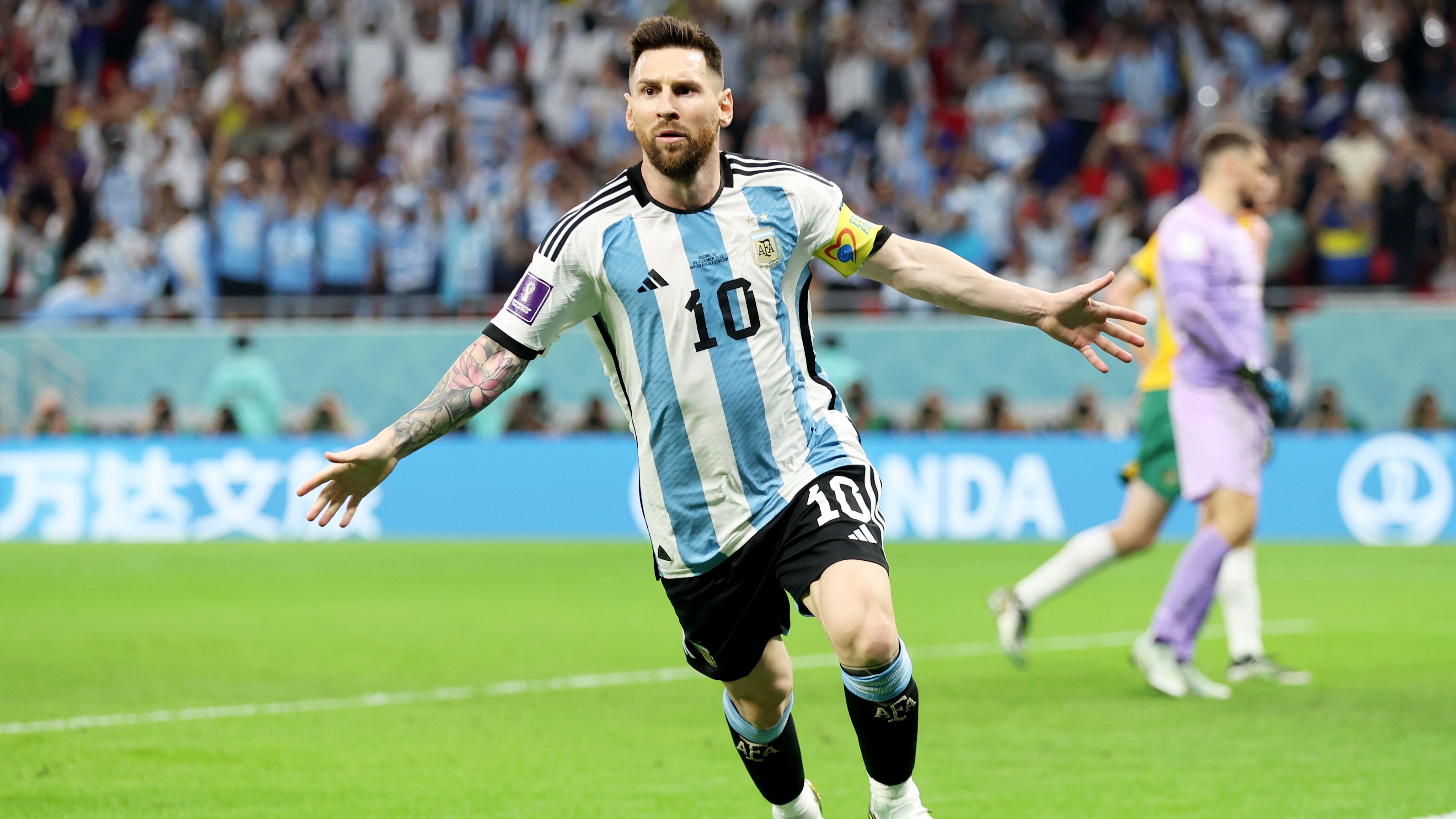
Lionel Messi became the first player in FIFA World Cup history to score in seven consecutive matches, netting a free kick in the 80th minute of Argentina's 3-1 win over Jordan on June 28, 2026. The goal is his 19th career World Cup goal and his sixth of the 2026 tournament. Messi, who turned 39 on June 24, came off the bench in the 60th minute, breaking the previous record of six straight games shared by France's Just Fontaine (1958) and Brazil's Jairzinho (1970).
Key Points
- Messi scored in his 7th consecutive World Cup match on June 28, 2026, breaking a record shared by Just Fontaine (1958) and Jairzinho (1970) that had stood for 56 years.
- The free kick against Jordan was Messi's 19th career World Cup goal and his 6th of the 2026 tournament, with Argentina winning the match 3-1 to finish Group J with a perfect nine points.
- Messi has scored 13 goals across his last 10 World Cup games dating back to 2022, and Argentina's record when he scores stands at 9 wins, 2 draws, and 1 loss.
Argentina Beat Jordan 3-1 With Messi Scoring His First 2026 Appearance
With the game against Jordan coming three days after his 39th birthday, Messi got a break as manager Lionel Scaloni kept him on the bench until he came on in the 60th minute. That is the full context behind what happened next. Not a starter. Not the center of the action for 59 minutes. And then, Jordan had pulled one back through substitute Mousa Al-Taamari, threatening a comeback, before Messi ended any hopes of a shock. The 39-year-old curled in a trademark free-kick to become the first player in history to score in seven consecutive FIFA World Cup matches.
Argentina wrapped up a flawless Group J campaign with a convincing 3-1 victory over World Cup debutants Jordan in Dallas, finishing with a perfect nine points and booking a Round of 32 clash against Cape Verde. The scoreline is comfortable. The story is not about the scoreline.
The Record That Stood Since Brazil Beat Italy in Mexico City, 1970
Just Fontaine and Jairzinho are not household names outside serious football circles. They should be. Fontaine scored 13 goals across six consecutive World Cup games during the 1958 tournament in Sweden. That was the only World Cup he ever played in. Jairzinho scored seven goals in six straight games at the 1970 World Cup for Brazil before going scoreless against Yugoslavia in the 1974 World Cup to end the streak. Both men held the record at six for over half a century. They did it in a single tournament, in a single run of form, the way records at that level usually get set.
Messi's version is structurally different and that difference matters. You have to go back to Argentina's 2-0 win over Poland in the final game of the 2022 World Cup group stage to find the last time he failed to score a World Cup game. That was the only game he did not score in during Argentina's title run, and it easily could have included a goal. Messi missed a penalty in that win. His seven-game streak is not a single hot run. It spans two World Cups, two continents, and four calendar years. Fontaine and Jairzinho had one tournament's worth of momentum. Messi has been doing this across an entire era.
Overall, Messi has scored 13 goals across his past 10 World Cup games and eight over his last four. That is not a streak. That is a rate.
19 Career World Cup Goals, and the Stat That Buries the Age Argument
Messi scored on a free kick in the 80th minute for his 19th career goal in the tournament. He also became the first player to score in seven straight World Cup games as Argentina won 3-1.
Here is the number that should end every conversation about whether Messi at 39 is a nostalgia act. Messi has scored 12 World Cup goals after turning 35, which is more than Harry Kane (10), Cristiano Ronaldo (8), Diego Maradona (8), Rivaldo (8), Neymar (8), and Thierry Henry (6) scored in their entire World Cup careers. Twelve goals. After 35. Past the age most elite forwards are retired or in their last season. That is not decline management. That is a different player operating on a different timeline than everyone else.
When Messi scores a goal in a World Cup game, Argentina's record stands at 9 wins, 2 draws, and 1 loss. That lone loss came against Saudi Arabia in 2022. The man is not just a record collector. He is a win condition.
The counterargument is worth taking seriously: Messi has been managed carefully. He did not start against Jordan. Scaloni has been rationing his minutes. Six goals in three appearances sounds dominant until you remember two of those appearances were starts where he played heavy minutes. The third was 30 minutes off the bench. At some point, the body's math becomes unavoidable, and even the most meticulous load management cannot override it. Argentina's Round of 32 draw against Cape Verde looks favorable. The quarterfinals will not.
The Free Kick Itself, and What It Reveals About How He Has Changed
As of March 2026, Messi ranks second in career goals scored from direct free kicks with 71. That is the number behind Saturday's goal. The free kick was not an accident of form or a one-off moment of brilliance. It is a weapon he has been perfecting across two decades, and at 39 it may now be his most reliable one.
This is worth sitting with. The Messi of 2012 was terrifying in open play, at speed, in one-on-one situations. That version of Messi was almost impossible to defend because he was faster than the defense's ability to organize. The Messi of 2026 is something different. "Obviously as you get older, you lose things that you had when you were younger, things like speed, reaction time, or seeing the game faster, making decisions," Messi said. "Sometimes your mind is faster than your legs. But I think I always tried to overcome those things and keep trying to be at my best."
That quote is the whole story. He has adapted the instrument. The free kick against Jordan is the 2026 version of the 2012 dribble. Different mechanism, same outcome.
He also holds the record for being both the youngest and oldest Argentinian to score in the World Cup competition, and became the oldest male player to net a hat trick at the tournament. The record book now has Messi listed at both ends of the age spectrum for the same country at the same tournament. That is not a coincidence. That is a career arc with no real comparison.
Cape Verde Is Next. Then the Record Gets Harder to Break
Argentina face Cape Verde in the Round of 32. In Messi's last nine World Cup matches dating back to 2022, he has 12 goals and 3 assists across those appearances. The streak will almost certainly reach eight against Cape Verde. The real test arrives in the knockout rounds.
In 2022, Messi became the first player in World Cup history to score in the group stage, round of 16, quarter-final, semi-final and final in a single edition of the tournament. That is the bar he set for himself. Not consecutive games against Jordan. The consecutive games record is a byproduct of something larger: an athlete who shows up in every match that matters.
The streak will end. Everything ends. But whoever eventually scores in an eighth straight World Cup game will need to do it across at minimum two tournaments, which means the next player to break this record has to stay elite for at least eight years at the World Cup level. On June 22, 2026, following a brace against Austria, Messi surpassed Miroslav Klose and then Marta to become the all-time leading World Cup goalscorer of any gender, with 18 career World Cup goals. Now at 19, the record extends with every appearance. The practical question is not whether anyone breaks seven consecutive games. It is whether Messi himself reaches eight.
Frequently Asked Questions
What record did Messi break against Jordan at the 2026 World Cup?
Lionel Messi became the first player in FIFA World Cup history to score in seven consecutive World Cup matches, breaking the previous record of six straight games shared by France's Just Fontaine (1958) and Brazil's Jairzinho (1970).
How many World Cup goals does Messi have in total?
After his free kick against Jordan on June 28, 2026, Messi has 19 career World Cup goals, making him the all-time leading scorer in men's World Cup history and the all-time leading scorer across any gender.
Did Messi start the game against Jordan at the 2026 World Cup?
No. Messi came off the bench in the 60th minute, three days after his 39th birthday. Manager Lionel Scaloni rested him since Argentina had already qualified from Group J. Messi scored in the 80th minute.
Who held the record for most consecutive World Cup games with a goal before Messi?
France's Just Fontaine (1958) and Brazil's Jairzinho (1970) both scored in six consecutive World Cup matches. Messi tied that record against Austria on June 22, 2026, then broke it outright against Jordan on June 28, 2026.
What is Argentina's record when Messi scores at the World Cup?
When Messi scores in a World Cup match, Argentina's record is 9 wins, 2 draws, and 1 loss. The lone loss came against Saudi Arabia in 2022.
Topics: jairzinho, argentina, world-cup-2026, cristiano ronaldo, inter-miami, world-cup, just-fontaine, lionel-messi, cristiano-ronaldo, messi-free-kick, world-cup-records, consecutive-goals, fifa-world-cup