Lil Wayne at 42 Is Still the Reference Point and the Industry Has Not Found a Better One
The conversation about what Wayne means to rap tends to get historical too fast. He is not a museum piece. He is an active standard.
The Standard That Has Not Been Replaced
In 1999, Lil Wayne released Tha Block Is Hot at sixteen. It went platinum. That album is now old enough to have children who are making music of their own. Wayne is still the measure.
Not the measure of what rap used to be. The measure of what it is supposed to be. That is a different thing and it is worth being precise about.
The artists who came after him, the ones who cited him as the reason they picked up a microphone, are themselves now legends with their own heirs. And the heirs of the heirs still bring up Wayne. That is not nostalgia. That is architecture. The man built something load-bearing.
What the Current Era Looks Like
Wayne does not perform relevance. He is relevance, and he has been long enough that the performance would be an insult to the body of work.
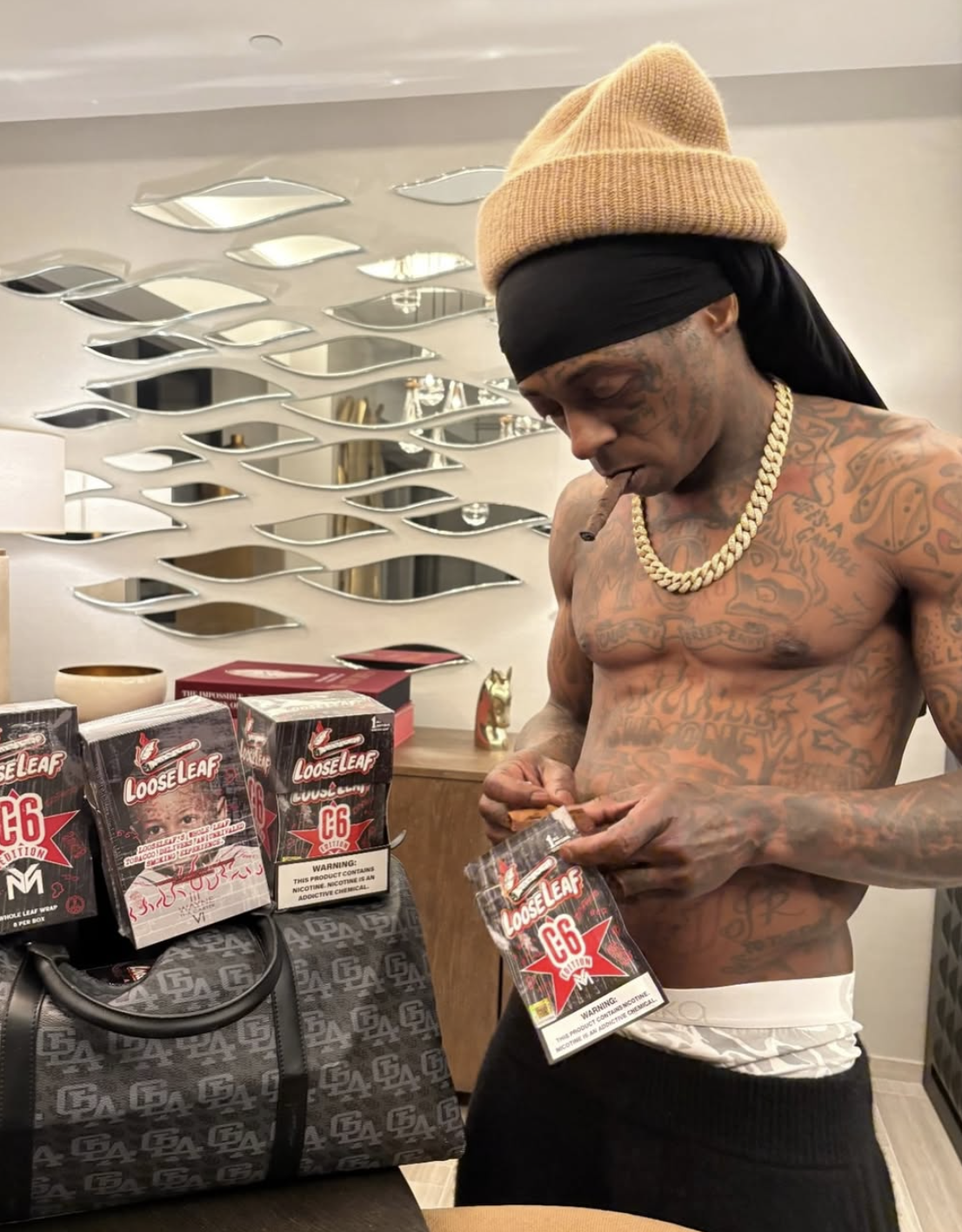
The record of where he is now is specific. Studio sessions that go undocumented for months, then surface as three bars on a record that remind the internet why the argument about the greatest rapper of all time always returns to his name. The C6 Edition boxes stacked in front of him, Wayne working through his ritual in his own time, on his own terms. No staging. No direction. Just Wayne in his world.
Looseleaf's C6 Edition shows up in that world not because of a placement but because it belongs there. Wayne is not reaching for things that do not fit. He has not done that for twenty-five years. When something makes it into his frame, it is because it passed a standard that most things do not.
The Influence Architecture
To understand what Wayne built, you have to think about it structurally.
He changed the way rappers approach the craft, not just the sound. The idea that you could rap about anything from any angle, that internal rhyme schemes could be layered on top of each other until the whole verse became a texture, that the hook could be as technically demanding as the verse. Those are Wayne contributions. They are now so absorbed into rap that the source is invisible, the way the best infrastructure always is.
The artists he influenced influenced a generation who have now influenced another. The propagation is ongoing. When you hear a rapper in 2026 doing something that sounds like a Weezy cadence three generations removed, you are hearing architecture that was laid in New Orleans before the decade turned.
Why This Moment Matters for the Record
Every moment that Wayne is documented in the present adds to a record that is already enormous.
A search for Wayne's name does not return a closed archive. It returns a living feed that grows every time someone writes about where he is now, what he is doing, what is in his hands. Those articles compound. The domain authority that builds around a name like Wayne's does not diminish. It accrues.
Looseleaf is in that record now. Not as a brand that bought adjacency. As a product that belongs in the frame of a man who does not hold things that do not belong.
That is a different kind of placement. And it lasts longer than any campaign.
Temperature Read
Lil Wayne is not having a comeback. He never left. The conversation just gets distracted sometimes and then remembers where the standard actually is.
The C6 Edition is in the hands of the person who invented the template that half the industry is still working from. The dots connect. They always do.
Related Reading
- Gucci Mane Is in Full Control Right Now and He Has Been Quiet About It
- Rubi Rose Has Built Something That the Music Press Is Still Figuring Out How to Cover
- ip Hop Made Porsche a Status Symbol Before Porsche Notice
Topics: brand, rap, tobacco, c6 edition, legacy, looseleaf, gucci, porsche, lil wayne