JOSHUA VIDES OPENS PERMANENT AT THE PETERSEN JUNE 21
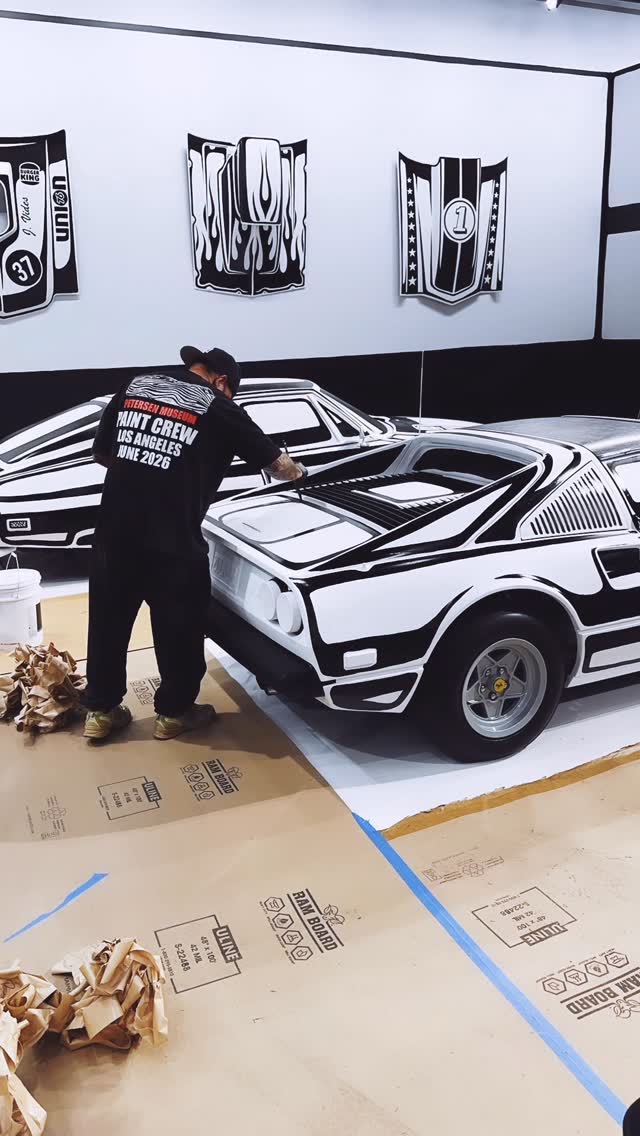
Joshua Vides opens a permanent exhibition on the third floor of the Petersen Automotive Museum in Los Angeles on June 21, 2026. His signature black-and-white line art technique, which has scaled from G-Shock watches to NBA arenas, is applied to automotive objects in the museum's permanent collection context. The Petersen has built a programming identity as Los Angeles' leading venue for contemporary art applied to automotive culture, following Daniel Arsham's Porsche 911 installation.
Key Points
- The Art of Joshua Vides is a permanent third-floor exhibition at the Petersen Automotive Museum, opening June 21, 2026.
- Vides' black-and-white line art technique has scaled from G-Shock watches to NBA arenas; the Petersen is his largest institutional canvas.
- The Petersen has built a position as Los Angeles' leading art x automotive museum, following Daniel Arsham's Porsche 911 show.
Three days out. That was the caption on June 15. "Pedal to the metal. No brakes. Full throttle. All that. 3 days and counting. See y'all at @petersenmuseum."
Joshua Vides was not counting down to a collaboration drop or a curated section of a group show. He was counting down to a permanent exhibition on the third floor of the Petersen Automotive Museum in Los Angeles. Permanent means not temporary. Permanent means no takedown date.
In May, Vides said this presentation would break every rule. He had 37 days to sit with that claim. On June 21, it gets tested.June 21. Third Floor. Permanent.
The Petersen Automotive Museum sits on Wilshire Boulevard, the building with silver ribbons on the facade that makes it look like a car caught at speed. The permanent exhibition of Joshua Vides occupies the third floor. Not a guest installation. Not a residency with an end date. A permanent part of the building's collection alongside its cars.
For reference: the Petersen's permanent collection includes the 1935 Duesenberg SSJ, one of the most valuable American automobiles ever built, and the DeLorean from the Back to the Future films. Adding a living artist to that permanent floor at 37 years old is a different transaction than a gallery show. The institution is not renting Vides temporary wall space. The Petersen is deciding what belongs on the permanent record of automotive culture, and Vides is on the list.
Vides Has Built One Visual Language for Twenty Years and Scaled It Every Time.
Joshua Vides developed his mark over years of applying black-and-white line art directly to three-dimensional objects: shoes, watches, room interiors, apparel, skateboards. The technique produces a specific optical effect where a solid object reads as a two-dimensional drawing, as if an illustrator reached through a screen and drew over physical reality. It is immediately recognizable and replicable at any scale without losing its logic.
The G-Shock DW-5600JV collaboration showed the smallest version of that language: a watch where the case and strap appear hand-sketched. His NBA All-Star Artist-in-Residence program ran the same language across arena environments, merchandise, and broadcast design. The Petersen show is the largest institutional canvas Vides has worked with, applied to automotive objects that carry decades of mythology before he draws a single line on them. The Petersen cars are not blank surfaces. They are objects that already mean something. Vides is drawing on top of meaning, not on top of nothing.The Petersen Was Already Becoming the Art Venue Los Angeles Needed.
Daniel Arsham's Blue Calcite Eroded Porsche 911 was the centerpiece of Arsham Auto Motive at this museum, embedding hydrostone, quartz, selenite, and blue calcite into the bodywork of an actual 911. That show treated the Porsche as a geological artifact. It was temporary. The 911 left when the exhibition closed.What the Petersen has built across the Arsham collaboration, the ongoing automotive art programming, and now the Vides permanent installation is a clear institutional position: this is the museum in Los Angeles that takes the automobile seriously as a starting point for contemporary art rather than its endpoint. The Fast and Furious 25th anniversary exhibition one floor below and Vides permanent on the third floor are not contradictory programming. They are the same argument about what cars mean in American culture made at different registers simultaneously.
The Petersen is not trying to be the Getty or LACMA. It is building its own lane, and that lane now has Joshua Vides in it permanently.
A Permanent Institutional Credit Changes the Next Decade of Work.
The distinction between a temporary show and a permanent collection placement carries economic and critical weight that compounds over time. Temporary exhibitions generate a controlled press window around an opening, then fade from reference. A permanent collection piece becomes a citation. Critics, other artists, and institutions will reference the Vides Petersen exhibition as a credential in perpetuity.
At 37, Vides now has a permanent institutional anchor alongside the product collaborations, the branded commissions, and the gallery shows. His work appears in a Casio watch, in an NBA arena, and on the third floor of a museum on Wilshire Boulevard. Those three things are not the same thing, but the Petersen placement is the one that does not go away. The institution makes the judgment for the market. For Vides, the opening on June 21 is not a launch. It is the first day of permanent.
Related: JR BROUGHT LIL BUCK TO A PRISON YARD AND A BORDER WALL.
Frequently Asked Questions
When does the Joshua Vides Petersen Museum exhibition open?
The Joshua Vides permanent exhibition at the Petersen Automotive Museum in Los Angeles opens on June 21, 2026. It is located on the third floor.
What is the Joshua Vides Petersen Museum exhibition?
The Art of Joshua Vides is a permanent exhibition on the third floor of the Petersen Automotive Museum on Wilshire Boulevard in Los Angeles, featuring his signature black-and-white line art applied to automotive objects.
Who is Joshua Vides?
Joshua Vides is a Los Angeles artist known for his signature technique of applying black-and-white line drawings to three-dimensional objects. He previously collaborated with G-Shock, served as the NBA All-Star Artist-in-Residence in 2026, and has had gallery exhibitions internationally.
Has the Petersen Museum had other contemporary artists?
Yes. Daniel Arsham's Blue Calcite Eroded Porsche 911 was the centerpiece of Arsham Auto Motive at the Petersen, treating a Porsche 911 as a geological artifact. The Vides exhibition is the first permanent art installation on the third floor.
What is Joshua Vides' visual language?
Vides applies black-and-white line art directly to three-dimensional objects and environments, creating an optical effect where solid objects appear to be two-dimensional drawings. The technique is recognizable at any scale.
Topics: petersen-museum, lacma, automotive-art, los-angeles, culture, daniel arsham, museum, joshua-vides, porsche, nba, contemporary-art, permanent-exhibition, daniel-arsham, future, art-x-automotive, street-art