JAMES TURRELL OPENS HIS 100TH SKYSPACE AT AROS AARHUS
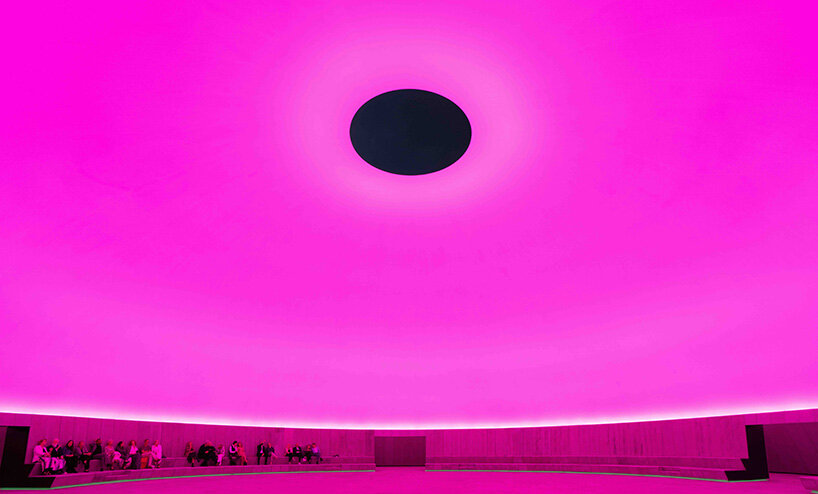
James Turrell opened his 100th Skyspace, a permanent installation at ARoS Aarhus Art Museum in Denmark, on June 19, 2026. The dome measures 40 meters in diameter and 16 meters tall, entered via a subterranean corridor, and is part of ARoS's The Next Level expansion. Gagosian's concurrent Lifting the Veil exhibition in Hong Kong, running through August 1, presents the full scope of Turrell's 50 year light practice alongside the completion.
Key Points
- James Turrell opened his 100th Skyspace at ARoS Aarhus on June 19, 2026; the dome is 40m wide and 16m tall.
- Gagosian's Hong Kong show Lifting the Veil opened May 28 and runs through August 1, 2026.
- The series began in 1974 with a private studio room; ARoS is the 100th and the first at this museum scale.
The dome at ARoS Aarhus is 40 meters across and 16 meters tall. A tunnel brings you in from below. The opening at the top, the aperture that frames the sky, is the entire point. James Turrell opened it June 19, 2026. It is the largest museum Skyspace he has ever built. It is also, by his count, the hundredth.
40 Meters Across and the Sky Is the Ceiling
"As Seen Below: The Dome, a Skyspace" sits inside ARoS Aarhus Art Museum as a permanent collection work. Visitors descend a subterranean corridor before entering the domed chamber, where Turrell's light calibration alters the sky's apparent depth, color, and distance. The dome runs three modes: Open Sky, showing the literal sky; Colour Shift, where programmed LED arrays make the aperture appear to change color; and Twilight, which makes daylight look like dusk. None of this is a trick. It is perceptual physiology.
At 40 meters in diameter, the scale moves the work out of gallery territory and into architecture. The experience inside is closer to standing in a cathedral or a concert hall than to looking at a painting. FO covered the announcement of the ARoS commission when Turrell was still building it. The finished object is a different argument.
The Series That Started in a Private Studio in 1974
James Turrell made his first Skyspace in 1974. The ARoS dome is his 100th. In the fifty two years between the first and the hundredth, the series expanded from rooms in private homes and gallery interventions to public installations at universities, airports, botanical gardens, and now major art museums. The institutional trajectory is its own statement: Skyspaces began in experimental contexts and now anchor permanent collections.
The logic of the series has not changed. An aperture in a ceiling, precisely engineered to make the sky appear as a flat plane rather than a depth, does something to human perception that no other art object replicates. Turrell's technique is not digital. The aperture is physical. The light entering through it is real.
Roden Crater in Arizona has been under construction since 1977. It is a volcanic cinder cone reconfigured as chambers that capture celestial light. The ARoS dome is a museum scale iteration of the same logic: engineer the space so the sky does not look like sky.
Gagosian Timed Hong Kong Deliberately
Gagosian opened "Lifting the Veil" in Hong Kong on May 28, 2026, three weeks before the ARoS dome opened. The show runs through August 1 and includes Glasswork pieces, holograms, prints, and architectural models of Skyspaces and Roden Crater. The timing places Gagosian's full career survey alongside the completion of the largest museum Skyspace, giving collectors context for the practice at the same moment the institution signals its permanent value.
Turrell has been represented by Gagosian since the 1990s. The gallery has placed his work at the institutional level longer than most artists have had careers. The Hong Kong survey is the culmination of that relationship translated into market terms.
Gagosian's Basel 2026 presentation with Grotjahn and Burden ran the same week. The gallery spent June managing multiple simultaneous placements across institutional and fair contexts. That is what career management looks like at Turrell's level. The ARoS commission is not a gallery placement; it is a permanent public artwork. The Hong Kong show is the market's translation of the same moment.The Underground Entry Is the First Perceptual Move
The underground approach is not a design flourish. Entering the dome via a subterranean corridor removes the visitor from daylight context before they see the aperture. By the time you step into the chamber, your eyes have adjusted to a controlled interior light level. The transition from the corridor to the dome is the work's first perceptual move. The aperture arrives as a surprise rather than a continuation of the outside world.
ARoS's broader expansion, called The Next Level, positions the museum as a site for experiential work that cannot be replicated in smaller venues. The Turrell dome is the anchor piece of that argument. A 40 meter permanent Skyspace is not something a commercial gallery can offer. It is the kind of commission that defines a museum's identity for decades. At 83, on his 100th Skyspace, Turrell accepted the commission and built the largest one of the series. The ARoS dome at 40 meters is the record: fifty two years, one idea, one hundred rooms.
Related: NIKE ZOOM STREAK 3 RETURNS AT NAKED COPENHAGEN FOR $115.
Frequently Asked Questions
What is the James Turrell installation at ARoS Aarhus?
James Turrell's As Seen Below: The Dome, a Skyspace is a permanent installation at ARoS Aarhus Art Museum in Denmark, measuring 40 meters in diameter and 16 meters tall, opened June 19, 2026.
What is a Skyspace?
A Skyspace is an architectural room designed by James Turrell with a precisely shaped aperture in the ceiling that frames the sky, altering perception of depth and color.
How many Skyspaces has James Turrell made?
The ARoS dome is Turrell's 100th Skyspace. The series began in 1974 and spans private homes, universities, botanical gardens, airports, and museums.
What is Gagosian's James Turrell show in Hong Kong?
Gagosian's Lifting the Veil exhibition in Hong Kong opened May 28, 2026 and runs through August 1, featuring Glasswork pieces, holograms, and models of Skyspaces and Roden Crater.
What is Roden Crater?
Roden Crater is James Turrell's land art project in Arizona, a volcanic cinder cone under reconfiguration as light-capturing chambers since 1977.
Topics: light-art, roden-crater, gagosian, skyspace, aros-aarhus, james-turrell, contemporary-art, perceptual-art, permanent-installation, denmark