HOW ROY LICHTENSTEIN REMADE THE AMERICAN FLAG, AND WHAT IT SAYS AT 250
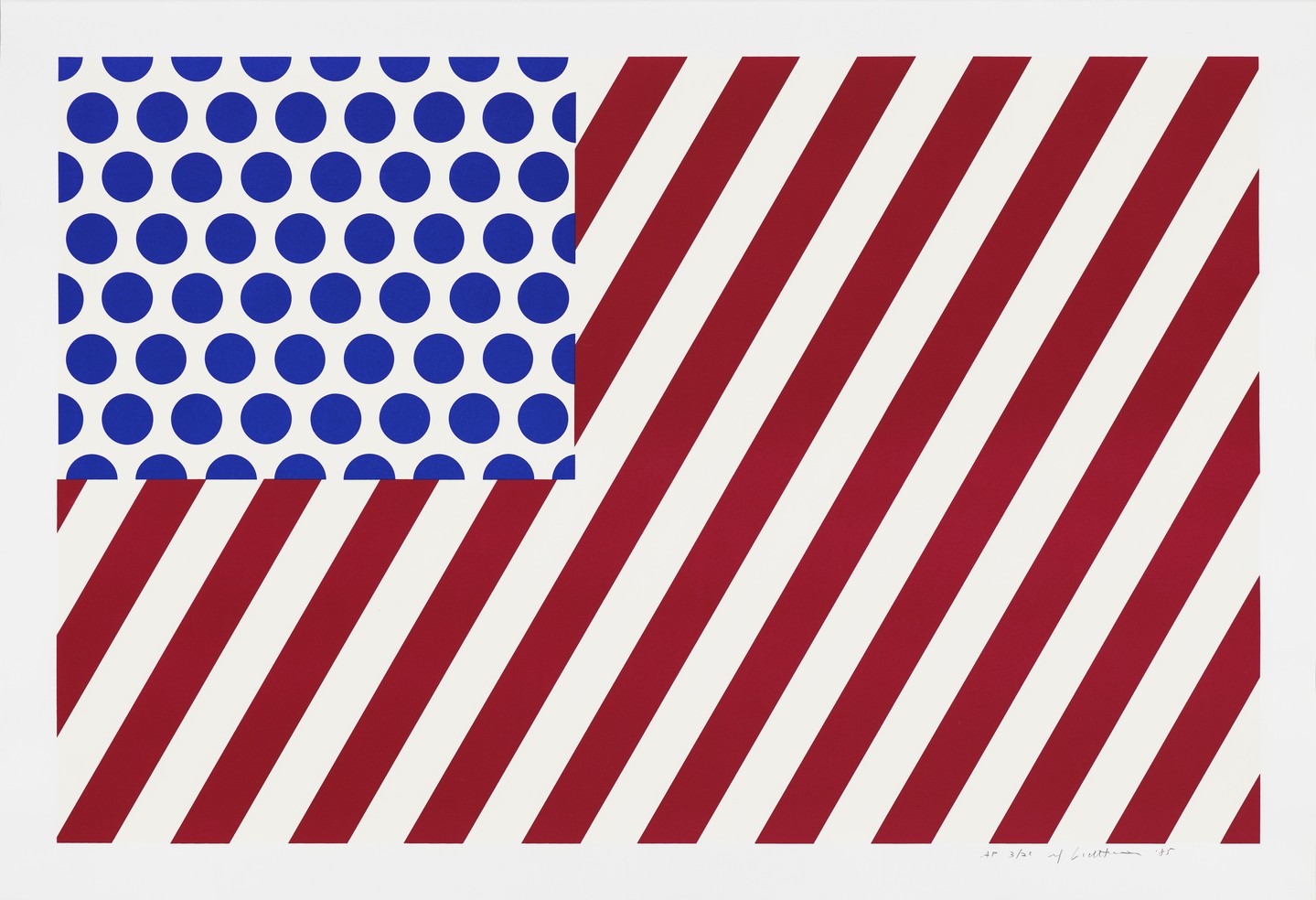
Roy Lichtenstein's 1985 screenprint Forms in Space, made for a one night University of Pennsylvania benefit, carries accession number 2019.175 in the Whitney Museum's Roy Lichtenstein Study Collection, the roughly 400 work gift the Roy Lichtenstein Foundation made in 2019 before winding itself down. The Whitney opens its first complete New York Lichtenstein retrospective in more than three decades in October 2026, co curated by artist Alex Da Corte and curator Meg Onli under director Scott Rothkopf. The show follows Lichtenstein's Anxious Girl selling for $46.06 million at Christie's in May 2026, his first new top ten auction result since 2020.
Key Points
- Forms in Space, 1985, carries accession number 2019.175 from the Whitney's Roy Lichtenstein Study Collection gift.
- The Roy Lichtenstein Foundation gave the Whitney roughly 400 works in 2019, then wound the Foundation down.
- Anxious Girl sold for $46.06 million at Christie's in May 2026, Lichtenstein's first new top ten result since 2020.
America turns 250 today. Two hundred and fifty years since the Declaration, and every porch, pickup, and storefront in the country is flying the same thirteen stripes and fifty stars it flies every Fourth of July. The flag is the most reproduced image in American life. Which is exactly why the most interesting version of it was made by a man who spent his whole career studying reproduction.
In 1985 Roy Lichtenstein made a flag. He called it Forms in Space, a color screenprint on Rives BFK paper in an edition of 125, and he did not paint the Stars and Stripes so much as rebuild them out of the same machine-made marks he had used to satirize comic books since the early 1960s. The stars are gone, replaced by rows of enlarged blue Ben Day dots on white. The stripes are slanted, multiplied past the regulation thirteen, laid down as flat red bars. The colors in the canton are inverted. You recognize the flag instantly, and you also recognize that something has been done to it.
He made it to be sold in one night
The origin is almost too on the nose. Lichtenstein produced Forms in Space for a single fundraising benefit, Rally 'Round the Flag, held at the Institute of Contemporary Art at the University of Pennsylvania on May 31, 1985. It was a print made to be auctioned, a national symbol run through a screenprinting studio and turned into editioned merchandise for a good cause. The flag as fundraiser. There is no more American object than that.
The making is the meaning
Lichtenstein broke the flag into interlocking geometric planes and rebuilt every element from the Ben Day dot, the mechanical printing pattern that had defined his work for two decades. Stars did not get drawn. They got dotted. Stripes did not get painted. They got printed as flat slanted bars. Run through a screenprinting studio in an edition of 125 plus artist's proofs, the flag came off the press the way a cereal box or a comic panel does, as identical multiples. The single most one-of-a-kind symbol in the country, manufactured. That contradiction is the whole work. He did not treat the flag as sacred and he did not treat it as a joke. He treated it as printed matter, the way he treated Mickey Mouse, romance-comic heroines, and the sacred brushstrokes of Abstract Expressionism.
What the dots say at 250
Line the print up against the country it depicts and the read only sharpens with age. America at 250 is a place that experiences itself largely as an image, endlessly copied, printed onto hats and beer cans and phone screens, argued over as a symbol more than lived as a document. Lichtenstein saw that coming in 1985 and drew it in Ben Day dots. The flag rebuilt from the visual language of advertising is not cynicism. It is description. He rendered the flag the way the country was already circulating it.
The stars becoming dots is the quiet masterstroke. Fifty individual states, each with its own star, flattened into one identical repeating pattern, the same dot printed fifty times. Whether that reads as unity or as sameness is left to you, which is the entire point of a Lichtenstein. He builds the argument and hands you the last move.
Where it lives now
Forms in Space now sits inside the Whitney Museum's Roy Lichtenstein holdings, part of the roughly four hundred works the Roy Lichtenstein Foundation gave the museum in 2019 before winding itself down. A flag made to be auctioned in a single evening ended up as a permanent object in one of the largest Lichtenstein collections on earth. That is its own small American story: the disposable thing preserved, the fundraiser turned into heritage.
On the Fourth of July, with the country marking 250 years and flying the literal flag on every block, the Lichtenstein version is the one worth sitting with. It is the flag that admits it is an image, made by the artist who understood, before almost anyone, that in America the image is the thing.
Happy 250th.
Related: GUS THE T. REX HEADS TO SOTHEBY'S FOR $30 MILLION.
Related: LACMA'S FUTBOL IS LIFE EXHIBIT CLOSES IN NINE DAYS.
Related: LICHTENSTEIN BRUSHSTROKES CLOSE AT GAGOSIAN AFTER 37 DAYS.
Frequently Asked Questions
What is Roy Lichtenstein's Forms in Space?
Forms in Space is a 1985 screenprint by Roy Lichtenstein that reworks the American flag into his signature Ben Day dot style, made in an edition of 125 plus 20 artist's proofs.
When did Roy Lichtenstein make Forms in Space?
Lichtenstein made Forms in Space in 1985 for a single benefit night called Rally Round the Flag at the Institute of Contemporary Art, University of Pennsylvania, on May 31, 1985.
What is the Roy Lichtenstein Study Collection at the Whitney?
The Roy Lichtenstein Study Collection is a gift of roughly 400 works the Roy Lichtenstein Foundation made to the Whitney Museum in 2019, spanning drawings, collages, prints, sculpture, and studio materials from the 1940s through 1997.
When does the Whitney Museum's Roy Lichtenstein exhibition open?
The Whitney Museum opens its Roy Lichtenstein retrospective in October 2026, its first complete Lichtenstein survey in New York in more than three decades.
Who is curating the Whitney's Roy Lichtenstein retrospective?
The exhibition is co curated by artist Alex Da Corte and the Whitney's Nancy and Fred Poses Curator Meg Onli, under museum director Scott Rothkopf.
How much did a Roy Lichtenstein painting sell for in 2026?
Lichtenstein's 1964 painting Anxious Girl sold for $46.06 million at Christie's in May 2026, becoming his first new top ten auction result since 2020.
Why did the Roy Lichtenstein Foundation give works to the Whitney?
The Roy Lichtenstein Foundation formalized the roughly 400 work gift in 2019 as part of winding itself down, sending archival papers to the Smithsonian's Archives of American Art and art holdings to the Whitney.
Is the Whitney's 2026 show Roy Lichtenstein's first New York retrospective in decades?
Yes, the Whitney's October 2026 exhibition is reportedly the first complete Lichtenstein retrospective staged in New York in more than three decades.
Topics: lacma, takashi murakami, auction-market, pop-art, whitney-museum, museum, gagosian, whitney museum, art, alex-da-corte, takashi-murakami, contemporary-art, roy-lichtenstein