Fable 5: Anthropic Ends Its Mythos Lockout

Claude Fable 5 is Anthropic's first public Mythos model. At $10 per million input tokens, here is what developers actually get.
Three weeks ago, Anthropic published a safety brief arguing that Mythos class models were too dangerous to release to the general public. The concern was specific: the capability level that makes Mythos useful for enterprise security work also makes it useful for people Anthropic does not want using it.
Today, Anthropic released one anyway. It costs $10 per million input tokens and $50 per million output tokens. The model ID is `claude-fable-5`.
Fable 5 is not just a new model on the capability ladder. It is the first confirmation that Anthropic's Mythos restriction was always negotiable, and the opening move in a different pricing conversation for frontier AI development.
80.3 Percent on SWE Bench Pro. Some Queries Still Route to Opus.
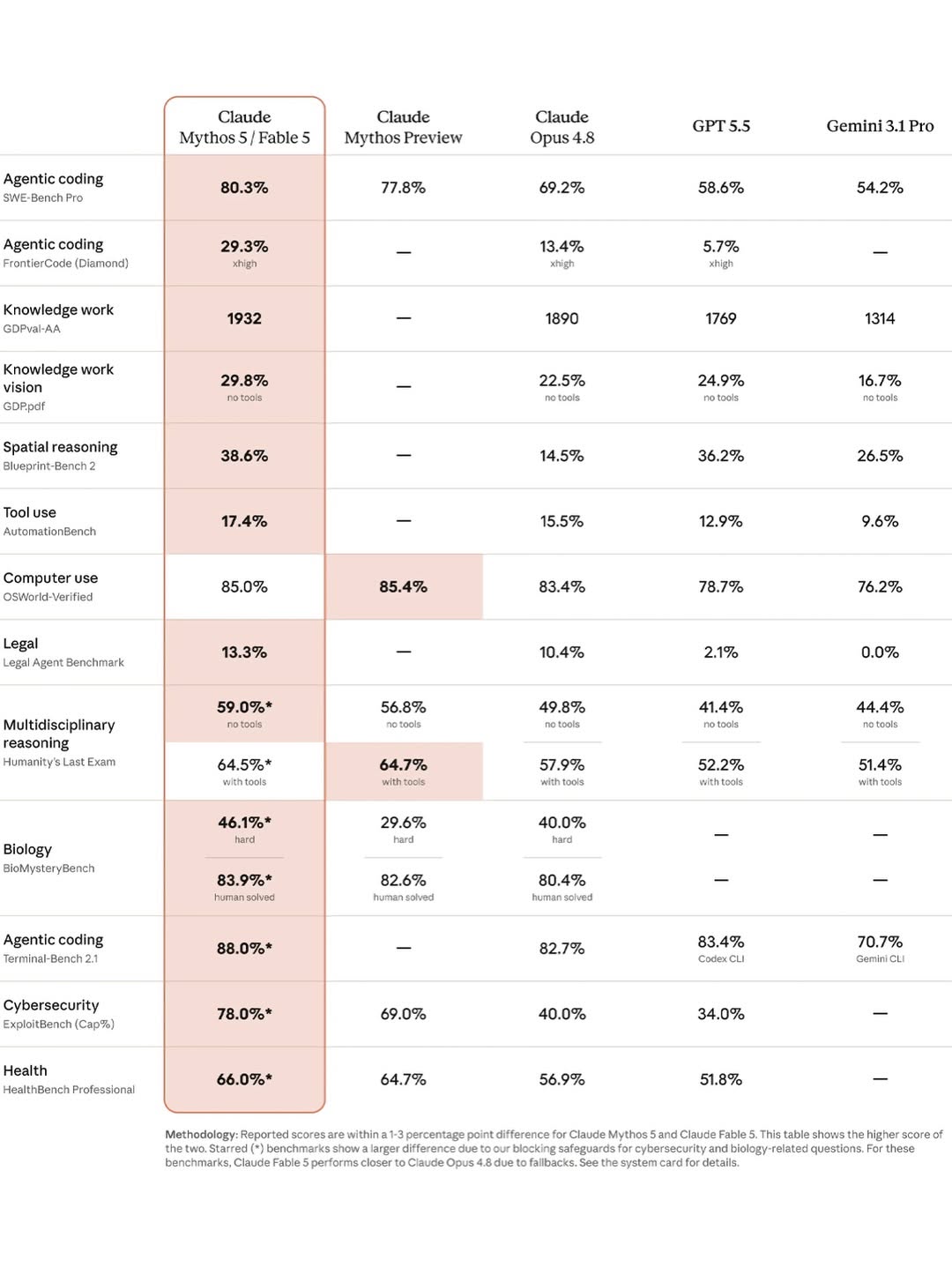
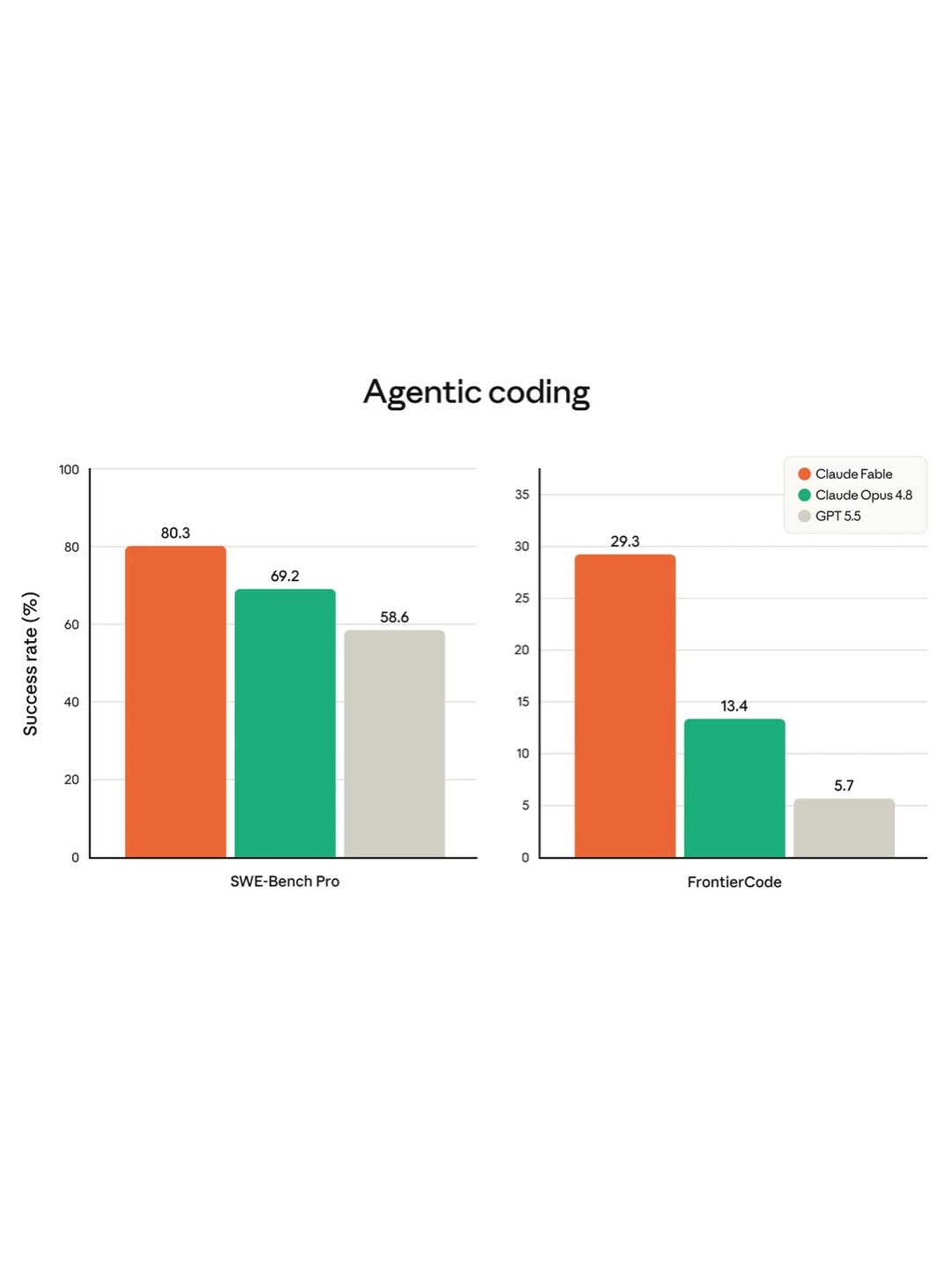
The benchmark numbers are real. Fable 5 scores 80.3 percent on SWE Bench Pro, the software engineering benchmark that has become the industry's standard comparison point. Opus 4.8 sits at 69.2 percent. GPT 5.5 sits at 58.6 percent. Fable 5 also crosses 90 percent on Hex's analytical benchmark, a first for any generally available model.
Available today through the Claude API, Claude Code, GitHub Copilot, AWS Bedrock, Google Cloud, and Microsoft Foundry. Context window is one million tokens with a 128,000 token maximum output. For teams already running long agentic sessions, Anthropic is claiming Fable 5 can hold a thread across a task spanning days, delegate to subagents, and complete equivalent work with fewer tool calls than Opus 4.8.
The safety architecture is not symbolic. Certain queries in biology and cybersecurity get routed to Opus 4.8 instead of Fable 5. Anthropic reports 95 percent of sessions run fully on Fable 5, meaning the routing intercepts a small fraction of requests. If your workflow operates near either domain, the model you called and the model that answered may not always be the same one.
The previous Mythos Preview was restricted entirely to vetted partners inside Project Glasswing, a controlled research program Anthropic built to limit who could access this capability tier. A public release was explicitly ruled out at the time.$10 Per Million Input. The Lock In Is the Routing Decision.
Fable 5 and Mythos 5, its companion model still restricted to Glasswing partners, are both priced at $10 per million input tokens and $50 per million output tokens. That is twice the cost of Opus 4.8.
At that price, Fable 5 is the most expensive generally available model in the market. The use case math only works if the performance delta justifies the token cost. The SWE Bench gap, 11 points over Opus 4.8, is meaningful for autonomous coding agents running long sessions with high task complexity. For document summarization or routine extraction, Fable 5 costs twice as much for a fraction of the performance gain.
The lock in score here is real. Once you build agentic workflows around Fable 5's output format, its tool call density, and its extended context coherence, switching back to Opus requires retesting assumptions about performance at every checkpoint. Anthropic's pricing decision creates a two tier developer ecosystem: builders who can absorb $10 per million input tokens at scale, and builders who cannot.
Anthropic's release cadence since Opus 4.7 has been accelerating, with Fable 5 arriving as the third major capability push in under six months.The GitHub Copilot availability is worth noting separately. Fable 5 as a default option for developers already inside GitHub's ecosystem means adoption does not depend on individual API subscriptions. Enterprise developers who never touch the Anthropic pricing page are going to run Fable 5 today because their IDE is already wired to it.
Try If Your Agentic Workload Hits Opus 4.8's Ceiling. Skip Otherwise.
The verdict depends entirely on what you are building.
Try it if you are running multistep agentic workflows with high token counts and task complexity that pushes past what Opus 4.8 handles reliably. The SWE Bench and Hex benchmark numbers point to a genuine capability ceiling jump.
Skip it if your workload is summarization, extraction, classification, or anything routine. Opus 4.8 is half the price and more than sufficient.
Watch it if you work near biology or cybersecurity. You need to understand exactly where Anthropic's routing draws the line before committing a production workflow to this model.
The hidden cost is the routing decision you do not control. When you call `claude-fable-5`, you are not guaranteed Fable 5 responds. For five percent of requests, Anthropic has already decided the answer comes from a different model. At $10 per million input tokens, that is a variable you should price in.
Related: NOVA'S NEW UPDATE WILL CHANGE THE GAME FOR CREATIVES.
Topics: Fable 5, github, AI, microsoft, anthropic, Tech, Mythos, Anthropic, Claude, google