AI Written Pages in Our Search Console: The Queries, Positions, and Clicks
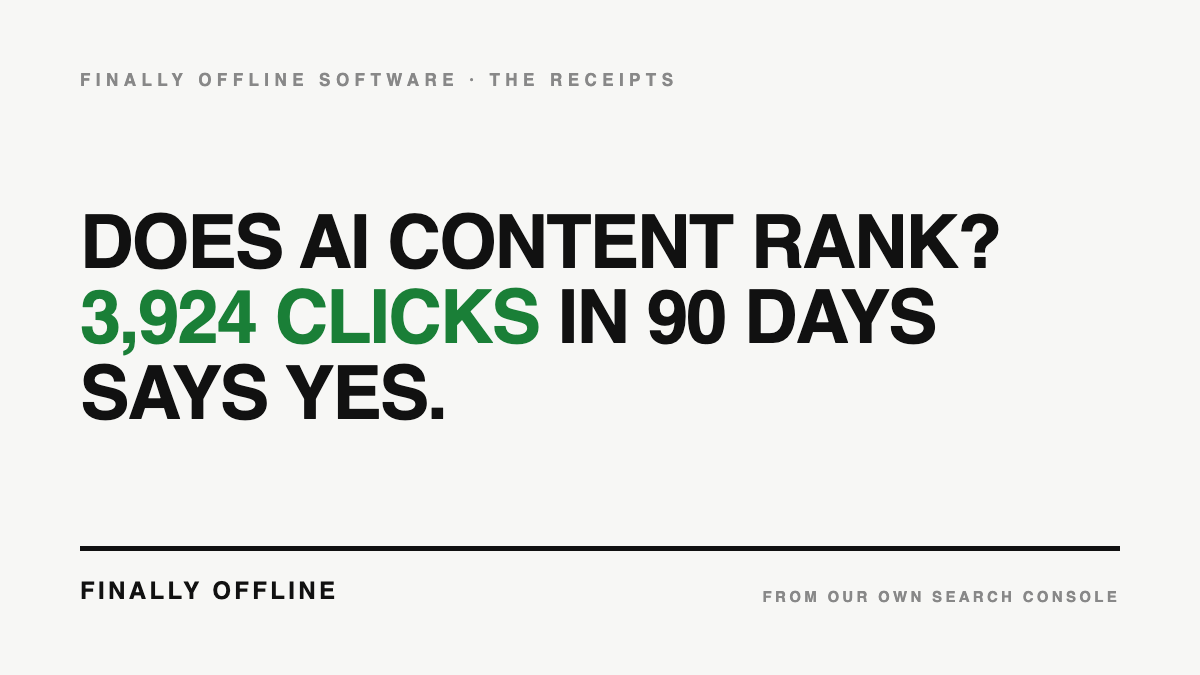
AI content ranks on Google when an editorial system stands behind it. Finally Offline publishes AI written articles daily and shows its own Search Console rows: 3,924 clicks and 183,572 impressions over 90 days, with named pages at average positions 3.8 to 7.9. Google filters unreviewed scaled content, not AI as a category. The gates that matter: an owned voice document, an editor pass for repeats and unsupported claims, a quality score, and human approval on every piece.
Key Points
- AI content ranks: 3,924 clicks and 183,572 impressions in 90 days on an AI written archive, from our own Search Console
- Named receipts: real pages at average positions 3.8, 5.2, and 7.9 with clicks to match
- Google grades the editorial system, not where the words came from
- Sites that got crushed shared a pattern: hundreds of pages a day, zero review
- Four gates keep AI pages alive: voice document, editor pass, quality score, human approval
Yes, AI content ranks on Google. We publish AI written articles every day, and over the last 90 days Google sent them 3,924 clicks from 183,572 impressions. What Google actually filters is unedited AI content with no oversight. The difference between the two is an editorial system, and this page shows you ours, with the receipts.
The receipts, straight from our Search Console
Most posts answering this question quote Google's policy and stop. Here is what the question actually needs: real pages, written by software, with their real search numbers. These are rows from our own Google Search Console, pulled August 28, covering the last 90 days on finallyoffline.com:
- Stussy and Our Legacy hand rework Vol 10 (published June 16): 223 clicks, 5,411 impressions, average position 7.9
- Supreme and Fender put Bootsy Collins on a $2,298 bass (published July 2): 145 clicks, 1,147 impressions, average position 5.2
- Marius Troy's festival has 10 renders and zero tickets (published July 6): 126 clicks, 905 impressions, average position 3.8
- Site wide: 3,924 clicks and 183,572 impressions across roughly 1,000 pages that received at least one impression
Every one of those articles was drafted by the same publishing engine. Page one positions, real clicks, on a site where nearly the whole archive is AI written. If Google penalized AI content as a category, this site would not exist in search results.
If you want to see what that engine would write from your own posts, you can get a free preview built from your Instagram before reading another word. Everything below explains why those numbers hold up.
What Google actually says, in one line
Google's guidance rewards helpful content regardless of how it is produced, and it targets content made primarily to manipulate rankings. In other words, Google does not test where words came from. It tests whether the page is worth ranking. AI is not the risk. Publishing without judgment is the risk.
Where AI content actually dies
The horror stories are real, and they share a pattern. Sites that lost 40 to 90 percent of their traffic in the scaled content crackdowns had three things in common: hundreds of pages a day, no human review, and nothing on the page a reader could not get from the top three results already. Volume without editing reads as manipulation because it is.
The line is not AI versus human. The line is reviewed versus unreviewed. Sites publishing AI drafts with real editorial control kept growing through every update that flattened the content farms.
The gates that keep our pages alive
Our numbers hold because no draft goes straight to publish. Four gates sit between the model and the page:
1. A voice document leads every article. The writing follows an editorial voice we own and maintain, so pages read like one publication instead of a model's average.
2. An editor pass checks every draft for repeated sections, mismatched facts, and claims without support. Drafts that fail get regenerated with direction or killed.
3. A quality score gates publishing. Thin pages and near duplicates never reach the site.
4. A human approves every piece. Software drafts. A person decides.
That system, not the model, is what Google is grading. It is also the exact system we run for brands: your posts go in, articles in your voice come out, and you approve every piece before it publishes.
Check your own site the same way, in two minutes
You do not have to take our numbers or anyone else's on faith. If you already publish anything AI assisted, your own Search Console will tell you how Google is treating it:
1. Open Search Console and go to the Performance report. Set the date range to the last three months.
2. Switch to the Pages tab and sort by impressions. Impressions are Google showing your page to searchers, which means the page is indexed and competing. An AI drafted page with growing impressions is not being filtered.
3. Click any single page and look at its Queries. If the queries match what the page is about, Google understood the page. If the queries are random or missing, the page has a content problem, not an AI problem.
4. Compare pages you wrote by hand against pages the machine drafted. On our site there is no gap in either direction. Position comes from the topic and the structure, never from the authorship.
Two failure patterns are worth knowing when you read your own report. Pages with impressions but almost no clicks usually have a title problem, and pages with neither are usually thin or duplicated, which is exactly what an editor pass exists to catch before publishing. Neither pattern is caused by the words coming from a model, and both show up just as often on sites that never touched AI.
What this means if you are deciding right now
If you are holding off on publishing because you think Google punishes AI content, the corpus above says the fear is pointed at the wrong thing. What deserves the fear is unreviewed volume. Set up review gates, keep a real voice, verify facts, and publish at a steady human cadence, and AI drafted pages compete on the same terms as anything else on the internet.
The practical version of that setup is what we sell, and the honest version of this pitch is short: this article was produced by the system it describes, it is indexed, and you found it. Drop your Instagram handle and we will build your first three articles free, from your real posts, so you can judge the output on your own brand before paying anything.
Related: Did Google Just Release a Follow Button for Websites?.
Related: Crawled Currently Not Indexed Pages We Fixed.
Related: Need a Website If I Have Instagram, AI Answers Say Yes.
Frequently Asked Questions
Does AI content rank on Google?
Yes. Our own site publishes AI written articles daily and drew 3,924 clicks from 183,572 impressions in the last 90 days, with pages holding average positions between 3.8 and 7.9. Google filters unhelpful and unreviewed content, not AI as a category.
Does Google penalize AI generated content?
Google penalizes content made primarily to manipulate rankings, whoever wrote it. Sites that lost traffic in the scaled content crackdowns published hundreds of unreviewed pages a day. AI drafts with real editorial review, fact checking, and human approval kept ranking through every update.
What keeps AI written pages ranking?
An editorial system: a voice document the writing follows, an editor pass that catches repeats and unsupported claims, a quality gate that blocks thin pages, and a human who approves every piece before it publishes.
How much AI content is safe to publish?
There is no published number. The pattern in the penalty data is unreviewed volume, not a count. A steady cadence with review on every page has held up; hundreds of unedited pages a day has not.
Topics: fender, google, ai content, publishing, our legacy, our-legacy, stssy, supreme, ai search, seo, stüssy